

3.4 Boundary Conditions of the Coupling Model
75
Right dot product: σ ·
→
u =
⎛
⎝
σ xx σ xy σ xz
σ yx σ yy σ yz
σ zx σ zy σ zz
⎞
⎠
⎛
⎝
u x
u y
u z
⎞
⎠
(3.27)
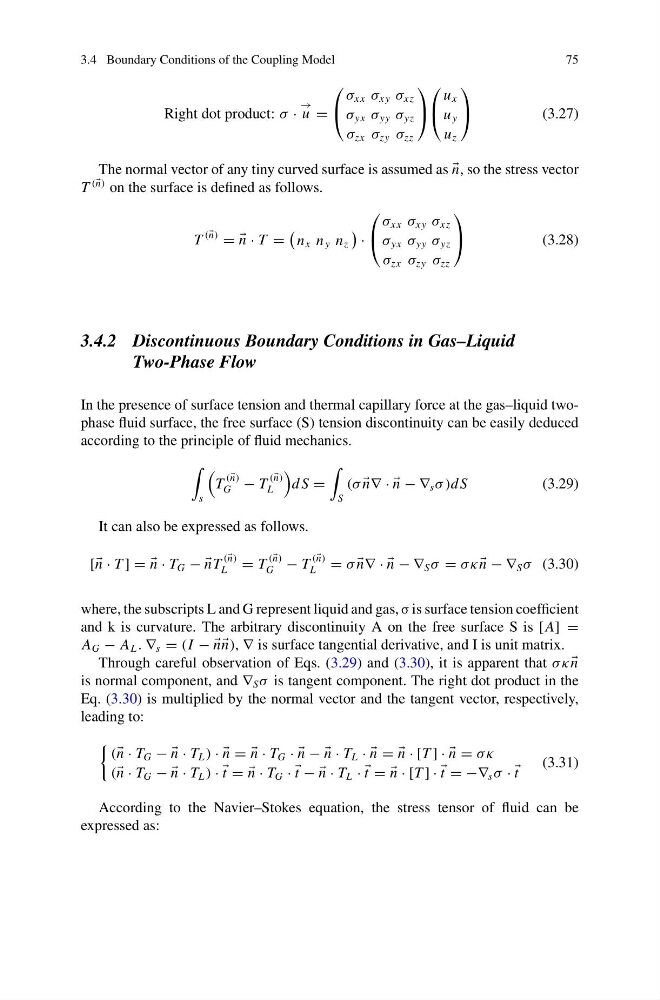
The normal vector of any tiny curved surface is assumed as
n, so the stress vector
T
( n) on the surface is defined as follows.
T
( n)
= =
n · T =
n x n y n z
·
⎛
⎝
σ xx σ xy σ xz
σ yx σ yy σ yz
σ zx σ zy σ zz
⎞
⎠
(3.28)
3.4.2 Discontinuous Boundary Conditions in Gas–Liquid
Two-Phase Flow
In the presence of surface tension and thermal capillary force at the gas–liquid twophase fluid surface, the free surface (S) tension discontinuity can be easily deduced
according to the principle of fluid mechanics.
s
T
( n)
G − T
( n)
L
d S =
S
(σ
n∇ · ·
n − ∇ s σ )d S
(3.29)
It can also be expressed as follows.
[[ n · T ] = =
n · T G − −
nT
( n)
L = T
( n)
G − T
( n)
L = σ
n∇ · ·
n − ∇ S σ = σ κ
n − ∇ S σ (3.30)
where, the subscripts L and G represent liquid and gas, σ is surface tension coefficient
and k is curvature. The arbitrary discontinuity A on the free surface S is [A] =
A G − A L . ∇ s = (I − −
n
n), ∇ is surface tangential derivative, and I is unit matrix.
Through careful observation of Eqs. (3.29) and (3.30), it is apparent that σ κ
n
is normal component, and ∇ S σ is tangent component. The right dot product in the
Eq. (3.30) is multiplied by the normal vector and the tangent vector, respectively,
leading to:
( n · T G − −
n · T L ) · ·
n = =
n · T G · ·
n − −
n · T L · ·
n = =
n · [T ] · ·
n = σ κ
( n · T G − −
n · T L ) ·
t = =
n · T G ·
t − −
n · T L ·
t = =
n · [T ] ·
t = −∇ s σ ·
t
(3.31)
According to the Navier–Stokes equation, the stress tensor of fluid can be
expressed as:
75
Right dot product: σ ·
→
u =
⎛
⎝
σ xx σ xy σ xz
σ yx σ yy σ yz
σ zx σ zy σ zz
⎞
⎠
⎛
⎝
u x
u y
u z
⎞
⎠
(3.27)
The normal vector of any tiny curved surface is assumed as
n, so the stress vector
T
( n) on the surface is defined as follows.
T
( n)
= =
n · T =
n x n y n z
·
⎛
⎝
σ xx σ xy σ xz
σ yx σ yy σ yz
σ zx σ zy σ zz
⎞
⎠
(3.28)
3.4.2 Discontinuous Boundary Conditions in Gas–Liquid
Two-Phase Flow
In the presence of surface tension and thermal capillary force at the gas–liquid twophase fluid surface, the free surface (S) tension discontinuity can be easily deduced
according to the principle of fluid mechanics.
s
T
( n)
G − T
( n)
L
d S =
S
(σ
n∇ · ·
n − ∇ s σ )d S
(3.29)
It can also be expressed as follows.
[[ n · T ] = =
n · T G − −
nT
( n)
L = T
( n)
G − T
( n)
L = σ
n∇ · ·
n − ∇ S σ = σ κ
n − ∇ S σ (3.30)
where, the subscripts L and G represent liquid and gas, σ is surface tension coefficient
and k is curvature. The arbitrary discontinuity A on the free surface S is [A] =
A G − A L . ∇ s = (I − −
n
n), ∇ is surface tangential derivative, and I is unit matrix.
Through careful observation of Eqs. (3.29) and (3.30), it is apparent that σ κ
n
is normal component, and ∇ S σ is tangent component. The right dot product in the
Eq. (3.30) is multiplied by the normal vector and the tangent vector, respectively,
leading to:
( n · T G − −
n · T L ) · ·
n = =
n · T G · ·
n − −
n · T L · ·
n = =
n · [T ] · ·
n = σ κ
( n · T G − −
n · T L ) ·
t = =
n · T G ·
t − −
n · T L ·
t = =
n · [T ] ·
t = −∇ s σ ·
t
(3.31)
According to the Navier–Stokes equation, the stress tensor of fluid can be
expressed as: