

74
3 Coupling Model and Numerical Computation Method of Keyhole and Weld Pool
of gas–liquid two-phase fluid across both sides of the keyhole. Besides, the existence of thermal capillary force and friction force will cause mathematical discontinuity of the gas–liquid two-phase viscosity stress tensor. In numerical simulation, precisely considering these mathematical discontinuities is an essential prerequisite for obtaining accurate solutions consistent with physical processes. Therefore, discontinuous numerical method is used to handle these important boundary
conditions.
The theoretical derivation of discontinuous conditions with the presence of
thermal capillary force and surface tension is lacked at home and abroad. In this
section, a detailed theoretical derivation is made for the discontinuous boundary
conditions on the free surface of the keyhole during deep penetration laser welding
based on the fundamental principles of viscous fluid mechanics.
3.4.1 Basic Agreements
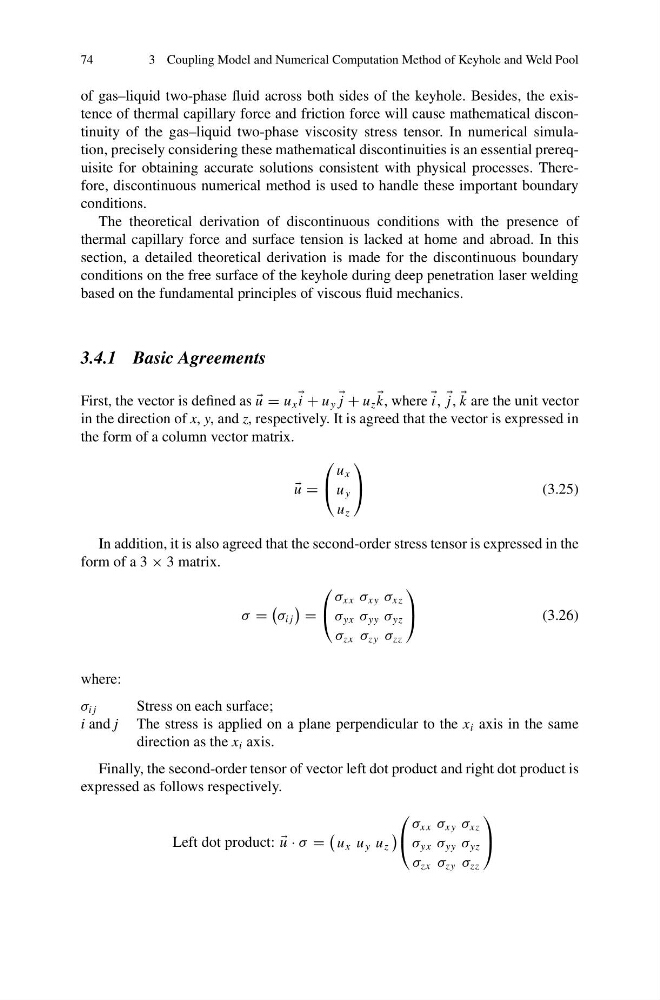
First, the vector is defined as
u = u x i + u y j + u z
k, where i, j,
k are the unit vector
in the direction of x, y, and z, respectively. It is agreed that the vector is expressed in
the form of a column vector matrix.
u =
⎛
⎝
u x
u y
u z
⎞
⎠
(3.25)
In addition, it is also agreed that the second-order stress tensor is expressed in the
form of a 3 × 3 matrix.
σ =
σ i j
=
⎛
⎝
σ xx σ xy σ xz
σ yx σ yy σ yz
σ zx σ zy σ zz
⎞
⎠
(3.26)
where:
σ i j
Stress on each surface;
i and j The stress is applied on a plane perpendicular to the x i axis in the same
direction as the x i axis.
Finally, the second-order tensor of vector left dot product and right dot product is
expressed as follows respectively.
Left dot product: :
u · σ =
u x u y u z
⎛
⎝
σ xx σ xy σ xz
σ yx σ yy σ yz
σ zx σ zy σ zz
⎞
⎠
3 Coupling Model and Numerical Computation Method of Keyhole and Weld Pool
of gas–liquid two-phase fluid across both sides of the keyhole. Besides, the existence of thermal capillary force and friction force will cause mathematical discontinuity of the gas–liquid two-phase viscosity stress tensor. In numerical simulation, precisely considering these mathematical discontinuities is an essential prerequisite for obtaining accurate solutions consistent with physical processes. Therefore, discontinuous numerical method is used to handle these important boundary
conditions.
The theoretical derivation of discontinuous conditions with the presence of
thermal capillary force and surface tension is lacked at home and abroad. In this
section, a detailed theoretical derivation is made for the discontinuous boundary
conditions on the free surface of the keyhole during deep penetration laser welding
based on the fundamental principles of viscous fluid mechanics.
3.4.1 Basic Agreements
First, the vector is defined as
u = u x i + u y j + u z
k, where i, j,
k are the unit vector
in the direction of x, y, and z, respectively. It is agreed that the vector is expressed in
the form of a column vector matrix.
u =
⎛
⎝
u x
u y
u z
⎞
⎠
(3.25)
In addition, it is also agreed that the second-order stress tensor is expressed in the
form of a 3 × 3 matrix.
σ =
σ i j
=
⎛
⎝
σ xx σ xy σ xz
σ yx σ yy σ yz
σ zx σ zy σ zz
⎞
⎠
(3.26)
where:
σ i j
Stress on each surface;
i and j The stress is applied on a plane perpendicular to the x i axis in the same
direction as the x i axis.
Finally, the second-order tensor of vector left dot product and right dot product is
expressed as follows respectively.
Left dot product: :
u · σ =
u x u y u z
⎛
⎝
σ xx σ xy σ xz
σ yx σ yy σ yz
σ zx σ zy σ zz
⎞
⎠