

2.3 Implementation of Numerical Solution
37
weld pool and the thermal conductivity of the material during deep penetration laser
welding are neglected.
After inputting material parameters and determining the melting/solidification
model, the calculation program of the body heat source is added to the energy equation
through the user-defined function. After defining the boundary conditions, a solution
method is selected for iterative calculation.
The separation solution algorithm in the separation solver means that the equations
are independent of each other in the process of sequentially solving each equation
in the governing equations. Because all the equations in the governing equations are
nonlinear, several cycles of loop iteration are needed to make the solution converge.
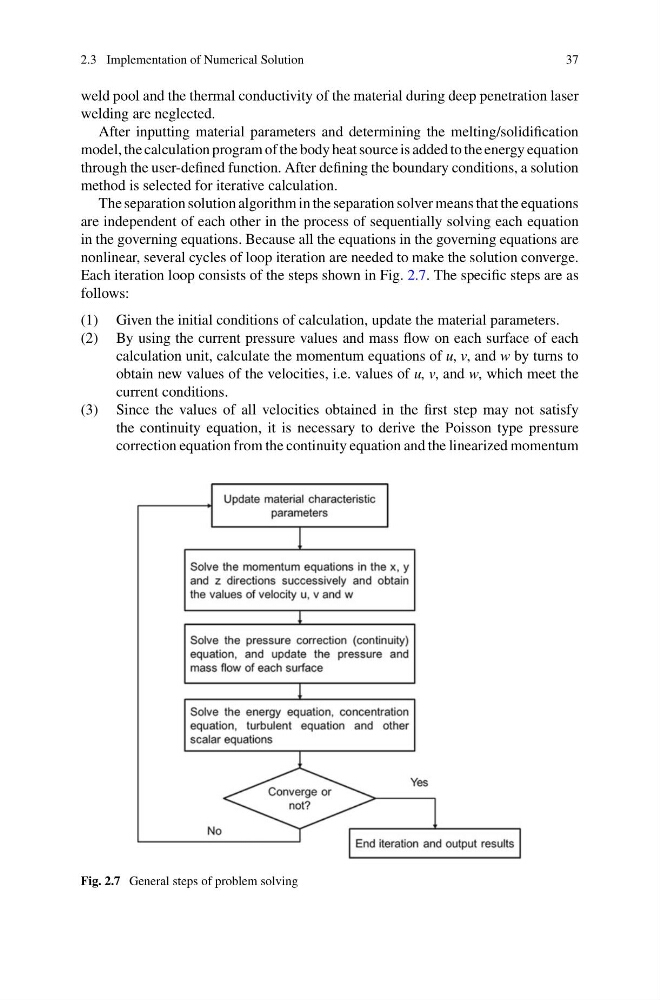
Each iteration loop consists of the steps shown in Fig. 2.7. The specific steps are as
follows:
(1) Given the initial conditions of calculation, update the material parameters.
(2) By using the current pressure values and mass flow on each surface of each
calculation unit, calculate the momentum equations of u, v, and w by turns to
obtain new values of the velocities, i.e. values of u, v, and w, which meet the
current conditions.
(3) Since the values of all velocities obtained in the first step may not satisfy
the continuity equation, it is necessary to derive the Poisson type pressure
correction equation from the continuity equation and the linearized momentum
Fig. 2.7 General steps of problem solving
37
weld pool and the thermal conductivity of the material during deep penetration laser
welding are neglected.
After inputting material parameters and determining the melting/solidification
model, the calculation program of the body heat source is added to the energy equation
through the user-defined function. After defining the boundary conditions, a solution
method is selected for iterative calculation.
The separation solution algorithm in the separation solver means that the equations
are independent of each other in the process of sequentially solving each equation
in the governing equations. Because all the equations in the governing equations are
nonlinear, several cycles of loop iteration are needed to make the solution converge.
Each iteration loop consists of the steps shown in Fig. 2.7. The specific steps are as
follows:
(1) Given the initial conditions of calculation, update the material parameters.
(2) By using the current pressure values and mass flow on each surface of each
calculation unit, calculate the momentum equations of u, v, and w by turns to
obtain new values of the velocities, i.e. values of u, v, and w, which meet the
current conditions.
(3) Since the values of all velocities obtained in the first step may not satisfy
the continuity equation, it is necessary to derive the Poisson type pressure
correction equation from the continuity equation and the linearized momentum
Fig. 2.7 General steps of problem solving