

38
2 Model of Quasi-Steady Weld Pool Dynamics and Numerical Simulation
equations. Solve the pressure correction equation and obtain the necessary
pressure correction values so that the velocity field and the mass flow on each
face satisfy the continuity equation.
2.4 Physical Properties and Calculation Parameters
The established three-dimensional mathematical model of laser welding keyhole
formation and weld pool flow process is used for numerical simulation of the welded
workpiece of TC4 titanium alloy with a radius of 0.015 m and thickness of 0.025 m.
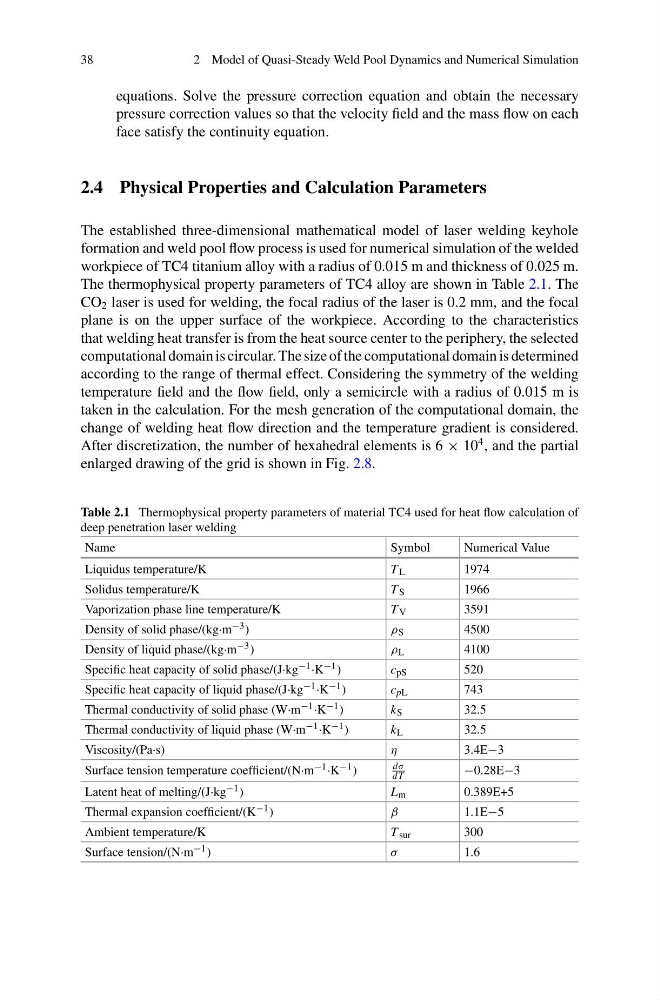
The thermophysical property parameters of TC4 alloy are shown in Table 2.1. The
CO 2 laser is used for welding, the focal radius of the laser is 0.2 mm, and the focal
plane is on the upper surface of the workpiece. According to the characteristics
that welding heat transfer is from the heat source center to the periphery, the selected
computational domain is circular. The size of the computational domain is determined
according to the range of thermal effect. Considering the symmetry of the welding
temperature field and the flow field, only a semicircle with a radius of 0.015 m is
taken in the calculation. For the mesh generation of the computational domain, the
change of welding heat flow direction and the temperature gradient is considered.
After discretization, the number of hexahedral elements is 6 × 10
4 , and the partial
enlarged drawing of the grid is shown in Fig. 2.8.
Table 2.1 Thermophysical property parameters of material TC4 used for heat flow calculation of
deep penetration laser welding
Name
Symbol
Numerical Value
Liquidus temperature/K
T L
1974
Solidus temperature/K
T S
1966
Vaporization phase line temperature/K
T V
3591
Density of solid phase/(kg·m −3 )
ρ S
4500
Density of liquid phase/(kg·m −3 )
ρ L
4100
Specific heat capacity of solid phase/(J·kg −1 ·K −1 )
c pS
520
Specific heat capacity of liquid phase/(J·kg −1 ·K −1 )
c pL
743
Thermal conductivity of solid phase (W·m −1 ·K −1 )
k S
32.5
Thermal conductivity of liquid phase (W·m −1 ·K −1 )
k L
32.5
Viscosity/(Pa·s)
η
3.4E−3
Surface tension temperature coefficient/(N·m −1 ·K −1 )
dσ
dT
−0.28E−3
Latent heat of melting/(J·kg −1 )
L m
0.389E+5
Thermal expansion coefficient/(K −1 )
β
1.1E−5
Ambient temperature/K
T sur
300
Surface tension/(N·m −1 )
σ
1.6
2 Model of Quasi-Steady Weld Pool Dynamics and Numerical Simulation
equations. Solve the pressure correction equation and obtain the necessary
pressure correction values so that the velocity field and the mass flow on each
face satisfy the continuity equation.
2.4 Physical Properties and Calculation Parameters
The established three-dimensional mathematical model of laser welding keyhole
formation and weld pool flow process is used for numerical simulation of the welded
workpiece of TC4 titanium alloy with a radius of 0.015 m and thickness of 0.025 m.
The thermophysical property parameters of TC4 alloy are shown in Table 2.1. The
CO 2 laser is used for welding, the focal radius of the laser is 0.2 mm, and the focal
plane is on the upper surface of the workpiece. According to the characteristics
that welding heat transfer is from the heat source center to the periphery, the selected
computational domain is circular. The size of the computational domain is determined
according to the range of thermal effect. Considering the symmetry of the welding
temperature field and the flow field, only a semicircle with a radius of 0.015 m is
taken in the calculation. For the mesh generation of the computational domain, the
change of welding heat flow direction and the temperature gradient is considered.
After discretization, the number of hexahedral elements is 6 × 10
4 , and the partial
enlarged drawing of the grid is shown in Fig. 2.8.
Table 2.1 Thermophysical property parameters of material TC4 used for heat flow calculation of
deep penetration laser welding
Name
Symbol
Numerical Value
Liquidus temperature/K
T L
1974
Solidus temperature/K
T S
1966
Vaporization phase line temperature/K
T V
3591
Density of solid phase/(kg·m −3 )
ρ S
4500
Density of liquid phase/(kg·m −3 )
ρ L
4100
Specific heat capacity of solid phase/(J·kg −1 ·K −1 )
c pS
520
Specific heat capacity of liquid phase/(J·kg −1 ·K −1 )
c pL
743
Thermal conductivity of solid phase (W·m −1 ·K −1 )
k S
32.5
Thermal conductivity of liquid phase (W·m −1 ·K −1 )
k L
32.5
Viscosity/(Pa·s)
η
3.4E−3
Surface tension temperature coefficient/(N·m −1 ·K −1 )
dσ
dT
−0.28E−3
Latent heat of melting/(J·kg −1 )
L m
0.389E+5
Thermal expansion coefficient/(K −1 )
β
1.1E−5
Ambient temperature/K
T sur
300
Surface tension/(N·m −1 )
σ
1.6