

36
2 Model of Quasi-Steady Weld Pool Dynamics and Numerical Simulation
(3) Substitute the obtained (ρu*)
n+1 and (ρv*)
n+1 into the formula (2.45) to solve
the pressure p’.
(4) Calculate ρ
n+1 according to formula (2.36).
(5) Solve the momentum equation again using ρ
n+1 obtained from the fourth step,
use the ρ
n+1 as a new (ρ)
n and substitute it into the formula (2.42)—formula
(2.44), then return to the second step, and repeat the second to the fifth step
until the convergence.
To avoid the dispersion of solutions, the under-relaxation iteration is often
performed, and the formula in the fourth step is replaced by the following formula:
p
n+1
= ( p
∗
)
n
+ α p p
(2.49)
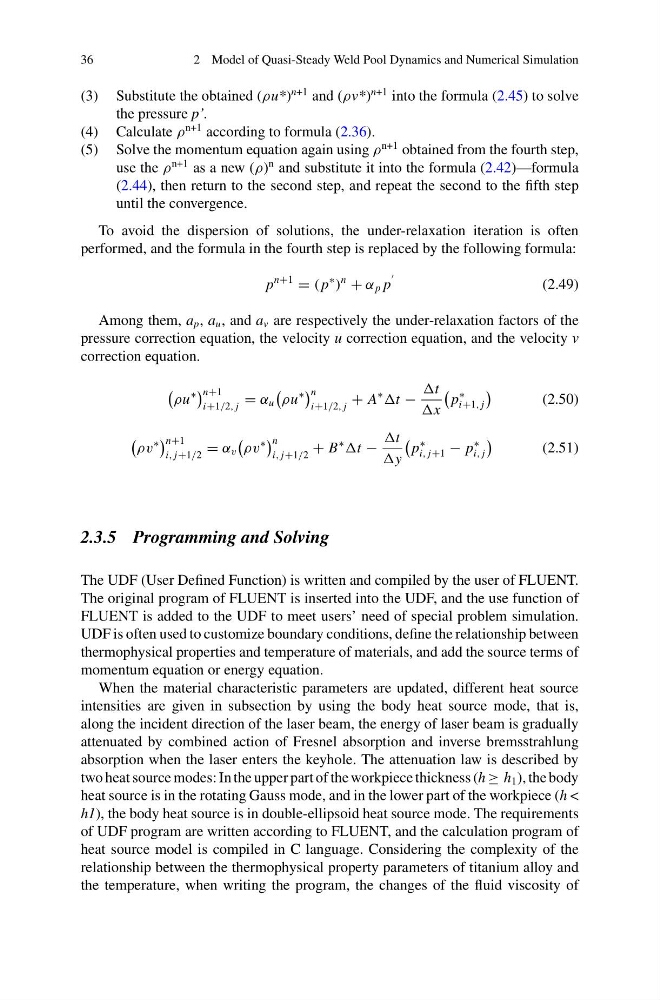
Among them, a p , a u , and a v are respectively the under-relaxation factors of the
pressure correction equation, the velocity u correction equation, and the velocity v
correction equation.
ρu
∗
n+1
i+1/2, j
= α u
ρu
∗
n
i+1/2, j
+ A
∗
t −
t
x
p
∗
i+1, j
(2.50)
ρv
∗
n+1
i, j+1/2
= α v
ρv
∗
n
i, j+1/2
+ B
∗
t −
t
y
p
∗
i, j+1 − p
∗
i, j
(2.51)
2.3.5 Programming and Solving
The UDF (User Defined Function) is written and compiled by the user of FLUENT.
The original program of FLUENT is inserted into the UDF, and the use function of
FLUENT is added to the UDF to meet users’ need of special problem simulation.
UDF is often used to customize boundary conditions, define the relationship between
thermophysical properties and temperature of materials, and add the source terms of
momentum equation or energy equation.
When the material characteristic parameters are updated, different heat source
intensities are given in subsection by using the body heat source mode, that is,
along the incident direction of the laser beam, the energy of laser beam is gradually
attenuated by combined action of Fresnel absorption and inverse bremsstrahlung
absorption when the laser enters the keyhole. The attenuation law is described by
two heat source modes: In the upper part of the workpiece thickness (h ≥ h 1 ), the body
heat source is in the rotating Gauss mode, and in the lower part of the workpiece (h <
h1), the body heat source is in double-ellipsoid heat source mode. The requirements
of UDF program are written according to FLUENT, and the calculation program of
heat source model is compiled in C language. Considering the complexity of the
relationship between the thermophysical property parameters of titanium alloy and
the temperature, when writing the program, the changes of the fluid viscosity of
2 Model of Quasi-Steady Weld Pool Dynamics and Numerical Simulation
(3) Substitute the obtained (ρu*)
n+1 and (ρv*)
n+1 into the formula (2.45) to solve
the pressure p’.
(4) Calculate ρ
n+1 according to formula (2.36).
(5) Solve the momentum equation again using ρ
n+1 obtained from the fourth step,
use the ρ
n+1 as a new (ρ)
n and substitute it into the formula (2.42)—formula
(2.44), then return to the second step, and repeat the second to the fifth step
until the convergence.
To avoid the dispersion of solutions, the under-relaxation iteration is often
performed, and the formula in the fourth step is replaced by the following formula:
p
n+1
= ( p
∗
)
n
+ α p p
(2.49)
Among them, a p , a u , and a v are respectively the under-relaxation factors of the
pressure correction equation, the velocity u correction equation, and the velocity v
correction equation.
ρu
∗
n+1
i+1/2, j
= α u
ρu
∗
n
i+1/2, j
+ A
∗
t −
t
x
p
∗
i+1, j
(2.50)
ρv
∗
n+1
i, j+1/2
= α v
ρv
∗
n
i, j+1/2
+ B
∗
t −
t
y
p
∗
i, j+1 − p
∗
i, j
(2.51)
2.3.5 Programming and Solving
The UDF (User Defined Function) is written and compiled by the user of FLUENT.
The original program of FLUENT is inserted into the UDF, and the use function of
FLUENT is added to the UDF to meet users’ need of special problem simulation.
UDF is often used to customize boundary conditions, define the relationship between
thermophysical properties and temperature of materials, and add the source terms of
momentum equation or energy equation.
When the material characteristic parameters are updated, different heat source
intensities are given in subsection by using the body heat source mode, that is,
along the incident direction of the laser beam, the energy of laser beam is gradually
attenuated by combined action of Fresnel absorption and inverse bremsstrahlung
absorption when the laser enters the keyhole. The attenuation law is described by
two heat source modes: In the upper part of the workpiece thickness (h ≥ h 1 ), the body
heat source is in the rotating Gauss mode, and in the lower part of the workpiece (h <
h1), the body heat source is in double-ellipsoid heat source mode. The requirements
of UDF program are written according to FLUENT, and the calculation program of
heat source model is compiled in C language. Considering the complexity of the
relationship between the thermophysical property parameters of titanium alloy and
the temperature, when writing the program, the changes of the fluid viscosity of