

2.2 Basic Models of Quasi-Steady Laser Welding
23
S(x, y, z)—The internal heat source term in welding;
H —Latent heat during phase transition.
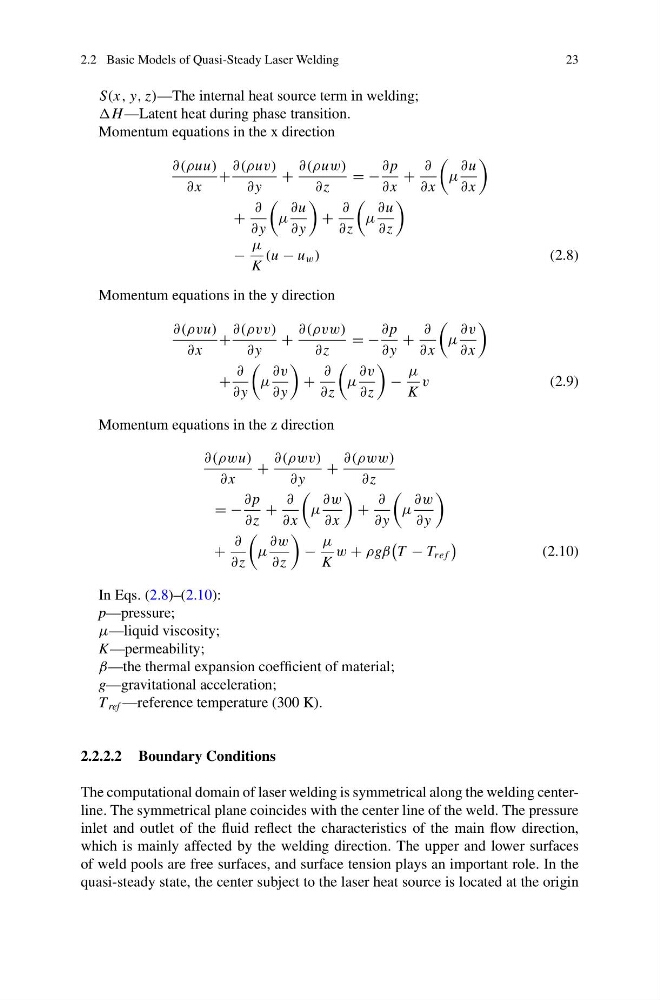
Momentum equations in the x direction
∂(ρuu)
∂ x
+
∂(ρuv)
∂ y
+
∂(ρuw)
∂z
= −
∂ p
∂ x
+
∂
∂ x
μ
∂u
∂ x
+
∂
∂ y
μ
∂u
∂ y
+
∂
∂z
μ
∂u
∂z
−
μ
K
(u − u w )
(2.8)
Momentum equations in the y direction
∂(ρvu)
∂ x
+
∂(ρvv)
∂ y
+
∂(ρvw)
∂z
= −
∂ p
∂ y
+
∂
∂ x
μ
∂v
∂ x
+
∂
∂ y
μ
∂v
∂ y
+
∂
∂z
μ
∂v
∂z
−
μ
K
v
(2.9)
Momentum equations in the z direction
∂(ρwu)
∂ x
+
∂(ρwv)
∂ y
+
∂(ρww)
∂z
= −
∂ p
∂z
+
∂
∂ x
μ
∂w
∂ x
+
∂
∂ y
μ
∂w
∂ y
+
∂
∂z
μ
∂w
∂z
−
μ
K
w + ρgβ
T − T re f
(2.10)
In Eqs. (2.8)–(2.10):
p—pressure;
μ—liquid viscosity;
K—permeability;
β—the thermal expansion coefficient of material;
g—gravitational acceleration;
T ref —reference temperature (300 K).
2.2.2.2 Boundary Conditions
The computational domain of laser welding is symmetrical along the welding centerline. The symmetrical plane coincides with the center line of the weld. The pressure
inlet and outlet of the fluid reflect the characteristics of the main flow direction,
which is mainly affected by the welding direction. The upper and lower surfaces
of weld pools are free surfaces, and surface tension plays an important role. In the
quasi-steady state, the center subject to the laser heat source is located at the origin
23
S(x, y, z)—The internal heat source term in welding;
H —Latent heat during phase transition.
Momentum equations in the x direction
∂(ρuu)
∂ x
+
∂(ρuv)
∂ y
+
∂(ρuw)
∂z
= −
∂ p
∂ x
+
∂
∂ x
μ
∂u
∂ x
+
∂
∂ y
μ
∂u
∂ y
+
∂
∂z
μ
∂u
∂z
−
μ
K
(u − u w )
(2.8)
Momentum equations in the y direction
∂(ρvu)
∂ x
+
∂(ρvv)
∂ y
+
∂(ρvw)
∂z
= −
∂ p
∂ y
+
∂
∂ x
μ
∂v
∂ x
+
∂
∂ y
μ
∂v
∂ y
+
∂
∂z
μ
∂v
∂z
−
μ
K
v
(2.9)
Momentum equations in the z direction
∂(ρwu)
∂ x
+
∂(ρwv)
∂ y
+
∂(ρww)
∂z
= −
∂ p
∂z
+
∂
∂ x
μ
∂w
∂ x
+
∂
∂ y
μ
∂w
∂ y
+
∂
∂z
μ
∂w
∂z
−
μ
K
w + ρgβ
T − T re f
(2.10)
In Eqs. (2.8)–(2.10):
p—pressure;
μ—liquid viscosity;
K—permeability;
β—the thermal expansion coefficient of material;
g—gravitational acceleration;
T ref —reference temperature (300 K).
2.2.2.2 Boundary Conditions
The computational domain of laser welding is symmetrical along the welding centerline. The symmetrical plane coincides with the center line of the weld. The pressure
inlet and outlet of the fluid reflect the characteristics of the main flow direction,
which is mainly affected by the welding direction. The upper and lower surfaces
of weld pools are free surfaces, and surface tension plays an important role. In the
quasi-steady state, the center subject to the laser heat source is located at the origin