

22
2 Model of Quasi-Steady Weld Pool Dynamics and Numerical Simulation
D l —the Darcy constant associated with the liquid fraction.
In liquid phase zone, f l = 1; in solid phase zone, f l < 1; in mushy zone,
0 < f l < 1.
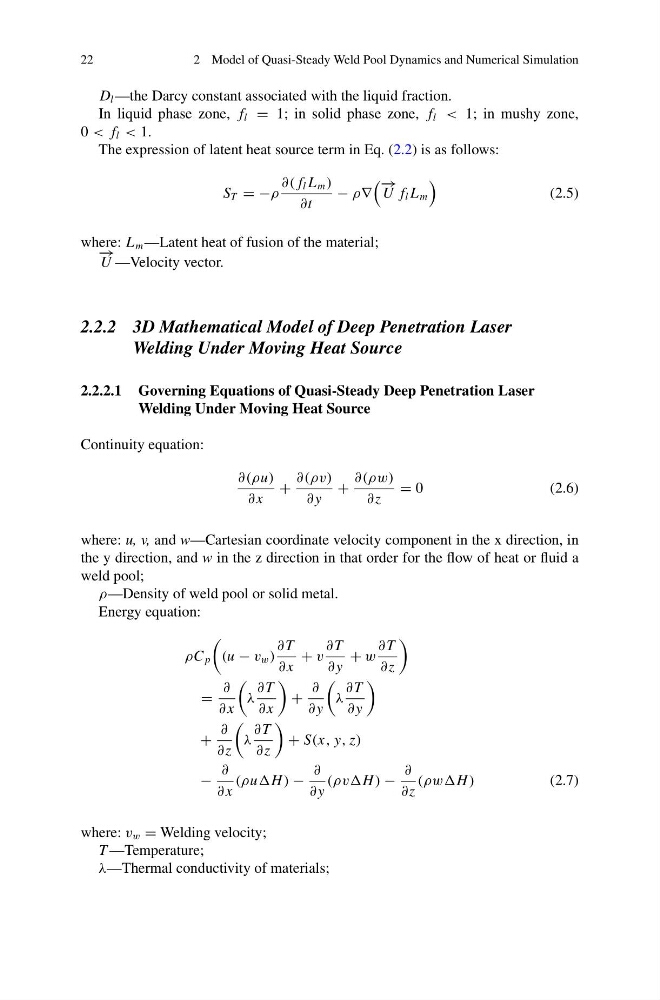
The expression of latent heat source term in Eq. (2.2) is as follows:
S T = −ρ
∂( f l L m )
∂t
− ρ∇
− →
U f l L m
(2.5)
where: L m —Latent heat of fusion of the material;
− →
U —Velocity vector.
2.2.2 3D Mathematical Model of Deep Penetration Laser
Welding Under Moving Heat Source
2.2.2.1 Governing Equations of Quasi-Steady Deep Penetration Laser
Welding Under Moving Heat Source
Continuity equation:
∂(ρu)
∂ x
+
∂(ρv)
∂ y
+
∂(ρw)
∂z
= 0
(2.6)
where: u, v, and w—Cartesian coordinate velocity component in the x direction, in
the y direction, and w in the z direction in that order for the flow of heat or fluid a
weld pool;
ρ—Density of weld pool or solid metal.
Energy equation:
ρC p
(u − v w )
∂ T
∂ x
+ v
∂ T
∂ y
+ w
∂ T
∂z
=
∂
∂ x
λ
∂ T
∂ x
+
∂
∂ y
λ
∂ T
∂ y
+
∂
∂z
λ
∂ T
∂z
+ S(x, y, z)
−
∂
∂ x
(ρuH ) −
∂
∂ y
(ρvvH ) −
∂
∂z
(ρwwH )
(2.7)
where: v w = Welding velocity;
T —Temperature;
λ—Thermal conductivity of materials;
2 Model of Quasi-Steady Weld Pool Dynamics and Numerical Simulation
D l —the Darcy constant associated with the liquid fraction.
In liquid phase zone, f l = 1; in solid phase zone, f l < 1; in mushy zone,
0 < f l < 1.
The expression of latent heat source term in Eq. (2.2) is as follows:
S T = −ρ
∂( f l L m )
∂t
− ρ∇
− →
U f l L m
(2.5)
where: L m —Latent heat of fusion of the material;
− →
U —Velocity vector.
2.2.2 3D Mathematical Model of Deep Penetration Laser
Welding Under Moving Heat Source
2.2.2.1 Governing Equations of Quasi-Steady Deep Penetration Laser
Welding Under Moving Heat Source
Continuity equation:
∂(ρu)
∂ x
+
∂(ρv)
∂ y
+
∂(ρw)
∂z
= 0
(2.6)
where: u, v, and w—Cartesian coordinate velocity component in the x direction, in
the y direction, and w in the z direction in that order for the flow of heat or fluid a
weld pool;
ρ—Density of weld pool or solid metal.
Energy equation:
ρC p
(u − v w )
∂ T
∂ x
+ v
∂ T
∂ y
+ w
∂ T
∂z
=
∂
∂ x
λ
∂ T
∂ x
+
∂
∂ y
λ
∂ T
∂ y
+
∂
∂z
λ
∂ T
∂z
+ S(x, y, z)
−
∂
∂ x
(ρuH ) −
∂
∂ y
(ρvvH ) −
∂
∂z
(ρwwH )
(2.7)
where: v w = Welding velocity;
T —Temperature;
λ—Thermal conductivity of materials;