

268
9 Dynamical Behaviors of Keyhole and Weld Pool …
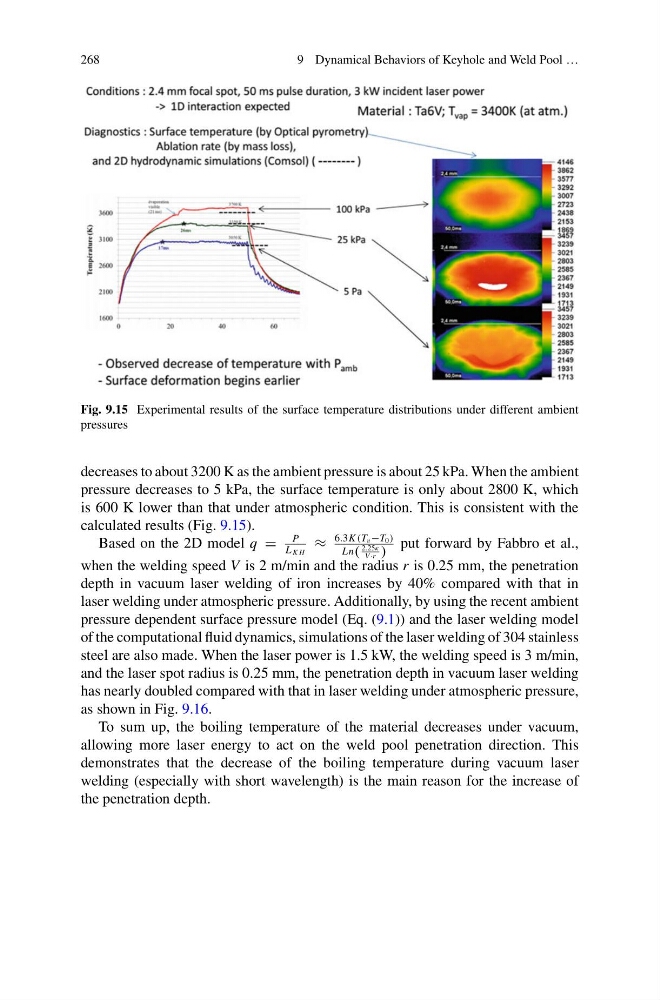
Fig. 9.15 Experimental results of the surface temperature distributions under different ambient
pressures
decreases to about 3200 K as the ambient pressure is about 25 kPa. When the ambient
pressure decreases to 5 kPa, the surface temperature is only about 2800 K, which
is 600 K lower than that under atmospheric condition. This is consistent with the
calculated results (Fig. 9.15).
Based on the 2D model q =
P
L K H
≈
6.3K (T v −T 0 )
Ln(
2.25κ
V ·r )
put forward by Fabbro et al.,
when the welding speed V is 2 m/min and the radius r is 0.25 mm, the penetration
depth in vacuum laser welding of iron increases by 40% compared with that in
laser welding under atmospheric pressure. Additionally, by using the recent ambient
pressure dependent surface pressure model (Eq. (9.1)) and the laser welding model
of the computational fluid dynamics, simulations of the laser welding of 304 stainless
steel are also made. When the laser power is 1.5 kW, the welding speed is 3 m/min,
and the laser spot radius is 0.25 mm, the penetration depth in vacuum laser welding
has nearly doubled compared with that in laser welding under atmospheric pressure,
as shown in Fig. 9.16.
To sum up, the boiling temperature of the material decreases under vacuum,
allowing more laser energy to act on the weld pool penetration direction. This
demonstrates that the decrease of the boiling temperature during vacuum laser
welding (especially with short wavelength) is the main reason for the increase of
the penetration depth.
9 Dynamical Behaviors of Keyhole and Weld Pool …
Fig. 9.15 Experimental results of the surface temperature distributions under different ambient
pressures
decreases to about 3200 K as the ambient pressure is about 25 kPa. When the ambient
pressure decreases to 5 kPa, the surface temperature is only about 2800 K, which
is 600 K lower than that under atmospheric condition. This is consistent with the
calculated results (Fig. 9.15).
Based on the 2D model q =
P
L K H
≈
6.3K (T v −T 0 )
Ln(
2.25κ
V ·r )
put forward by Fabbro et al.,
when the welding speed V is 2 m/min and the radius r is 0.25 mm, the penetration
depth in vacuum laser welding of iron increases by 40% compared with that in
laser welding under atmospheric pressure. Additionally, by using the recent ambient
pressure dependent surface pressure model (Eq. (9.1)) and the laser welding model
of the computational fluid dynamics, simulations of the laser welding of 304 stainless
steel are also made. When the laser power is 1.5 kW, the welding speed is 3 m/min,
and the laser spot radius is 0.25 mm, the penetration depth in vacuum laser welding
has nearly doubled compared with that in laser welding under atmospheric pressure,
as shown in Fig. 9.16.
To sum up, the boiling temperature of the material decreases under vacuum,
allowing more laser energy to act on the weld pool penetration direction. This
demonstrates that the decrease of the boiling temperature during vacuum laser
welding (especially with short wavelength) is the main reason for the increase of
the penetration depth.