

9.4 Penetration Depth Increase in Laser Welding Under Vacuum …
269
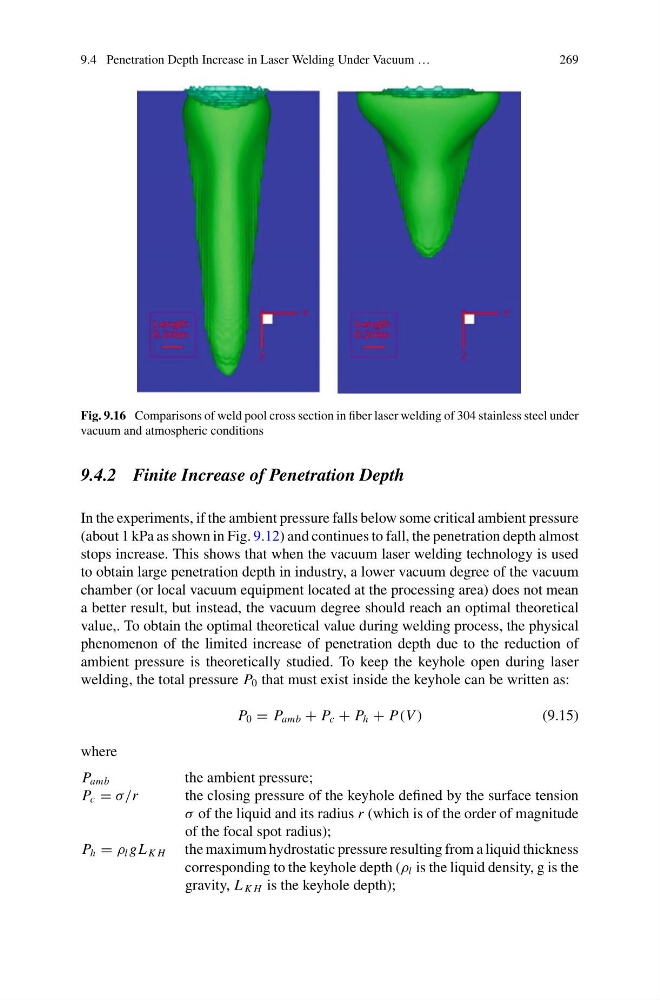
Fig. 9.16 Comparisons of weld pool cross section in fiber laser welding of 304 stainless steel under
vacuum and atmospheric conditions
9.4.2 Finite Increase of Penetration Depth
In the experiments, if the ambient pressure falls below some critical ambient pressure
(about 1 kPa as shown in Fig. 9.12) and continues to fall, the penetration depth almost
stops increase. This shows that when the vacuum laser welding technology is used
to obtain large penetration depth in industry, a lower vacuum degree of the vacuum
chamber (or local vacuum equipment located at the processing area) does not mean
a better result, but instead, the vacuum degree should reach an optimal theoretical
value,. To obtain the optimal theoretical value during welding process, the physical
phenomenon of the limited increase of penetration depth due to the reduction of
ambient pressure is theoretically studied. To keep the keyhole open during laser
welding, the total pressure P 0 that must exist inside the keyhole can be written as:
P 0 = P amb + P c + P h + P(V )
(9.15)
where
P amb
the ambient pressure;
P c = σ/r
the closing pressure of the keyhole defined by the surface tension
σ of the liquid and its radius r (which is of the order of magnitude
of the focal spot radius);
P h = ρ l gL K H the maximum hydrostatic pressure resulting from a liquid thickness
corresponding to the keyhole depth (ρ l is the liquid density, g is the
gravity, L K H is the keyhole depth);
269
Fig. 9.16 Comparisons of weld pool cross section in fiber laser welding of 304 stainless steel under
vacuum and atmospheric conditions
9.4.2 Finite Increase of Penetration Depth
In the experiments, if the ambient pressure falls below some critical ambient pressure
(about 1 kPa as shown in Fig. 9.12) and continues to fall, the penetration depth almost
stops increase. This shows that when the vacuum laser welding technology is used
to obtain large penetration depth in industry, a lower vacuum degree of the vacuum
chamber (or local vacuum equipment located at the processing area) does not mean
a better result, but instead, the vacuum degree should reach an optimal theoretical
value,. To obtain the optimal theoretical value during welding process, the physical
phenomenon of the limited increase of penetration depth due to the reduction of
ambient pressure is theoretically studied. To keep the keyhole open during laser
welding, the total pressure P 0 that must exist inside the keyhole can be written as:
P 0 = P amb + P c + P h + P(V )
(9.15)
where
P amb
the ambient pressure;
P c = σ/r
the closing pressure of the keyhole defined by the surface tension
σ of the liquid and its radius r (which is of the order of magnitude
of the focal spot radius);
P h = ρ l gL K H the maximum hydrostatic pressure resulting from a liquid thickness
corresponding to the keyhole depth (ρ l is the liquid density, g is the
gravity, L K H is the keyhole depth);