

9.4 Penetration Depth Increase in Laser Welding Under Vacuum …
267
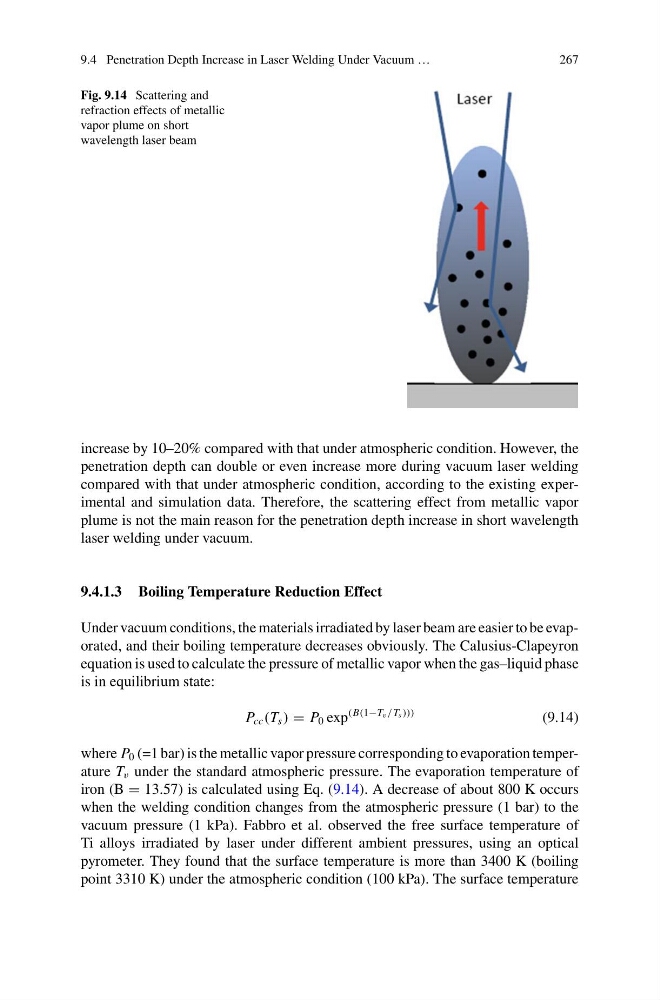
Fig. 9.14 Scattering and
refraction effects of metallic
vapor plume on short
wavelength laser beam
increase by 10–20% compared with that under atmospheric condition. However, the
penetration depth can double or even increase more during vacuum laser welding
compared with that under atmospheric condition, according to the existing experimental and simulation data. Therefore, the scattering effect from metallic vapor
plume is not the main reason for the penetration depth increase in short wavelength
laser welding under vacuum.
9.4.1.3 Boiling Temperature Reduction Effect
Under vacuum conditions, the materials irradiated by laser beam are easier to be evaporated, and their boiling temperature decreases obviously. The Calusius-Clapeyron
equation is used to calculate the pressure of metallic vapor when the gas–liquid phase
is in equilibrium state:
P cc (T s ) = P 0 exp
(B(1−T v /T s )))
(9.14)
where P 0 (=1 bar) is the metallic vapor pressure corresponding to evaporation temperature T v under the standard atmospheric pressure. The evaporation temperature of
iron (B = 13.57) is calculated using Eq. (9.14). A decrease of about 800 K occurs
when the welding condition changes from the atmospheric pressure (1 bar) to the
vacuum pressure (1 kPa). Fabbro et al. observed the free surface temperature of
Ti alloys irradiated by laser under different ambient pressures, using an optical
pyrometer. They found that the surface temperature is more than 3400 K (boiling
point 3310 K) under the atmospheric condition (100 kPa). The surface temperature
267
Fig. 9.14 Scattering and
refraction effects of metallic
vapor plume on short
wavelength laser beam
increase by 10–20% compared with that under atmospheric condition. However, the
penetration depth can double or even increase more during vacuum laser welding
compared with that under atmospheric condition, according to the existing experimental and simulation data. Therefore, the scattering effect from metallic vapor
plume is not the main reason for the penetration depth increase in short wavelength
laser welding under vacuum.
9.4.1.3 Boiling Temperature Reduction Effect
Under vacuum conditions, the materials irradiated by laser beam are easier to be evaporated, and their boiling temperature decreases obviously. The Calusius-Clapeyron
equation is used to calculate the pressure of metallic vapor when the gas–liquid phase
is in equilibrium state:
P cc (T s ) = P 0 exp
(B(1−T v /T s )))
(9.14)
where P 0 (=1 bar) is the metallic vapor pressure corresponding to evaporation temperature T v under the standard atmospheric pressure. The evaporation temperature of
iron (B = 13.57) is calculated using Eq. (9.14). A decrease of about 800 K occurs
when the welding condition changes from the atmospheric pressure (1 bar) to the
vacuum pressure (1 kPa). Fabbro et al. observed the free surface temperature of
Ti alloys irradiated by laser under different ambient pressures, using an optical
pyrometer. They found that the surface temperature is more than 3400 K (boiling
point 3310 K) under the atmospheric condition (100 kPa). The surface temperature