

266
9 Dynamical Behaviors of Keyhole and Weld Pool …
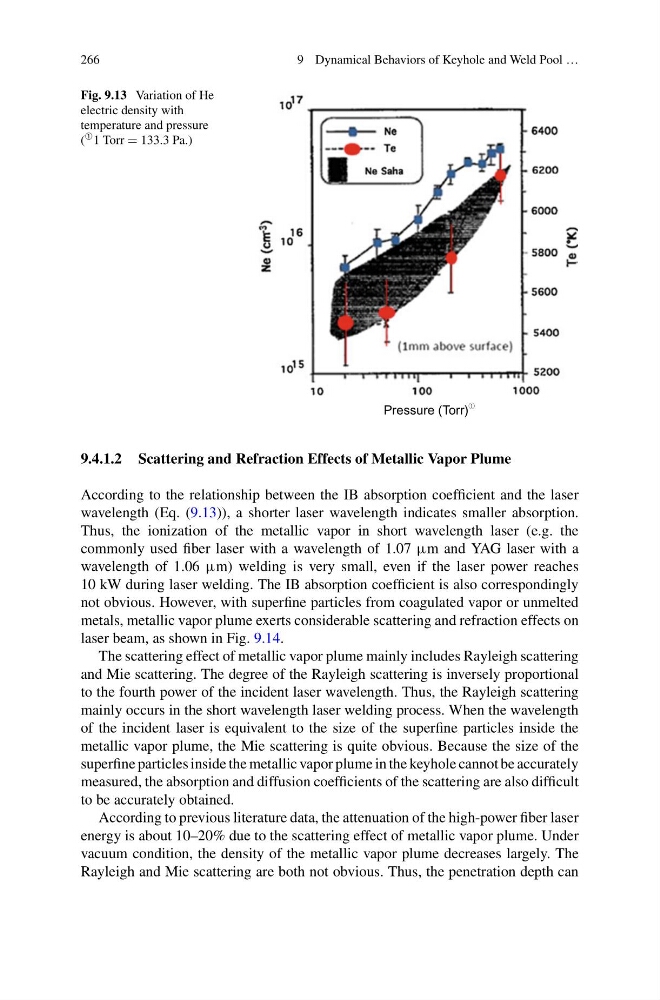
Fig. 9.13 Variation of He
electric density with
temperature and pressure
( ➀ 1 Torr = 133.3 Pa.)
Pressure (Torr)
9.4.1.2 Scattering and Refraction Effects of Metallic Vapor Plume
According to the relationship between the IB absorption coefficient and the laser
wavelength (Eq. (9.13)), a shorter laser wavelength indicates smaller absorption.
Thus, the ionization of the metallic vapor in short wavelength laser (e.g. the
commonly used fiber laser with a wavelength of 1.07 µm and YAG laser with a
wavelength of 1.06 µm) welding is very small, even if the laser power reaches
10 kW during laser welding. The IB absorption coefficient is also correspondingly
not obvious. However, with superfine particles from coagulated vapor or unmelted
metals, metallic vapor plume exerts considerable scattering and refraction effects on
laser beam, as shown in Fig. 9.14.
The scattering effect of metallic vapor plume mainly includes Rayleigh scattering
and Mie scattering. The degree of the Rayleigh scattering is inversely proportional
to the fourth power of the incident laser wavelength. Thus, the Rayleigh scattering
mainly occurs in the short wavelength laser welding process. When the wavelength
of the incident laser is equivalent to the size of the superfine particles inside the
metallic vapor plume, the Mie scattering is quite obvious. Because the size of the
superfine particles inside the metallic vapor plume in the keyhole cannot be accurately
measured, the absorption and diffusion coefficients of the scattering are also difficult
to be accurately obtained.
According to previous literature data, the attenuation of the high-power fiber laser
energy is about 10–20% due to the scattering effect of metallic vapor plume. Under
vacuum condition, the density of the metallic vapor plume decreases largely. The
Rayleigh and Mie scattering are both not obvious. Thus, the penetration depth can
9 Dynamical Behaviors of Keyhole and Weld Pool …
Fig. 9.13 Variation of He
electric density with
temperature and pressure
( ➀ 1 Torr = 133.3 Pa.)
Pressure (Torr)
9.4.1.2 Scattering and Refraction Effects of Metallic Vapor Plume
According to the relationship between the IB absorption coefficient and the laser
wavelength (Eq. (9.13)), a shorter laser wavelength indicates smaller absorption.
Thus, the ionization of the metallic vapor in short wavelength laser (e.g. the
commonly used fiber laser with a wavelength of 1.07 µm and YAG laser with a
wavelength of 1.06 µm) welding is very small, even if the laser power reaches
10 kW during laser welding. The IB absorption coefficient is also correspondingly
not obvious. However, with superfine particles from coagulated vapor or unmelted
metals, metallic vapor plume exerts considerable scattering and refraction effects on
laser beam, as shown in Fig. 9.14.
The scattering effect of metallic vapor plume mainly includes Rayleigh scattering
and Mie scattering. The degree of the Rayleigh scattering is inversely proportional
to the fourth power of the incident laser wavelength. Thus, the Rayleigh scattering
mainly occurs in the short wavelength laser welding process. When the wavelength
of the incident laser is equivalent to the size of the superfine particles inside the
metallic vapor plume, the Mie scattering is quite obvious. Because the size of the
superfine particles inside the metallic vapor plume in the keyhole cannot be accurately
measured, the absorption and diffusion coefficients of the scattering are also difficult
to be accurately obtained.
According to previous literature data, the attenuation of the high-power fiber laser
energy is about 10–20% due to the scattering effect of metallic vapor plume. Under
vacuum condition, the density of the metallic vapor plume decreases largely. The
Rayleigh and Mie scattering are both not obvious. Thus, the penetration depth can