

9.4 Penetration Depth Increase in Laser Welding Under Vacuum …
265
and refraction effects of metallic vapor plume are reduced; (3) the decrease of the
average keyhole wall temperature leads to more laser energy acting on the keyhole
wall in the penetration direction.
9.4.1.1 IB Absorption Effect of Plasma
During long wavelength laser welding (e.g. CO 2 laser with a wavelength of 10.6 µm)
process, highly ionized laser induced plasma is produced. The induced plasma can
absorb the long wavelength laser beam passed through. This will largely reduce the
laser energy acting on the keyhole wall, causing an obvious decrease of penetration
depth compared with that under atmospheric pressure. 10 kW CO 2 laser welding
is used as an example (laser spot diameter: 0.5 mm). He is used to measure IB
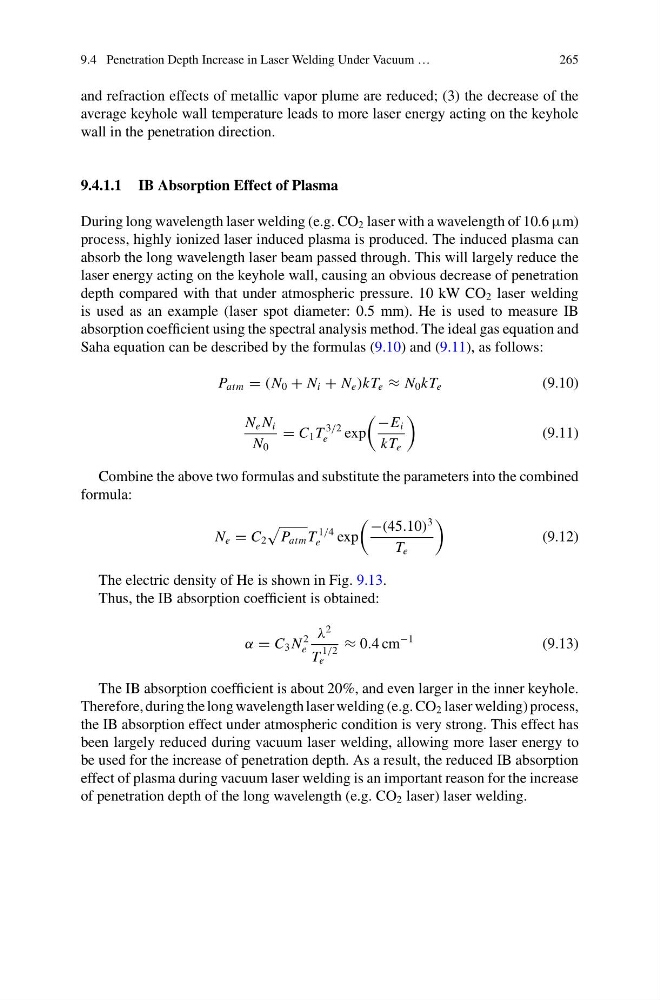
absorption coefficient using the spectral analysis method. The ideal gas equation and
Saha equation can be described by the formulas (9.10) and (9.11), as follows:
P atm = (N 0 + N i + N e )kT e ≈ N 0 kT e
(9.10)
N e N i
N 0
= C 1 T
3/2
e
exp
−E i
kT e
(9.11)
Combine the above two formulas and substitute the parameters into the combined
formula:
N e = C 2
P atm T
1/4
e
exp
−(45.10)
3
T e
(9.12)
The electric density of He is shown in Fig. 9.13.
Thus, the IB absorption coefficient is obtained:
α = C 3 N
2
e
λ
2
T
1/2
e
≈ 0.4 cm
−1
(9.13)
The IB absorption coefficient is about 20%, and even larger in the inner keyhole.
Therefore, during the long wavelength laser welding (e.g. CO 2 laser welding) process,
the IB absorption effect under atmospheric condition is very strong. This effect has
been largely reduced during vacuum laser welding, allowing more laser energy to
be used for the increase of penetration depth. As a result, the reduced IB absorption
effect of plasma during vacuum laser welding is an important reason for the increase
of penetration depth of the long wavelength (e.g. CO 2 laser) laser welding.
265
and refraction effects of metallic vapor plume are reduced; (3) the decrease of the
average keyhole wall temperature leads to more laser energy acting on the keyhole
wall in the penetration direction.
9.4.1.1 IB Absorption Effect of Plasma
During long wavelength laser welding (e.g. CO 2 laser with a wavelength of 10.6 µm)
process, highly ionized laser induced plasma is produced. The induced plasma can
absorb the long wavelength laser beam passed through. This will largely reduce the
laser energy acting on the keyhole wall, causing an obvious decrease of penetration
depth compared with that under atmospheric pressure. 10 kW CO 2 laser welding
is used as an example (laser spot diameter: 0.5 mm). He is used to measure IB
absorption coefficient using the spectral analysis method. The ideal gas equation and
Saha equation can be described by the formulas (9.10) and (9.11), as follows:
P atm = (N 0 + N i + N e )kT e ≈ N 0 kT e
(9.10)
N e N i
N 0
= C 1 T
3/2
e
exp
−E i
kT e
(9.11)
Combine the above two formulas and substitute the parameters into the combined
formula:
N e = C 2
P atm T
1/4
e
exp
−(45.10)
3
T e
(9.12)
The electric density of He is shown in Fig. 9.13.
Thus, the IB absorption coefficient is obtained:
α = C 3 N
2
e
λ
2
T
1/2
e
≈ 0.4 cm
−1
(9.13)
The IB absorption coefficient is about 20%, and even larger in the inner keyhole.
Therefore, during the long wavelength laser welding (e.g. CO 2 laser welding) process,
the IB absorption effect under atmospheric condition is very strong. This effect has
been largely reduced during vacuum laser welding, allowing more laser energy to
be used for the increase of penetration depth. As a result, the reduced IB absorption
effect of plasma during vacuum laser welding is an important reason for the increase
of penetration depth of the long wavelength (e.g. CO 2 laser) laser welding.