

264
9 Dynamical Behaviors of Keyhole and Weld Pool …
of these flows is more than 10 m/s, which is equivalent to that under atmospheric
pressure (about 15 m/s). From the above discussions, it can be seen that the intensity
of the flows in weld pool during vacuum laser welding, especially in surface weld
pool, is more gentle and stable than that during laser welding under atmospheric
pressure. This is in line with the experiments in recent years. Additionally, this also
demonstrates the mechanism that vacuum laser welding could efficiently reduce or
suppress the spatter defects. Moreover, the weld pool flow behaviors during vacuum
laser welding differ from those during laser welding under atmospheric pressure.
For example, in laser welding under atmospheric pressure, vigorous vortex flows
are observed on the weld pool behind the bottom of the keyhole; in vacuum laser
welding, however, such flows are not found in this area. The disappearance of this
vortex flow is good for the floating of the bottom bubbles, which may reduce the
possibility of the formation of the porosity defects.
9.4 Penetration Depth Increase in Laser Welding Under
Vacuum and Low Vacuum Conditions
9.4.1 Mechanism for Penetration Depth Increase
with Ambient Pressure Decrease
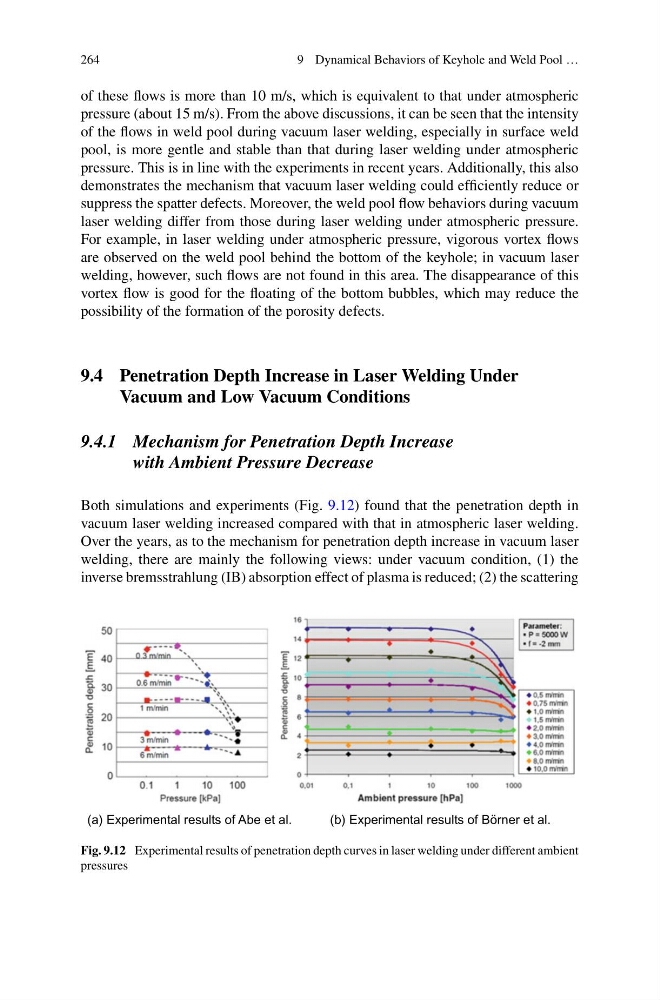
Both simulations and experiments (Fig. 9.12) found that the penetration depth in
vacuum laser welding increased compared with that in atmospheric laser welding.
Over the years, as to the mechanism for penetration depth increase in vacuum laser
welding, there are mainly the following views: under vacuum condition, (1) the
inverse bremsstrahlung (IB) absorption effect of plasma is reduced; (2) the scattering
(a) Experimental results of Abe et al.
(b) Experimental results of Börner et al.
Fig. 9.12 Experimental results of penetration depth curves in laser welding under different ambient
pressures
9 Dynamical Behaviors of Keyhole and Weld Pool …
of these flows is more than 10 m/s, which is equivalent to that under atmospheric
pressure (about 15 m/s). From the above discussions, it can be seen that the intensity
of the flows in weld pool during vacuum laser welding, especially in surface weld
pool, is more gentle and stable than that during laser welding under atmospheric
pressure. This is in line with the experiments in recent years. Additionally, this also
demonstrates the mechanism that vacuum laser welding could efficiently reduce or
suppress the spatter defects. Moreover, the weld pool flow behaviors during vacuum
laser welding differ from those during laser welding under atmospheric pressure.
For example, in laser welding under atmospheric pressure, vigorous vortex flows
are observed on the weld pool behind the bottom of the keyhole; in vacuum laser
welding, however, such flows are not found in this area. The disappearance of this
vortex flow is good for the floating of the bottom bubbles, which may reduce the
possibility of the formation of the porosity defects.
9.4 Penetration Depth Increase in Laser Welding Under
Vacuum and Low Vacuum Conditions
9.4.1 Mechanism for Penetration Depth Increase
with Ambient Pressure Decrease
Both simulations and experiments (Fig. 9.12) found that the penetration depth in
vacuum laser welding increased compared with that in atmospheric laser welding.
Over the years, as to the mechanism for penetration depth increase in vacuum laser
welding, there are mainly the following views: under vacuum condition, (1) the
inverse bremsstrahlung (IB) absorption effect of plasma is reduced; (2) the scattering
(a) Experimental results of Abe et al.
(b) Experimental results of Börner et al.
Fig. 9.12 Experimental results of penetration depth curves in laser welding under different ambient
pressures