

258
9 Dynamical Behaviors of Keyhole and Weld Pool …
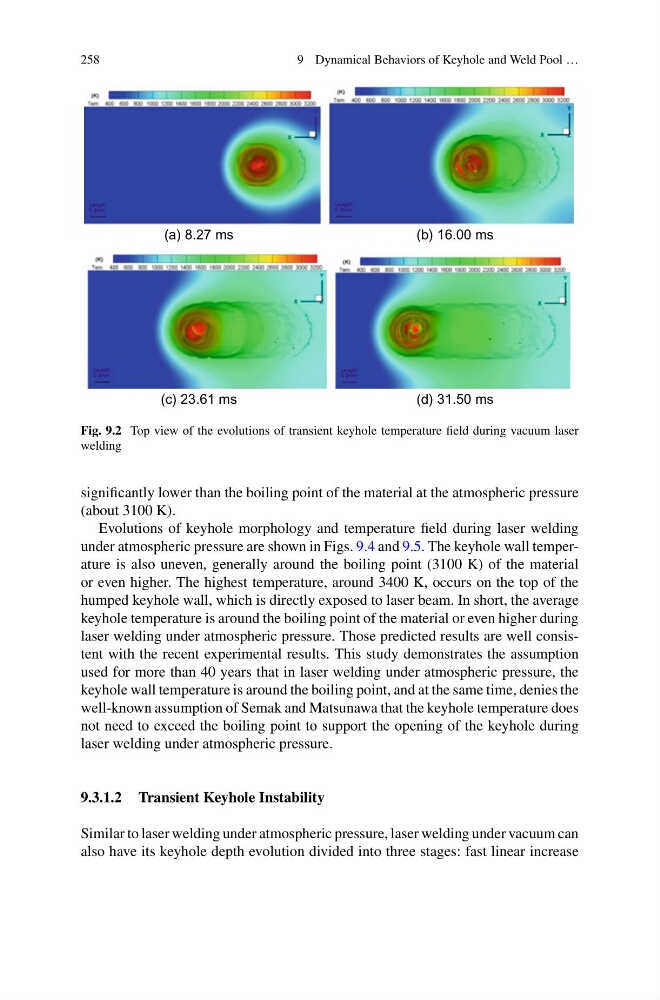
(a) 8.27 ms
(b) 16.00 ms
(c) 23.61 ms
(d) 31.50 ms
Fig. 9.2 Top view of the evolutions of transient keyhole temperature field during vacuum laser
welding
significantly lower than the boiling point of the material at the atmospheric pressure
(about 3100 K).
Evolutions of keyhole morphology and temperature field during laser welding
under atmospheric pressure are shown in Figs. 9.4 and 9.5. The keyhole wall temperature is also uneven, generally around the boiling point (3100 K) of the material
or even higher. The highest temperature, around 3400 K, occurs on the top of the
humped keyhole wall, which is directly exposed to laser beam. In short, the average
keyhole temperature is around the boiling point of the material or even higher during
laser welding under atmospheric pressure. Those predicted results are well consistent with the recent experimental results. This study demonstrates the assumption
used for more than 40 years that in laser welding under atmospheric pressure, the
keyhole wall temperature is around the boiling point, and at the same time, denies the
well-known assumption of Semak and Matsunawa that the keyhole temperature does
not need to exceed the boiling point to support the opening of the keyhole during
laser welding under atmospheric pressure.
9.3.1.2 Transient Keyhole Instability
Similar to laser welding under atmospheric pressure, laser welding under vacuum can
also have its keyhole depth evolution divided into three stages: fast linear increase
9 Dynamical Behaviors of Keyhole and Weld Pool …
(a) 8.27 ms
(b) 16.00 ms
(c) 23.61 ms
(d) 31.50 ms
Fig. 9.2 Top view of the evolutions of transient keyhole temperature field during vacuum laser
welding
significantly lower than the boiling point of the material at the atmospheric pressure
(about 3100 K).
Evolutions of keyhole morphology and temperature field during laser welding
under atmospheric pressure are shown in Figs. 9.4 and 9.5. The keyhole wall temperature is also uneven, generally around the boiling point (3100 K) of the material
or even higher. The highest temperature, around 3400 K, occurs on the top of the
humped keyhole wall, which is directly exposed to laser beam. In short, the average
keyhole temperature is around the boiling point of the material or even higher during
laser welding under atmospheric pressure. Those predicted results are well consistent with the recent experimental results. This study demonstrates the assumption
used for more than 40 years that in laser welding under atmospheric pressure, the
keyhole wall temperature is around the boiling point, and at the same time, denies the
well-known assumption of Semak and Matsunawa that the keyhole temperature does
not need to exceed the boiling point to support the opening of the keyhole during
laser welding under atmospheric pressure.
9.3.1.2 Transient Keyhole Instability
Similar to laser welding under atmospheric pressure, laser welding under vacuum can
also have its keyhole depth evolution divided into three stages: fast linear increase