

9.3 Behaviors of Keyhole and Weld Pool in Vacuum Laser Welding
259
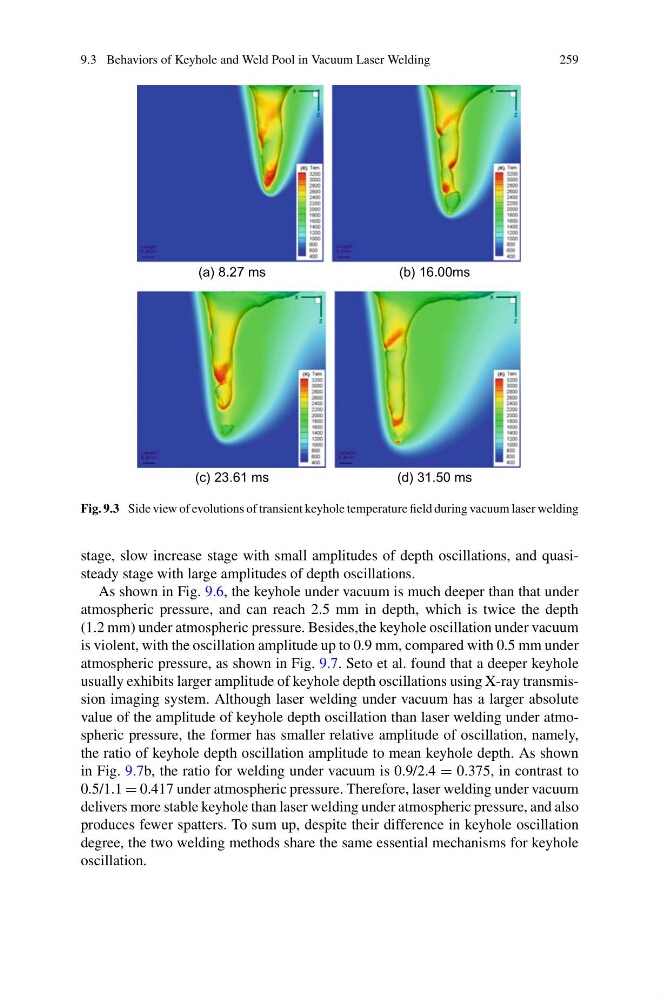
(a) 8.27 ms
(b) 16.00ms
(c) 23.61 ms
(d) 31.50 ms
Fig. 9.3 Side view of evolutions of transient keyhole temperature field during vacuum laser welding
stage, slow increase stage with small amplitudes of depth oscillations, and quasisteady stage with large amplitudes of depth oscillations.
As shown in Fig. 9.6, the keyhole under vacuum is much deeper than that under
atmospheric pressure, and can reach 2.5 mm in depth, which is twice the depth
(1.2 mm) under atmospheric pressure. Besides,the keyhole oscillation under vacuum
is violent, with the oscillation amplitude up to 0.9 mm, compared with 0.5 mm under
atmospheric pressure, as shown in Fig. 9.7. Seto et al. found that a deeper keyhole
usually exhibits larger amplitude of keyhole depth oscillations using X-ray transmission imaging system. Although laser welding under vacuum has a larger absolute
value of the amplitude of keyhole depth oscillation than laser welding under atmospheric pressure, the former has smaller relative amplitude of oscillation, namely,
the ratio of keyhole depth oscillation amplitude to mean keyhole depth. As shown
in Fig. 9.7b, the ratio for welding under vacuum is 0.9/2.4 = 0.375, in contrast to
0.5/1.1 = 0.417 under atmospheric pressure. Therefore, laser welding under vacuum
delivers more stable keyhole than laser welding under atmospheric pressure, and also
produces fewer spatters. To sum up, despite their difference in keyhole oscillation
degree, the two welding methods share the same essential mechanisms for keyhole
oscillation.
259
(a) 8.27 ms
(b) 16.00ms
(c) 23.61 ms
(d) 31.50 ms
Fig. 9.3 Side view of evolutions of transient keyhole temperature field during vacuum laser welding
stage, slow increase stage with small amplitudes of depth oscillations, and quasisteady stage with large amplitudes of depth oscillations.
As shown in Fig. 9.6, the keyhole under vacuum is much deeper than that under
atmospheric pressure, and can reach 2.5 mm in depth, which is twice the depth
(1.2 mm) under atmospheric pressure. Besides,the keyhole oscillation under vacuum
is violent, with the oscillation amplitude up to 0.9 mm, compared with 0.5 mm under
atmospheric pressure, as shown in Fig. 9.7. Seto et al. found that a deeper keyhole
usually exhibits larger amplitude of keyhole depth oscillations using X-ray transmission imaging system. Although laser welding under vacuum has a larger absolute
value of the amplitude of keyhole depth oscillation than laser welding under atmospheric pressure, the former has smaller relative amplitude of oscillation, namely,
the ratio of keyhole depth oscillation amplitude to mean keyhole depth. As shown
in Fig. 9.7b, the ratio for welding under vacuum is 0.9/2.4 = 0.375, in contrast to
0.5/1.1 = 0.417 under atmospheric pressure. Therefore, laser welding under vacuum
delivers more stable keyhole than laser welding under atmospheric pressure, and also
produces fewer spatters. To sum up, despite their difference in keyhole oscillation
degree, the two welding methods share the same essential mechanisms for keyhole
oscillation.