

8.2 Multiphase Transient Coupling Model in Laser Welding with Filler Wires
207
8.2.3 Boundary Conditions
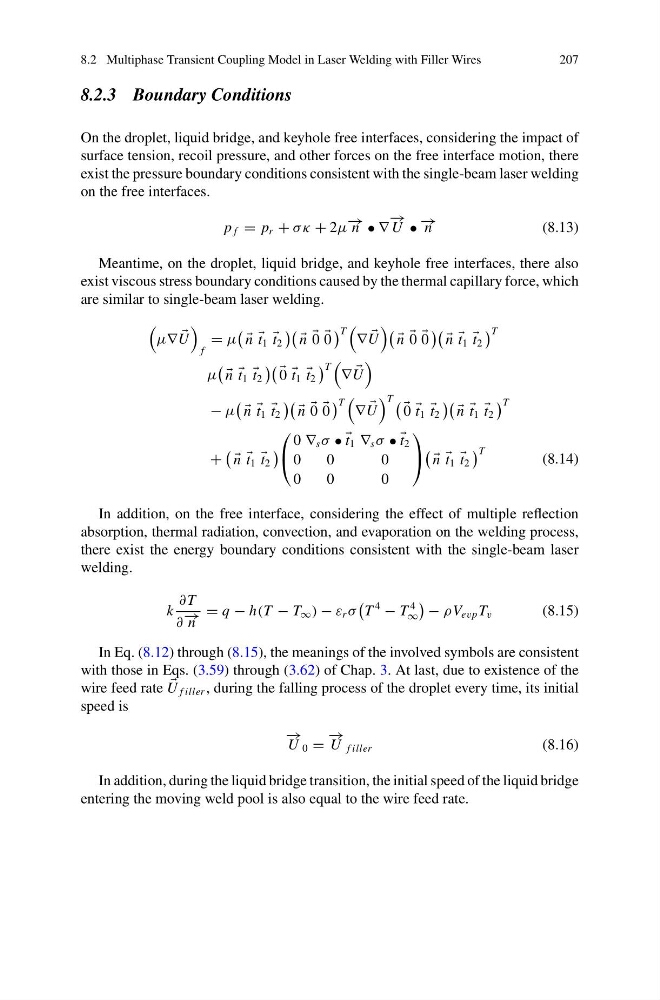
On the droplet, liquid bridge, and keyhole free interfaces, considering the impact of
surface tension, recoil pressure, and other forces on the free interface motion, there
exist the pressure boundary conditions consistent with the single-beam laser welding
on the free interfaces.
p f = p r + σ κ + 2μ − → n • ∇
− →
U • − → n
(8.13)
Meantime, on the droplet, liquid bridge, and keyhole free interfaces, there also
exist viscous stress boundary conditions caused by the thermal capillary force, which
are similar to single-beam laser welding.
μ∇
U
f
= μ
n
t 1
t 2
n
0
0
T
∇
U
n
0
0
n
t 1
t 2
T
μ
n
t 1
t 2
0
t 1
t 2
T
∇
U
− μ
n
t 1
t 2
n
0
0
T
∇
U
T
0
t 1
t 2
n
t 1
t 2
T
+
n
t 1
t 2
⎛
⎝
0 ∇ s σ •
t 1 ∇ s σ •
t 2
0
0
0
0
0
0
⎞
⎠
n
t 1
t 2
T
(8.14)
In addition, on the free interface, considering the effect of multiple reflection
absorption, thermal radiation, convection, and evaporation on the welding process,
there exist the energy boundary conditions consistent with the single-beam laser
welding.
k
∂ T
∂ − → n
= q − h(T − T ∞ ) − ε r σ
T
4
− T
4
∞
− ρV evp T v
(8.15)
In Eq. (8.12) through (8.15), the meanings of the involved symbols are consistent
with those in Eqs. (3.59) through (3.62) of Chap. 3. At last, due to existence of the
wire feed rate
U f iller , during the falling process of the droplet every time, its initial
speed is
− →
U 0 =
− →
U f iller
(8.16)
In addition, during the liquid bridge transition, the initial speed of the liquid bridge
entering the moving weld pool is also equal to the wire feed rate.
207
8.2.3 Boundary Conditions
On the droplet, liquid bridge, and keyhole free interfaces, considering the impact of
surface tension, recoil pressure, and other forces on the free interface motion, there
exist the pressure boundary conditions consistent with the single-beam laser welding
on the free interfaces.
p f = p r + σ κ + 2μ − → n • ∇
− →
U • − → n
(8.13)
Meantime, on the droplet, liquid bridge, and keyhole free interfaces, there also
exist viscous stress boundary conditions caused by the thermal capillary force, which
are similar to single-beam laser welding.
μ∇
U
f
= μ
n
t 1
t 2
n
0
0
T
∇
U
n
0
0
n
t 1
t 2
T
μ
n
t 1
t 2
0
t 1
t 2
T
∇
U
− μ
n
t 1
t 2
n
0
0
T
∇
U
T
0
t 1
t 2
n
t 1
t 2
T
+
n
t 1
t 2
⎛
⎝
0 ∇ s σ •
t 1 ∇ s σ •
t 2
0
0
0
0
0
0
⎞
⎠
n
t 1
t 2
T
(8.14)
In addition, on the free interface, considering the effect of multiple reflection
absorption, thermal radiation, convection, and evaporation on the welding process,
there exist the energy boundary conditions consistent with the single-beam laser
welding.
k
∂ T
∂ − → n
= q − h(T − T ∞ ) − ε r σ
T
4
− T
4
∞
− ρV evp T v
(8.15)
In Eq. (8.12) through (8.15), the meanings of the involved symbols are consistent
with those in Eqs. (3.59) through (3.62) of Chap. 3. At last, due to existence of the
wire feed rate
U f iller , during the falling process of the droplet every time, its initial
speed is
− →
U 0 =
− →
U f iller
(8.16)
In addition, during the liquid bridge transition, the initial speed of the liquid bridge
entering the moving weld pool is also equal to the wire feed rate.