

186
7 Keyhole and Weld Pool Dynamics in Dual-Beam Laser Welding
∂ϕ
∂t
+
U · ∇ϕ = 0
(7.7)
where,
U —kinematic velocity of keyhole interface.
7.2.1.3 Fresnel Absorption Formula
According to the relative position of two laser beams and welding direction in dual
beam laser welding, it can be classified into parallel dual beam welding and tandem
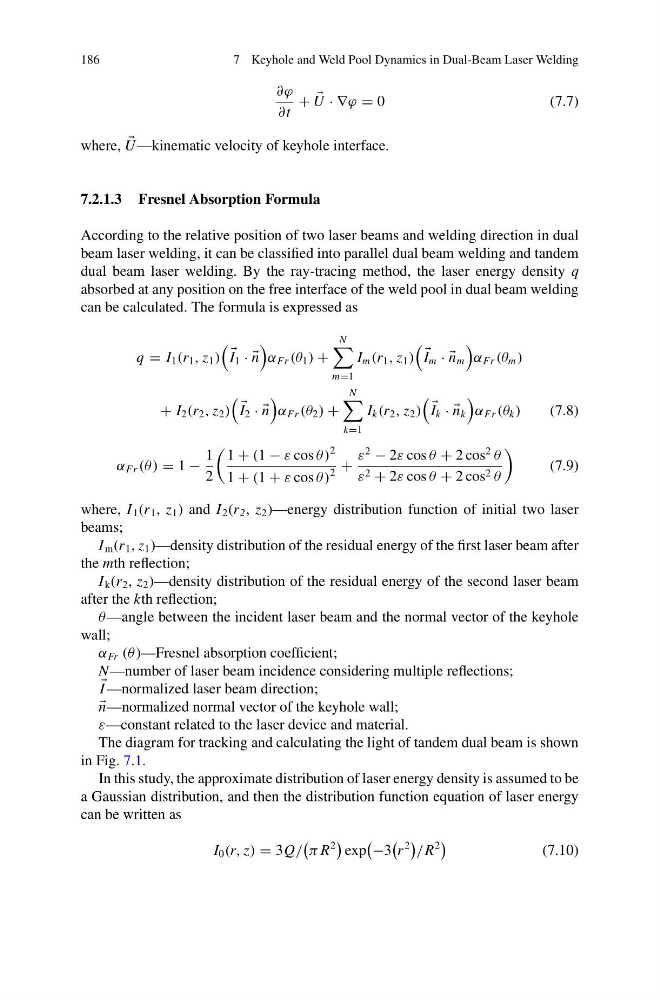
dual beam laser welding. By the ray-tracing method, the laser energy density q
absorbed at any position on the free interface of the weld pool in dual beam welding
can be calculated. The formula is expressed as
q = I 1 (r 1 , z 1 )
I 1 · ·
n
α Fr (θ 1 ) +
N
m=1
I m (r 1 , z 1 )
I m · ·
n m
α Fr (θ m )
+ I 2 (r 2 , z 2 )
I 2 · ·
n
α Fr (θ 2 ) +
N
k=1
I k (r 2 , z 2 )
I k · ·
n k
α Fr (θ k )
(7.8)
α Fr (θ ) = 1 −
1
2
1 + (1 − ε cos θ )
2
1 + (1 + ε cos θ )
2
+
ε
2
− 2ε cos θ + 2 cos
2
θ
ε 2 + 2ε cos θ + 2 cos 2 θ
(7.9)
where, I 1 (r 1 , z 1 ) and I 2 (r 2 , z 2 )—energy distribution function of initial two laser
beams;
I m (r 1 , z 1 )—density distribution of the residual energy of the first laser beam after
the mth reflection;
I k (r 2 , z 2 )—density distribution of the residual energy of the second laser beam
after the kth reflection;
θ —angle between the incident laser beam and the normal vector of the keyhole
wall;
α Fr (θ )—Fresnel absorption coefficient;
N—number of laser beam incidence considering multiple reflections;
I —normalized laser beam direction;
n—normalized normal vector of the keyhole wall;
ε—constant related to the laser device and material.
The diagram for tracking and calculating the light of tandem dual beam is shown
in Fig. 7.1.
In this study, the approximate distribution of laser energy density is assumed to be
a Gaussian distribution, and then the distribution function equation of laser energy
can be written as
I 0 (r, z) = 3Q/
π R
2
exp
−3
r
2
/R
2
(7.10)
7 Keyhole and Weld Pool Dynamics in Dual-Beam Laser Welding
∂ϕ
∂t
+
U · ∇ϕ = 0
(7.7)
where,
U —kinematic velocity of keyhole interface.
7.2.1.3 Fresnel Absorption Formula
According to the relative position of two laser beams and welding direction in dual
beam laser welding, it can be classified into parallel dual beam welding and tandem
dual beam laser welding. By the ray-tracing method, the laser energy density q
absorbed at any position on the free interface of the weld pool in dual beam welding
can be calculated. The formula is expressed as
q = I 1 (r 1 , z 1 )
I 1 · ·
n
α Fr (θ 1 ) +
N
m=1
I m (r 1 , z 1 )
I m · ·
n m
α Fr (θ m )
+ I 2 (r 2 , z 2 )
I 2 · ·
n
α Fr (θ 2 ) +
N
k=1
I k (r 2 , z 2 )
I k · ·
n k
α Fr (θ k )
(7.8)
α Fr (θ ) = 1 −
1
2
1 + (1 − ε cos θ )
2
1 + (1 + ε cos θ )
2
+
ε
2
− 2ε cos θ + 2 cos
2
θ
ε 2 + 2ε cos θ + 2 cos 2 θ
(7.9)
where, I 1 (r 1 , z 1 ) and I 2 (r 2 , z 2 )—energy distribution function of initial two laser
beams;
I m (r 1 , z 1 )—density distribution of the residual energy of the first laser beam after
the mth reflection;
I k (r 2 , z 2 )—density distribution of the residual energy of the second laser beam
after the kth reflection;
θ —angle between the incident laser beam and the normal vector of the keyhole
wall;
α Fr (θ )—Fresnel absorption coefficient;
N—number of laser beam incidence considering multiple reflections;
I —normalized laser beam direction;
n—normalized normal vector of the keyhole wall;
ε—constant related to the laser device and material.
The diagram for tracking and calculating the light of tandem dual beam is shown
in Fig. 7.1.
In this study, the approximate distribution of laser energy density is assumed to be
a Gaussian distribution, and then the distribution function equation of laser energy
can be written as
I 0 (r, z) = 3Q/
π R
2
exp
−3
r
2
/R
2
(7.10)