

7.2 Transient Coupling Model of Keyhole and Weld Pool in Dual-Beam Welding
187
Welding direction
Base
plate
(a) Without considering recoil pressure
(b) With recoil pressure considered
Light leaving the
keyhole
Light with extremely
low energy
Subdivided laser
light
Base plate
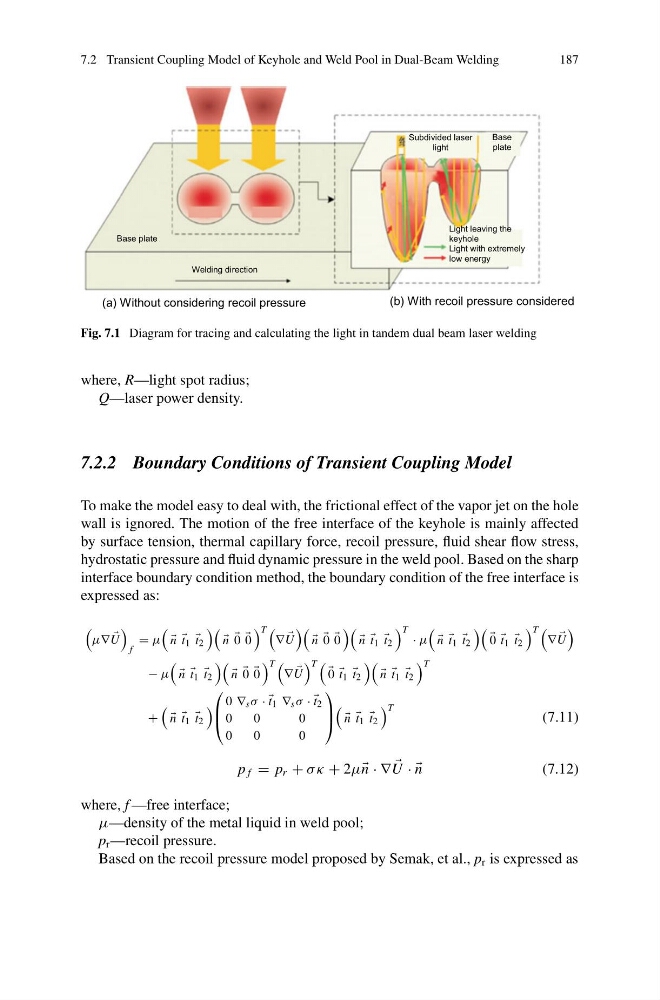
Fig. 7.1 Diagram for tracing and calculating the light in tandem dual beam laser welding
where, R—light spot radius;
Q—laser power density.
7.2.2 Boundary Conditions of Transient Coupling Model
To make the model easy to deal with, the frictional effect of the vapor jet on the hole
wall is ignored. The motion of the free interface of the keyhole is mainly affected
by surface tension, thermal capillary force, recoil pressure, fluid shear flow stress,
hydrostatic pressure and fluid dynamic pressure in the weld pool. Based on the sharp
interface boundary condition method, the boundary condition of the free interface is
expressed as:
μ∇
U
f
= μ
n
t 1
t 2
n
0
0
T
∇
U
n
0
0
n
t 1
t 2
T · μ
n
t 1
t 2
0
t 1
t 2
T
∇
U
− μ
n
t 1
t 2
n
0
0
T
∇
U
T
0
t 1
t 2
n
t 1
t 2
T
+
n
t 1
t 2
⎛
⎜
⎝
0 ∇ s σ ·
t 1 ∇ s σ ·
t 2
0
0
0
0
0
0
⎞
⎟
⎠
n
t 1
t 2
T
(7.11)
p f = p r + σ κ + 2μ n · ∇
U · ·
n
(7.12)
where, f —free interface;
μ—density of the metal liquid in weld pool;
p r —recoil pressure.
Based on the recoil pressure model proposed by Semak, et al., p r is expressed as
187
Welding direction
Base
plate
(a) Without considering recoil pressure
(b) With recoil pressure considered
Light leaving the
keyhole
Light with extremely
low energy
Subdivided laser
light
Base plate
Fig. 7.1 Diagram for tracing and calculating the light in tandem dual beam laser welding
where, R—light spot radius;
Q—laser power density.
7.2.2 Boundary Conditions of Transient Coupling Model
To make the model easy to deal with, the frictional effect of the vapor jet on the hole
wall is ignored. The motion of the free interface of the keyhole is mainly affected
by surface tension, thermal capillary force, recoil pressure, fluid shear flow stress,
hydrostatic pressure and fluid dynamic pressure in the weld pool. Based on the sharp
interface boundary condition method, the boundary condition of the free interface is
expressed as:
μ∇
U
f
= μ
n
t 1
t 2
n
0
0
T
∇
U
n
0
0
n
t 1
t 2
T · μ
n
t 1
t 2
0
t 1
t 2
T
∇
U
− μ
n
t 1
t 2
n
0
0
T
∇
U
T
0
t 1
t 2
n
t 1
t 2
T
+
n
t 1
t 2
⎛
⎜
⎝
0 ∇ s σ ·
t 1 ∇ s σ ·
t 2
0
0
0
0
0
0
⎞
⎟
⎠
n
t 1
t 2
T
(7.11)
p f = p r + σ κ + 2μ n · ∇
U · ·
n
(7.12)
where, f —free interface;
μ—density of the metal liquid in weld pool;
p r —recoil pressure.
Based on the recoil pressure model proposed by Semak, et al., p r is expressed as