

146
5 Dynamic Behaviors of Metal Vapor/Plasma Plume …
where p s —Pressure at free interface;
p r —Recoil pressure;
δ—Surface tension coefficient;
− → n —Normal unit vector of area differential element of the liquid metal near the
free interface of the keyhole;
− →
t 1 ,
− →
t 2 —Two tangential unit vectors that are perpendicular to each other;
∇ s = (I − − → n − → n )∇—Surface gradient operator;
∇ s σ —Marangoni force.
Most of previous mathematical models for laser welding did not address the effect
of ambient pressure. Recently, however, this effect has been identified as a significant
factor for keyhole evaporation. According to studies Pang Shengyong and others,
dynamic evolution of the keyhole is driven by surface pressure of the interface, i.e.,
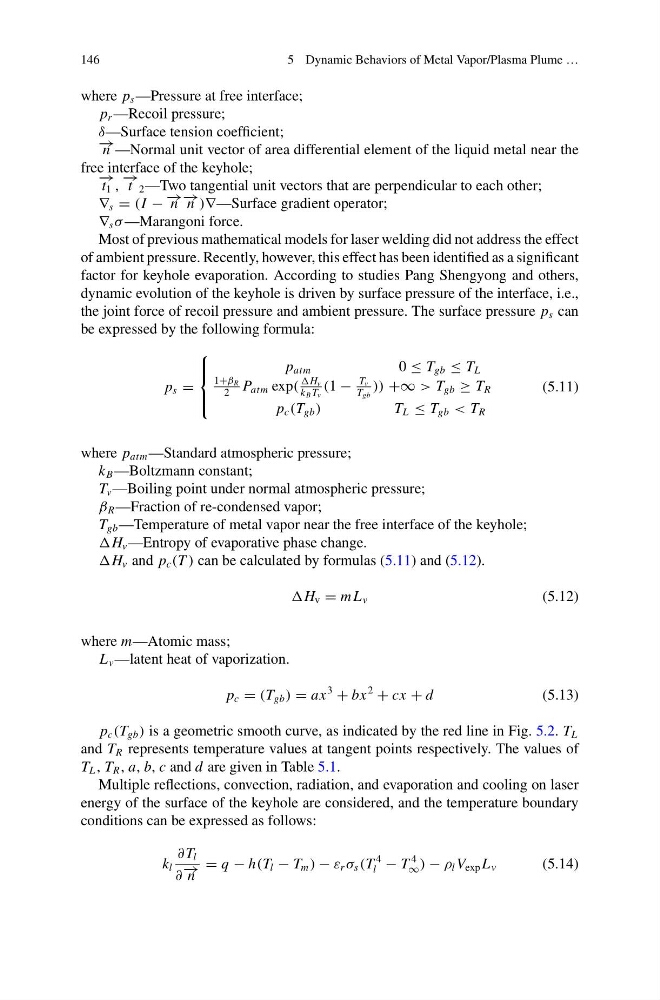
the joint force of recoil pressure and ambient pressure. The surface pressure p s can
be expressed by the following formula:
p s =
⎧
⎪ ⎨
⎪ ⎩
p atm
0 ≤ T gb ≤ T L
1+β R
2
P atm exp(
H v
k B T v
(1 −
T v
T gb
)) +∞ > T gb ≥ T R
p c (T gb )
T L ≤ T gb < T R
(5.11)
where p atm —Standard atmospheric pressure;
k B —Boltzmann constant;
T v —Boiling point under normal atmospheric pressure;
β R —Fraction of re-condensed vapor;
T gb —Temperature of metal vapor near the free interface of the keyhole;
H v —Entropy of evaporative phase change.
H v and p c (T ) can be calculated by formulas (5.11) and (5.12).
H v = m L v
(5.12)
where m—Atomic mass;
L v —latent heat of vaporization.
p c = (T gb ) = ax
3
+ bx
2
+ cx + d
(5.13)
p c (T gb ) is a geometric smooth curve, as indicated by the red line in Fig. 5.2. T L
and T R represents temperature values at tangent points respectively. The values of
T L , T R , a, b, c and d are given in Table 5.1.
Multiple reflections, convection, radiation, and evaporation and cooling on laser
energy of the surface of the keyhole are considered, and the temperature boundary
conditions can be expressed as follows:
k l
∂ T l
∂ − → n
= q − h(T l − T m ) − ε r σ s (T
4
l − T
4
∞ ) − ρ l V exp L v
(5.14)
5 Dynamic Behaviors of Metal Vapor/Plasma Plume …
where p s —Pressure at free interface;
p r —Recoil pressure;
δ—Surface tension coefficient;
− → n —Normal unit vector of area differential element of the liquid metal near the
free interface of the keyhole;
− →
t 1 ,
− →
t 2 —Two tangential unit vectors that are perpendicular to each other;
∇ s = (I − − → n − → n )∇—Surface gradient operator;
∇ s σ —Marangoni force.
Most of previous mathematical models for laser welding did not address the effect
of ambient pressure. Recently, however, this effect has been identified as a significant
factor for keyhole evaporation. According to studies Pang Shengyong and others,
dynamic evolution of the keyhole is driven by surface pressure of the interface, i.e.,
the joint force of recoil pressure and ambient pressure. The surface pressure p s can
be expressed by the following formula:
p s =
⎧
⎪ ⎨
⎪ ⎩
p atm
0 ≤ T gb ≤ T L
1+β R
2
P atm exp(
H v
k B T v
(1 −
T v
T gb
)) +∞ > T gb ≥ T R
p c (T gb )
T L ≤ T gb < T R
(5.11)
where p atm —Standard atmospheric pressure;
k B —Boltzmann constant;
T v —Boiling point under normal atmospheric pressure;
β R —Fraction of re-condensed vapor;
T gb —Temperature of metal vapor near the free interface of the keyhole;
H v —Entropy of evaporative phase change.
H v and p c (T ) can be calculated by formulas (5.11) and (5.12).
H v = m L v
(5.12)
where m—Atomic mass;
L v —latent heat of vaporization.
p c = (T gb ) = ax
3
+ bx
2
+ cx + d
(5.13)
p c (T gb ) is a geometric smooth curve, as indicated by the red line in Fig. 5.2. T L
and T R represents temperature values at tangent points respectively. The values of
T L , T R , a, b, c and d are given in Table 5.1.
Multiple reflections, convection, radiation, and evaporation and cooling on laser
energy of the surface of the keyhole are considered, and the temperature boundary
conditions can be expressed as follows:
k l
∂ T l
∂ − → n
= q − h(T l − T m ) − ε r σ s (T
4
l − T
4
∞ ) − ρ l V exp L v
(5.14)