

5.2 Dynamic Model of Metal Vapor/Plasma in Transient Keyhole
147
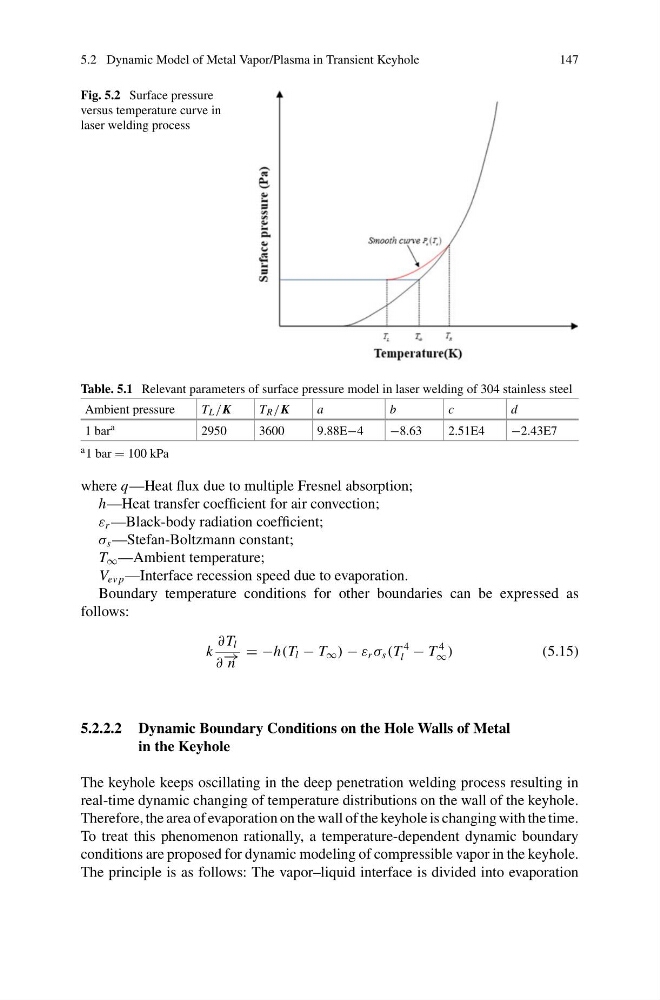
Fig. 5.2 Surface pressure
versus temperature curve in
laser welding process
Table. 5.1 Relevant parameters of surface pressure model in laser welding of 304 stainless steel
Ambient pressure
T L /K
T R /K
a
b
c
d
1 bar a
2950
3600
9.88E−4
−8.63
2.51E4
−2.43E7
a 1 bar = 100 kPa
where q—Heat flux due to multiple Fresnel absorption;
h—Heat transfer coefficient for air convection;
ε r —Black-body radiation coefficient;
σ s —Stefan-Boltzmann constant;
T ∞ —Ambient temperature;
V ev p —Interface recession speed due to evaporation.
Boundary temperature conditions for other boundaries can be expressed as
follows:
k
∂ T l
∂ − → n
= −h(T l − T ∞ ) − ε r σ s (T
4
l − T
4
∞ )
(5.15)
5.2.2.2 Dynamic Boundary Conditions on the Hole Walls of Metal
in the Keyhole
The keyhole keeps oscillating in the deep penetration welding process resulting in
real-time dynamic changing of temperature distributions on the wall of the keyhole.
Therefore, the area of evaporation on the wall of the keyhole is changing with the time.
To treat this phenomenon rationally, a temperature-dependent dynamic boundary
conditions are proposed for dynamic modeling of compressible vapor in the keyhole.
The principle is as follows: The vapor–liquid interface is divided into evaporation
147
Fig. 5.2 Surface pressure
versus temperature curve in
laser welding process
Table. 5.1 Relevant parameters of surface pressure model in laser welding of 304 stainless steel
Ambient pressure
T L /K
T R /K
a
b
c
d
1 bar a
2950
3600
9.88E−4
−8.63
2.51E4
−2.43E7
a 1 bar = 100 kPa
where q—Heat flux due to multiple Fresnel absorption;
h—Heat transfer coefficient for air convection;
ε r —Black-body radiation coefficient;
σ s —Stefan-Boltzmann constant;
T ∞ —Ambient temperature;
V ev p —Interface recession speed due to evaporation.
Boundary temperature conditions for other boundaries can be expressed as
follows:
k
∂ T l
∂ − → n
= −h(T l − T ∞ ) − ε r σ s (T
4
l − T
4
∞ )
(5.15)
5.2.2.2 Dynamic Boundary Conditions on the Hole Walls of Metal
in the Keyhole
The keyhole keeps oscillating in the deep penetration welding process resulting in
real-time dynamic changing of temperature distributions on the wall of the keyhole.
Therefore, the area of evaporation on the wall of the keyhole is changing with the time.
To treat this phenomenon rationally, a temperature-dependent dynamic boundary
conditions are proposed for dynamic modeling of compressible vapor in the keyhole.
The principle is as follows: The vapor–liquid interface is divided into evaporation