

5.2 Dynamic Model of Metal Vapor/Plasma in Transient Keyhole
145
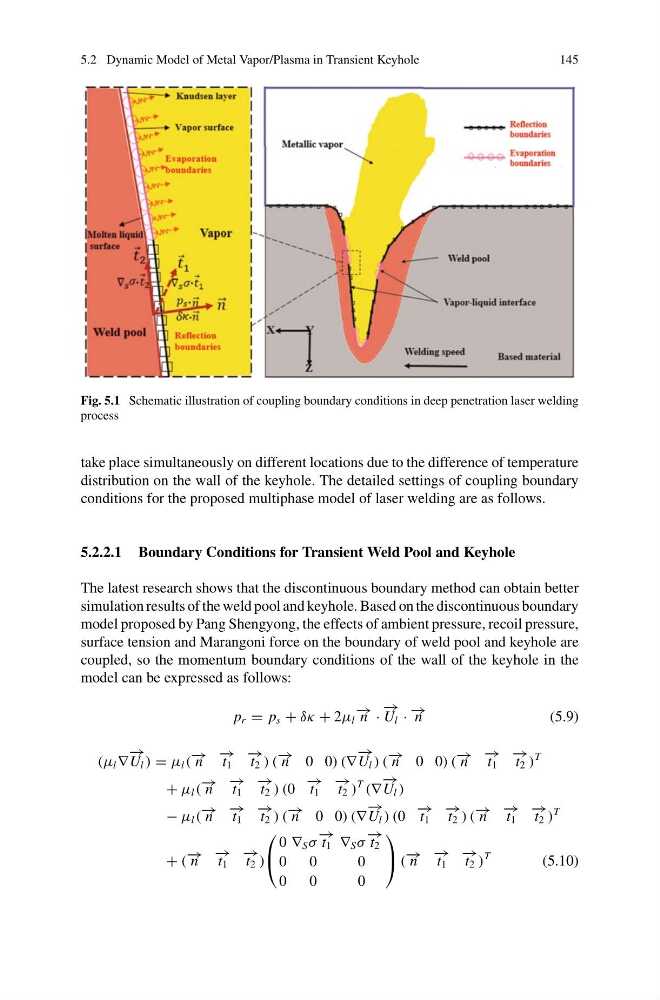
Fig. 5.1 Schematic illustration of coupling boundary conditions in deep penetration laser welding
process
take place simultaneously on different locations due to the difference of temperature
distribution on the wall of the keyhole. The detailed settings of coupling boundary
conditions for the proposed multiphase model of laser welding are as follows.
5.2.2.1 Boundary Conditions for Transient Weld Pool and Keyhole
The latest research shows that the discontinuous boundary method can obtain better
simulation results of the weld pool and keyhole. Based on the discontinuous boundary
model proposed by Pang Shengyong, the effects of ambient pressure, recoil pressure,
surface tension and Marangoni force on the boundary of weld pool and keyhole are
coupled, so the momentum boundary conditions of the wall of the keyhole in the
model can be expressed as follows:
p r = p s + δκ + 2μ l
− → n ·
− →
U l · − → n
(5.9)
(μ l ∇
− →
U l ) = μ l ( − → n
− →
t 1
− →
t 2 ) ( − → n 0 0) (∇
− →
U l ) ( − → n 0 0) ( − → n
− →
t 1
− →
t 2 )
T
+ μ l ( − → n
− →
t 1
− →
t 2 ) (0
− →
t 1
− →
t 2 )
T
(∇
− →
U l )
− μ l ( − → n
− →
t 1
− →
t 2 ) ( − → n 0 0) (∇
− →
U l ) (0
− →
t 1
− →
t 2 ) ( − → n
− →
t 1
− →
t 2 )
T
+ ( − → n
− →
t 1
− →
t 2 )
⎛
⎝
0 ∇ S σ
− →
t 1 ∇ S σ
− →
t 2
0
0
0
0
0
0
⎞
⎠ ( − → n
− →
t 1
− →
t 2 )
T
(5.10)
145
Fig. 5.1 Schematic illustration of coupling boundary conditions in deep penetration laser welding
process
take place simultaneously on different locations due to the difference of temperature
distribution on the wall of the keyhole. The detailed settings of coupling boundary
conditions for the proposed multiphase model of laser welding are as follows.
5.2.2.1 Boundary Conditions for Transient Weld Pool and Keyhole
The latest research shows that the discontinuous boundary method can obtain better
simulation results of the weld pool and keyhole. Based on the discontinuous boundary
model proposed by Pang Shengyong, the effects of ambient pressure, recoil pressure,
surface tension and Marangoni force on the boundary of weld pool and keyhole are
coupled, so the momentum boundary conditions of the wall of the keyhole in the
model can be expressed as follows:
p r = p s + δκ + 2μ l
− → n ·
− →
U l · − → n
(5.9)
(μ l ∇
− →
U l ) = μ l ( − → n
− →
t 1
− →
t 2 ) ( − → n 0 0) (∇
− →
U l ) ( − → n 0 0) ( − → n
− →
t 1
− →
t 2 )
T
+ μ l ( − → n
− →
t 1
− →
t 2 ) (0
− →
t 1
− →
t 2 )
T
(∇
− →
U l )
− μ l ( − → n
− →
t 1
− →
t 2 ) ( − → n 0 0) (∇
− →
U l ) (0
− →
t 1
− →
t 2 ) ( − → n
− →
t 1
− →
t 2 )
T
+ ( − → n
− →
t 1
− →
t 2 )
⎛
⎝
0 ∇ S σ
− →
t 1 ∇ S σ
− →
t 2
0
0
0
0
0
0
⎞
⎠ ( − → n
− →
t 1
− →
t 2 )
T
(5.10)