

138
4 Simulation of Transient Keyhole and Weld Pool
4.3.3.3 Influence of Spot Radius on Coupling Between Keyhole
and Moving Weld Pool
Under the condition that other welding technical parameters and calculation parameters are the same with that in Sect. 4.2.2, the following study mainly focuses on the
transient behavior of the keyhole and the moving weld pool under the condition that
the spot radius is 0.3 mm and 0.4 mm, respectively.
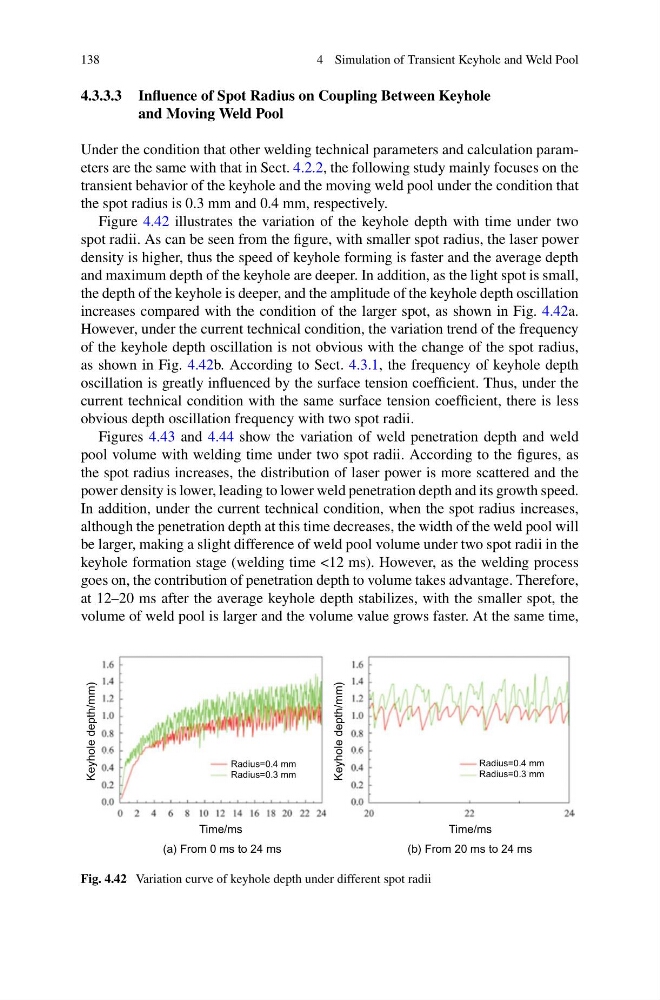
Figure 4.42 illustrates the variation of the keyhole depth with time under two
spot radii. As can be seen from the figure, with smaller spot radius, the laser power
density is higher, thus the speed of keyhole forming is faster and the average depth
and maximum depth of the keyhole are deeper. In addition, as the light spot is small,
the depth of the keyhole is deeper, and the amplitude of the keyhole depth oscillation
increases compared with the condition of the larger spot, as shown in Fig. 4.42a.
However, under the current technical condition, the variation trend of the frequency
of the keyhole depth oscillation is not obvious with the change of the spot radius,
as shown in Fig. 4.42b. According to Sect. 4.3.1, the frequency of keyhole depth
oscillation is greatly influenced by the surface tension coefficient. Thus, under the
current technical condition with the same surface tension coefficient, there is less
obvious depth oscillation frequency with two spot radii.
Figures 4.43 and 4.44 show the variation of weld penetration depth and weld
pool volume with welding time under two spot radii. According to the figures, as
the spot radius increases, the distribution of laser power is more scattered and the
power density is lower, leading to lower weld penetration depth and its growth speed.
In addition, under the current technical condition, when the spot radius increases,
although the penetration depth at this time decreases, the width of the weld pool will
be larger, making a slight difference of weld pool volume under two spot radii in the
keyhole formation stage (welding time <12 ms). However, as the welding process
goes on, the contribution of penetration depth to volume takes advantage. Therefore,
at 12–20 ms after the average keyhole depth stabilizes, with the smaller spot, the
volume of weld pool is larger and the volume value grows faster. At the same time,
Time/ms
Time/ms
Keyhole depth/mm)
Keyhole depth/mm)
(a) From 0 ms to 24 ms
(b) From 20 ms to 24 ms
Radius=0.4 mm
Radius=0.3 mm
Radius=0.4 mm
Radius=0.3 mm
Fig. 4.42 Variation curve of keyhole depth under different spot radii
4 Simulation of Transient Keyhole and Weld Pool
4.3.3.3 Influence of Spot Radius on Coupling Between Keyhole
and Moving Weld Pool
Under the condition that other welding technical parameters and calculation parameters are the same with that in Sect. 4.2.2, the following study mainly focuses on the
transient behavior of the keyhole and the moving weld pool under the condition that
the spot radius is 0.3 mm and 0.4 mm, respectively.
Figure 4.42 illustrates the variation of the keyhole depth with time under two
spot radii. As can be seen from the figure, with smaller spot radius, the laser power
density is higher, thus the speed of keyhole forming is faster and the average depth
and maximum depth of the keyhole are deeper. In addition, as the light spot is small,
the depth of the keyhole is deeper, and the amplitude of the keyhole depth oscillation
increases compared with the condition of the larger spot, as shown in Fig. 4.42a.
However, under the current technical condition, the variation trend of the frequency
of the keyhole depth oscillation is not obvious with the change of the spot radius,
as shown in Fig. 4.42b. According to Sect. 4.3.1, the frequency of keyhole depth
oscillation is greatly influenced by the surface tension coefficient. Thus, under the
current technical condition with the same surface tension coefficient, there is less
obvious depth oscillation frequency with two spot radii.
Figures 4.43 and 4.44 show the variation of weld penetration depth and weld
pool volume with welding time under two spot radii. According to the figures, as
the spot radius increases, the distribution of laser power is more scattered and the
power density is lower, leading to lower weld penetration depth and its growth speed.
In addition, under the current technical condition, when the spot radius increases,
although the penetration depth at this time decreases, the width of the weld pool will
be larger, making a slight difference of weld pool volume under two spot radii in the
keyhole formation stage (welding time <12 ms). However, as the welding process
goes on, the contribution of penetration depth to volume takes advantage. Therefore,
at 12–20 ms after the average keyhole depth stabilizes, with the smaller spot, the
volume of weld pool is larger and the volume value grows faster. At the same time,
Time/ms
Time/ms
Keyhole depth/mm)
Keyhole depth/mm)
(a) From 0 ms to 24 ms
(b) From 20 ms to 24 ms
Radius=0.4 mm
Radius=0.3 mm
Radius=0.4 mm
Radius=0.3 mm
Fig. 4.42 Variation curve of keyhole depth under different spot radii