

4.3 Effects of Physical Factors on the Coupling Behavior
137
Time/ms
(a)
(b)
Time/ms
Keyhole depth/mm)
Keyhole depth/mm)
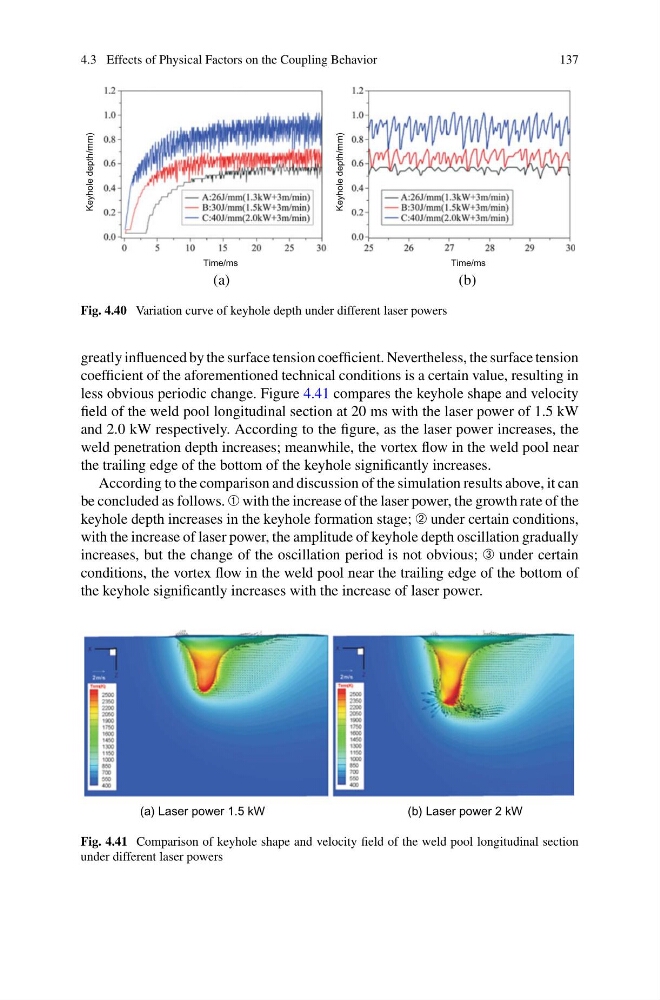
Fig. 4.40 Variation curve of keyhole depth under different laser powers
greatly influenced by the surface tension coefficient. Nevertheless, the surface tension
coefficient of the aforementioned technical conditions is a certain value, resulting in
less obvious periodic change. Figure 4.41 compares the keyhole shape and velocity
field of the weld pool longitudinal section at 20 ms with the laser power of 1.5 kW
and 2.0 kW respectively. According to the figure, as the laser power increases, the
weld penetration depth increases; meanwhile, the vortex flow in the weld pool near
the trailing edge of the bottom of the keyhole significantly increases.
According to the comparison and discussion of the simulation results above, it can
be concluded as follows. ➀ with the increase of the laser power, the growth rate of the
keyhole depth increases in the keyhole formation stage; ➁ under certain conditions,
with the increase of laser power, the amplitude of keyhole depth oscillation gradually
increases, but the change of the oscillation period is not obvious; ➂ under certain
conditions, the vortex flow in the weld pool near the trailing edge of the bottom of
the keyhole significantly increases with the increase of laser power.
(a) Laser power 1.5 kW
(b) Laser power 2 kW
Fig. 4.41 Comparison of keyhole shape and velocity field of the weld pool longitudinal section
under different laser powers
137
Time/ms
(a)
(b)
Time/ms
Keyhole depth/mm)
Keyhole depth/mm)
Fig. 4.40 Variation curve of keyhole depth under different laser powers
greatly influenced by the surface tension coefficient. Nevertheless, the surface tension
coefficient of the aforementioned technical conditions is a certain value, resulting in
less obvious periodic change. Figure 4.41 compares the keyhole shape and velocity
field of the weld pool longitudinal section at 20 ms with the laser power of 1.5 kW
and 2.0 kW respectively. According to the figure, as the laser power increases, the
weld penetration depth increases; meanwhile, the vortex flow in the weld pool near
the trailing edge of the bottom of the keyhole significantly increases.
According to the comparison and discussion of the simulation results above, it can
be concluded as follows. ➀ with the increase of the laser power, the growth rate of the
keyhole depth increases in the keyhole formation stage; ➁ under certain conditions,
with the increase of laser power, the amplitude of keyhole depth oscillation gradually
increases, but the change of the oscillation period is not obvious; ➂ under certain
conditions, the vortex flow in the weld pool near the trailing edge of the bottom of
the keyhole significantly increases with the increase of laser power.
(a) Laser power 1.5 kW
(b) Laser power 2 kW
Fig. 4.41 Comparison of keyhole shape and velocity field of the weld pool longitudinal section
under different laser powers