

4.3 Effects of Physical Factors on the Coupling Behavior
139
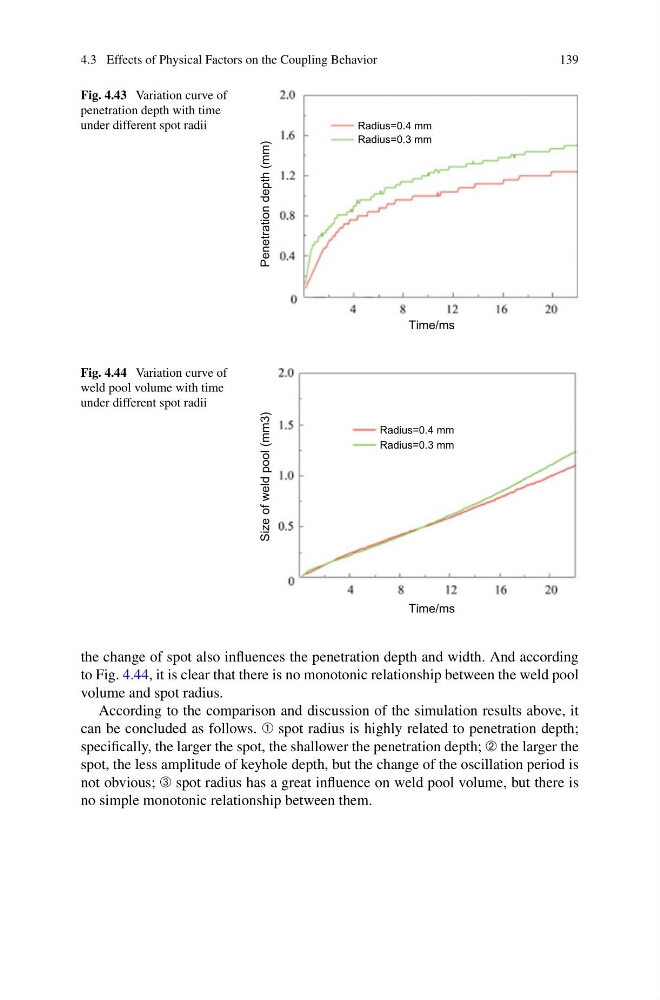
Fig. 4.43 Variation curve of
penetration depth with time
under different spot radii
Time/ms
Penetration depth (mm)
Radius=0.4 mm
Radius=0.3 mm
Fig. 4.44 Variation curve of
weld pool volume with time
under different spot radii
Time/ms
Size of weld pool (mm3)
Radius=0.4 mm
Radius=0.3 mm
the change of spot also influences the penetration depth and width. And according
to Fig. 4.44, it is clear that there is no monotonic relationship between the weld pool
volume and spot radius.
According to the comparison and discussion of the simulation results above, it
can be concluded as follows. ➀ spot radius is highly related to penetration depth;
specifically, the larger the spot, the shallower the penetration depth; ➁ the larger the
spot, the less amplitude of keyhole depth, but the change of the oscillation period is
not obvious; ➂ spot radius has a great influence on weld pool volume, but there is
no simple monotonic relationship between them.
139
Fig. 4.43 Variation curve of
penetration depth with time
under different spot radii
Time/ms
Penetration depth (mm)
Radius=0.4 mm
Radius=0.3 mm
Fig. 4.44 Variation curve of
weld pool volume with time
under different spot radii
Time/ms
Size of weld pool (mm3)
Radius=0.4 mm
Radius=0.3 mm
the change of spot also influences the penetration depth and width. And according
to Fig. 4.44, it is clear that there is no monotonic relationship between the weld pool
volume and spot radius.
According to the comparison and discussion of the simulation results above, it
can be concluded as follows. ➀ spot radius is highly related to penetration depth;
specifically, the larger the spot, the shallower the penetration depth; ➁ the larger the
spot, the less amplitude of keyhole depth, but the change of the oscillation period is
not obvious; ➂ spot radius has a great influence on weld pool volume, but there is
no simple monotonic relationship between them.