

134
4 Simulation of Transient Keyhole and Weld Pool
Time/ms
Small kinematic viscosity
Large kinematic viscosity
Small kinematic viscosity
Large kinematic viscosity
Time/ms
Keyhole depth/mm)
Keyhole depth/mm)
(a)
(b)
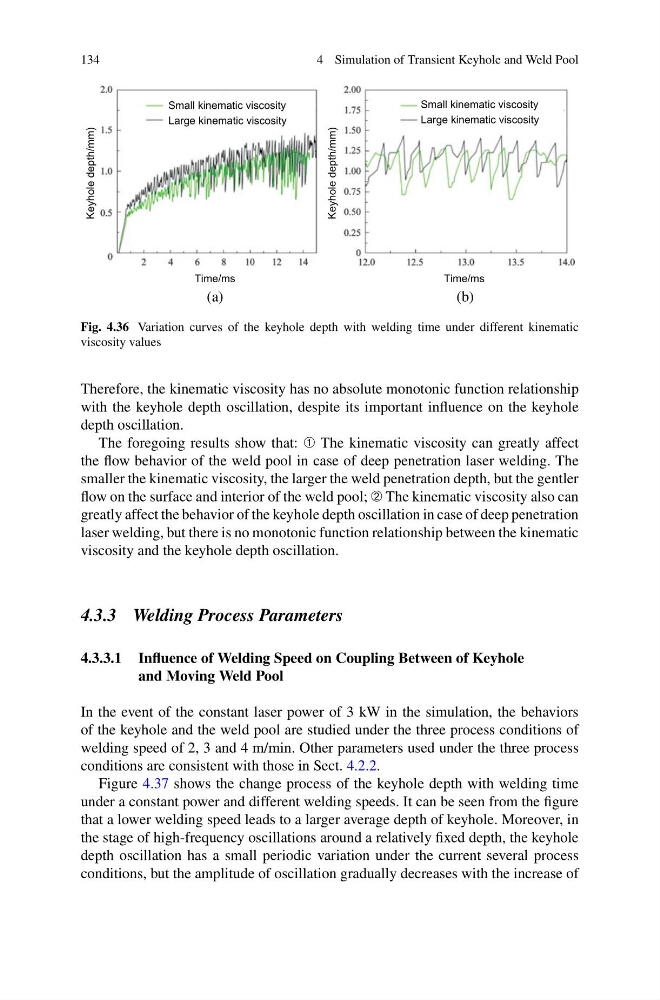
Fig. 4.36 Variation curves of the keyhole depth with welding time under different kinematic
viscosity values
Therefore, the kinematic viscosity has no absolute monotonic function relationship
with the keyhole depth oscillation, despite its important influence on the keyhole
depth oscillation.
The foregoing results show that: ➀ The kinematic viscosity can greatly affect
the flow behavior of the weld pool in case of deep penetration laser welding. The
smaller the kinematic viscosity, the larger the weld penetration depth, but the gentler
flow on the surface and interior of the weld pool; ➁ The kinematic viscosity also can
greatly affect the behavior of the keyhole depth oscillation in case of deep penetration
laser welding, but there is no monotonic function relationship between the kinematic
viscosity and the keyhole depth oscillation.
4.3.3 Welding Process Parameters
4.3.3.1 Influence of Welding Speed on Coupling Between of Keyhole
and Moving Weld Pool
In the event of the constant laser power of 3 kW in the simulation, the behaviors
of the keyhole and the weld pool are studied under the three process conditions of
welding speed of 2, 3 and 4 m/min. Other parameters used under the three process
conditions are consistent with those in Sect. 4.2.2.
Figure 4.37 shows the change process of the keyhole depth with welding time
under a constant power and different welding speeds. It can be seen from the figure
that a lower welding speed leads to a larger average depth of keyhole. Moreover, in
the stage of high-frequency oscillations around a relatively fixed depth, the keyhole
depth oscillation has a small periodic variation under the current several process
conditions, but the amplitude of oscillation gradually decreases with the increase of
4 Simulation of Transient Keyhole and Weld Pool
Time/ms
Small kinematic viscosity
Large kinematic viscosity
Small kinematic viscosity
Large kinematic viscosity
Time/ms
Keyhole depth/mm)
Keyhole depth/mm)
(a)
(b)
Fig. 4.36 Variation curves of the keyhole depth with welding time under different kinematic
viscosity values
Therefore, the kinematic viscosity has no absolute monotonic function relationship
with the keyhole depth oscillation, despite its important influence on the keyhole
depth oscillation.
The foregoing results show that: ➀ The kinematic viscosity can greatly affect
the flow behavior of the weld pool in case of deep penetration laser welding. The
smaller the kinematic viscosity, the larger the weld penetration depth, but the gentler
flow on the surface and interior of the weld pool; ➁ The kinematic viscosity also can
greatly affect the behavior of the keyhole depth oscillation in case of deep penetration
laser welding, but there is no monotonic function relationship between the kinematic
viscosity and the keyhole depth oscillation.
4.3.3 Welding Process Parameters
4.3.3.1 Influence of Welding Speed on Coupling Between of Keyhole
and Moving Weld Pool
In the event of the constant laser power of 3 kW in the simulation, the behaviors
of the keyhole and the weld pool are studied under the three process conditions of
welding speed of 2, 3 and 4 m/min. Other parameters used under the three process
conditions are consistent with those in Sect. 4.2.2.
Figure 4.37 shows the change process of the keyhole depth with welding time
under a constant power and different welding speeds. It can be seen from the figure
that a lower welding speed leads to a larger average depth of keyhole. Moreover, in
the stage of high-frequency oscillations around a relatively fixed depth, the keyhole
depth oscillation has a small periodic variation under the current several process
conditions, but the amplitude of oscillation gradually decreases with the increase of