

4.3 Effects of Physical Factors on the Coupling Behavior
133
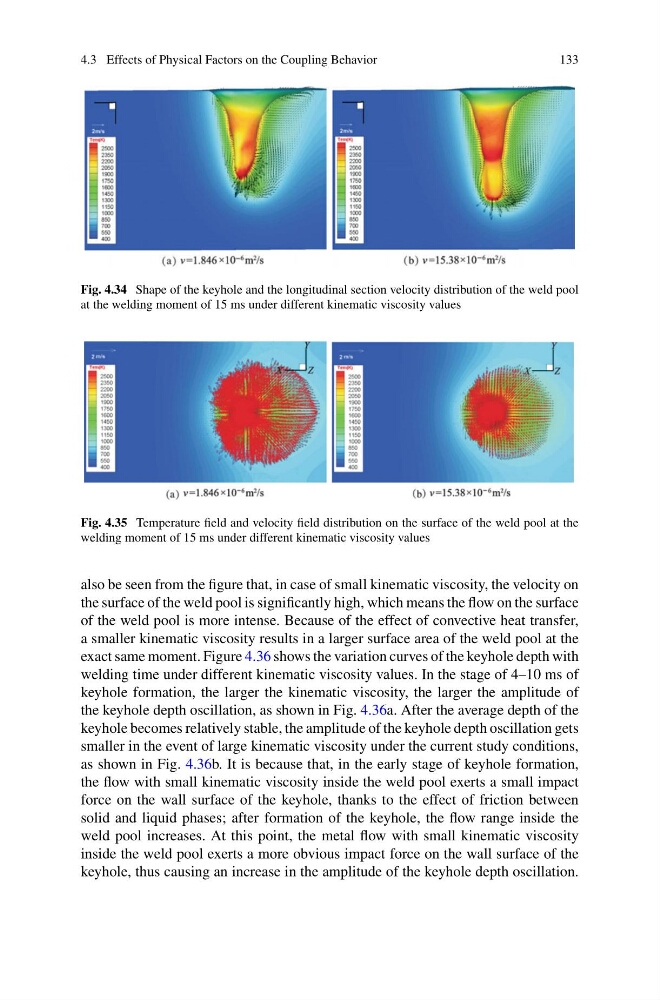
Fig. 4.34 Shape of the keyhole and the longitudinal section velocity distribution of the weld pool
at the welding moment of 15 ms under different kinematic viscosity values
Fig. 4.35 Temperature field and velocity field distribution on the surface of the weld pool at the
welding moment of 15 ms under different kinematic viscosity values
also be seen from the figure that, in case of small kinematic viscosity, the velocity on
the surface of the weld pool is significantly high, which means the flow on the surface
of the weld pool is more intense. Because of the effect of convective heat transfer,
a smaller kinematic viscosity results in a larger surface area of the weld pool at the
exact same moment. Figure 4.36 shows the variation curves of the keyhole depth with
welding time under different kinematic viscosity values. In the stage of 4–10 ms of
keyhole formation, the larger the kinematic viscosity, the larger the amplitude of
the keyhole depth oscillation, as shown in Fig. 4.36a. After the average depth of the
keyhole becomes relatively stable, the amplitude of the keyhole depth oscillation gets
smaller in the event of large kinematic viscosity under the current study conditions,
as shown in Fig. 4.36b. It is because that, in the early stage of keyhole formation,
the flow with small kinematic viscosity inside the weld pool exerts a small impact
force on the wall surface of the keyhole, thanks to the effect of friction between
solid and liquid phases; after formation of the keyhole, the flow range inside the
weld pool increases. At this point, the metal flow with small kinematic viscosity
inside the weld pool exerts a more obvious impact force on the wall surface of the
keyhole, thus causing an increase in the amplitude of the keyhole depth oscillation.
133
Fig. 4.34 Shape of the keyhole and the longitudinal section velocity distribution of the weld pool
at the welding moment of 15 ms under different kinematic viscosity values
Fig. 4.35 Temperature field and velocity field distribution on the surface of the weld pool at the
welding moment of 15 ms under different kinematic viscosity values
also be seen from the figure that, in case of small kinematic viscosity, the velocity on
the surface of the weld pool is significantly high, which means the flow on the surface
of the weld pool is more intense. Because of the effect of convective heat transfer,
a smaller kinematic viscosity results in a larger surface area of the weld pool at the
exact same moment. Figure 4.36 shows the variation curves of the keyhole depth with
welding time under different kinematic viscosity values. In the stage of 4–10 ms of
keyhole formation, the larger the kinematic viscosity, the larger the amplitude of
the keyhole depth oscillation, as shown in Fig. 4.36a. After the average depth of the
keyhole becomes relatively stable, the amplitude of the keyhole depth oscillation gets
smaller in the event of large kinematic viscosity under the current study conditions,
as shown in Fig. 4.36b. It is because that, in the early stage of keyhole formation,
the flow with small kinematic viscosity inside the weld pool exerts a small impact
force on the wall surface of the keyhole, thanks to the effect of friction between
solid and liquid phases; after formation of the keyhole, the flow range inside the
weld pool increases. At this point, the metal flow with small kinematic viscosity
inside the weld pool exerts a more obvious impact force on the wall surface of the
keyhole, thus causing an increase in the amplitude of the keyhole depth oscillation.