

4.3 Effects of Physical Factors on the Coupling Behavior
131
Fig. 4.31 Temperature field and velocity field distribution on the surface of the weld pool at the
welding moment of 15 ms under different thermal conductivity values
but the greater the temperature gradient on the surface of the weld pool, as shown in
Fig. 4.31.
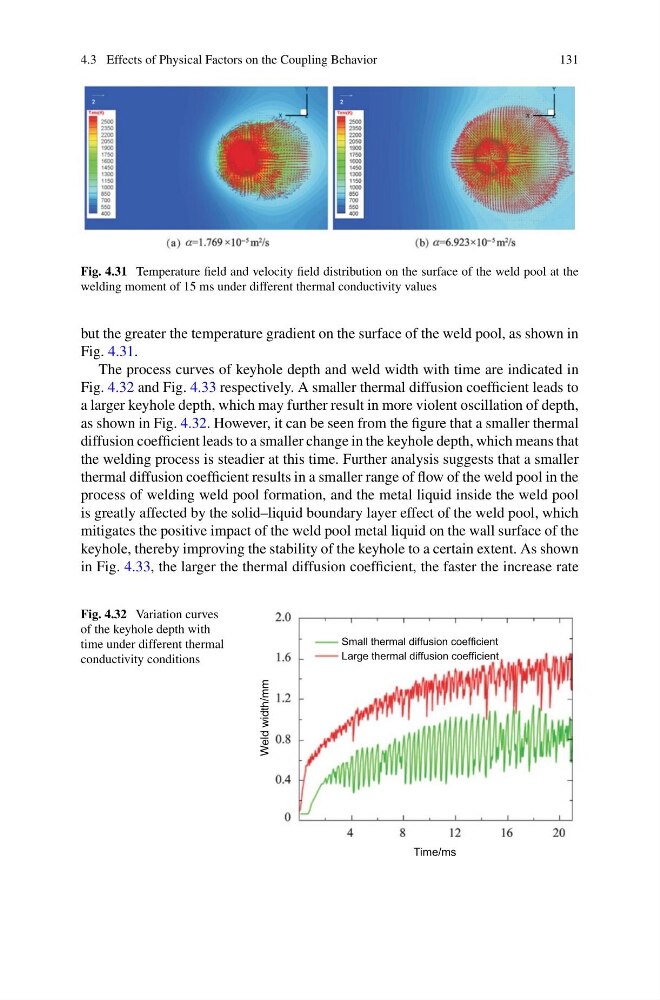
The process curves of keyhole depth and weld width with time are indicated in
Fig. 4.32 and Fig. 4.33 respectively. A smaller thermal diffusion coefficient leads to
a larger keyhole depth, which may further result in more violent oscillation of depth,
as shown in Fig. 4.32. However, it can be seen from the figure that a smaller thermal
diffusion coefficient leads to a smaller change in the keyhole depth, which means that
the welding process is steadier at this time. Further analysis suggests that a smaller
thermal diffusion coefficient results in a smaller range of flow of the weld pool in the
process of welding weld pool formation, and the metal liquid inside the weld pool
is greatly affected by the solid–liquid boundary layer effect of the weld pool, which
mitigates the positive impact of the weld pool metal liquid on the wall surface of the
keyhole, thereby improving the stability of the keyhole to a certain extent. As shown
in Fig. 4.33, the larger the thermal diffusion coefficient, the faster the increase rate
Fig. 4.32 Variation curves
of the keyhole depth with
time under different thermal
conductivity conditions
Time/ms
Small thermal diffusion coefficient
Large thermal diffusion coefficient
Weld width/mm
131
Fig. 4.31 Temperature field and velocity field distribution on the surface of the weld pool at the
welding moment of 15 ms under different thermal conductivity values
but the greater the temperature gradient on the surface of the weld pool, as shown in
Fig. 4.31.
The process curves of keyhole depth and weld width with time are indicated in
Fig. 4.32 and Fig. 4.33 respectively. A smaller thermal diffusion coefficient leads to
a larger keyhole depth, which may further result in more violent oscillation of depth,
as shown in Fig. 4.32. However, it can be seen from the figure that a smaller thermal
diffusion coefficient leads to a smaller change in the keyhole depth, which means that
the welding process is steadier at this time. Further analysis suggests that a smaller
thermal diffusion coefficient results in a smaller range of flow of the weld pool in the
process of welding weld pool formation, and the metal liquid inside the weld pool
is greatly affected by the solid–liquid boundary layer effect of the weld pool, which
mitigates the positive impact of the weld pool metal liquid on the wall surface of the
keyhole, thereby improving the stability of the keyhole to a certain extent. As shown
in Fig. 4.33, the larger the thermal diffusion coefficient, the faster the increase rate
Fig. 4.32 Variation curves
of the keyhole depth with
time under different thermal
conductivity conditions
Time/ms
Small thermal diffusion coefficient
Large thermal diffusion coefficient
Weld width/mm