

130
4 Simulation of Transient Keyhole and Weld Pool
regardless of multiple reflection or direct incidence; ➁ Fresnel absorption is closely
associated with the angle of incidence, and the beams incident along the wall surface
of the keyhole tend to reflect repeatedly inside the keyhole. Such beams are usually
far from the center of the light spot, and thus carry less energy. Consequently, the
multiple reflection absorption of such beams contributes little to the energy absorption
of the wall surface of the keyhole.
4.3.2 Thermophysical Parameters
4.3.2.1 Influence of Thermal Diffusion Coefficient on Coupling
Between Keyhole and Moving Weld Pool
This section mainly studies the influence of thermal diffusion coefficient α (α =
k/(ρc p )) on the transient coupling between a keyhole and moving weld pool during
deep penetration laser welding. The following two cases of α = 1.769 × 10
–5 m
2 /s
and α = 6.923 × 10
–5 m
2 /s are mainly considered. Other parameters involved in the
simulation process are consistent with those in Sect. 4.2.2.
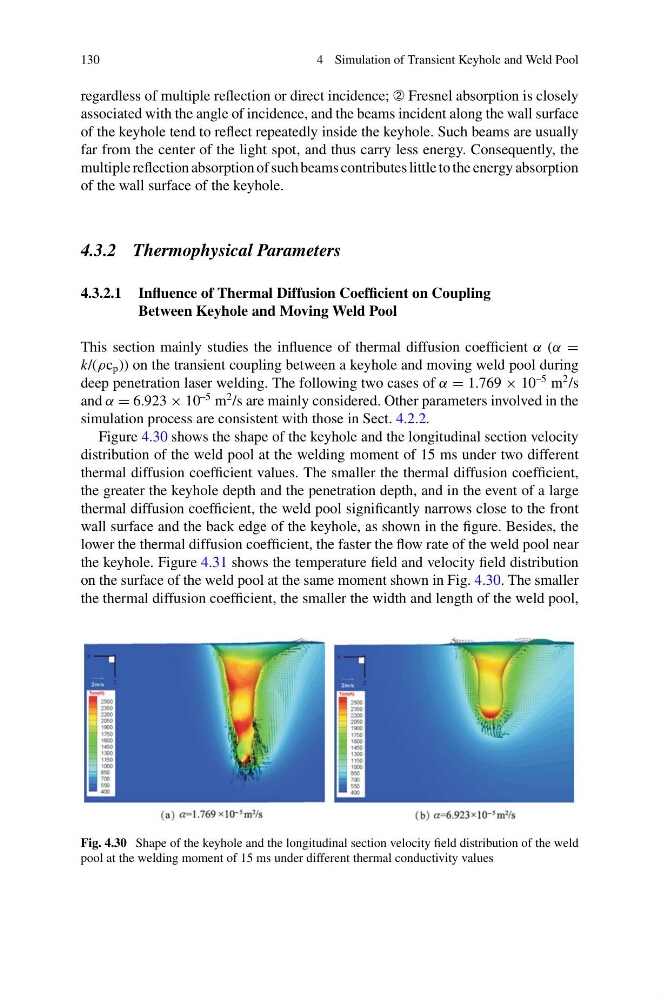
Figure 4.30 shows the shape of the keyhole and the longitudinal section velocity
distribution of the weld pool at the welding moment of 15 ms under two different
thermal diffusion coefficient values. The smaller the thermal diffusion coefficient,
the greater the keyhole depth and the penetration depth, and in the event of a large
thermal diffusion coefficient, the weld pool significantly narrows close to the front
wall surface and the back edge of the keyhole, as shown in the figure. Besides, the
lower the thermal diffusion coefficient, the faster the flow rate of the weld pool near
the keyhole. Figure 4.31 shows the temperature field and velocity field distribution
on the surface of the weld pool at the same moment shown in Fig. 4.30. The smaller
the thermal diffusion coefficient, the smaller the width and length of the weld pool,
Fig. 4.30 Shape of the keyhole and the longitudinal section velocity field distribution of the weld
pool at the welding moment of 15 ms under different thermal conductivity values
4 Simulation of Transient Keyhole and Weld Pool
regardless of multiple reflection or direct incidence; ➁ Fresnel absorption is closely
associated with the angle of incidence, and the beams incident along the wall surface
of the keyhole tend to reflect repeatedly inside the keyhole. Such beams are usually
far from the center of the light spot, and thus carry less energy. Consequently, the
multiple reflection absorption of such beams contributes little to the energy absorption
of the wall surface of the keyhole.
4.3.2 Thermophysical Parameters
4.3.2.1 Influence of Thermal Diffusion Coefficient on Coupling
Between Keyhole and Moving Weld Pool
This section mainly studies the influence of thermal diffusion coefficient α (α =
k/(ρc p )) on the transient coupling between a keyhole and moving weld pool during
deep penetration laser welding. The following two cases of α = 1.769 × 10
–5 m
2 /s
and α = 6.923 × 10
–5 m
2 /s are mainly considered. Other parameters involved in the
simulation process are consistent with those in Sect. 4.2.2.
Figure 4.30 shows the shape of the keyhole and the longitudinal section velocity
distribution of the weld pool at the welding moment of 15 ms under two different
thermal diffusion coefficient values. The smaller the thermal diffusion coefficient,
the greater the keyhole depth and the penetration depth, and in the event of a large
thermal diffusion coefficient, the weld pool significantly narrows close to the front
wall surface and the back edge of the keyhole, as shown in the figure. Besides, the
lower the thermal diffusion coefficient, the faster the flow rate of the weld pool near
the keyhole. Figure 4.31 shows the temperature field and velocity field distribution
on the surface of the weld pool at the same moment shown in Fig. 4.30. The smaller
the thermal diffusion coefficient, the smaller the width and length of the weld pool,
Fig. 4.30 Shape of the keyhole and the longitudinal section velocity field distribution of the weld
pool at the welding moment of 15 ms under different thermal conductivity values