

4.3 Effects of Physical Factors on the Coupling Behavior
129
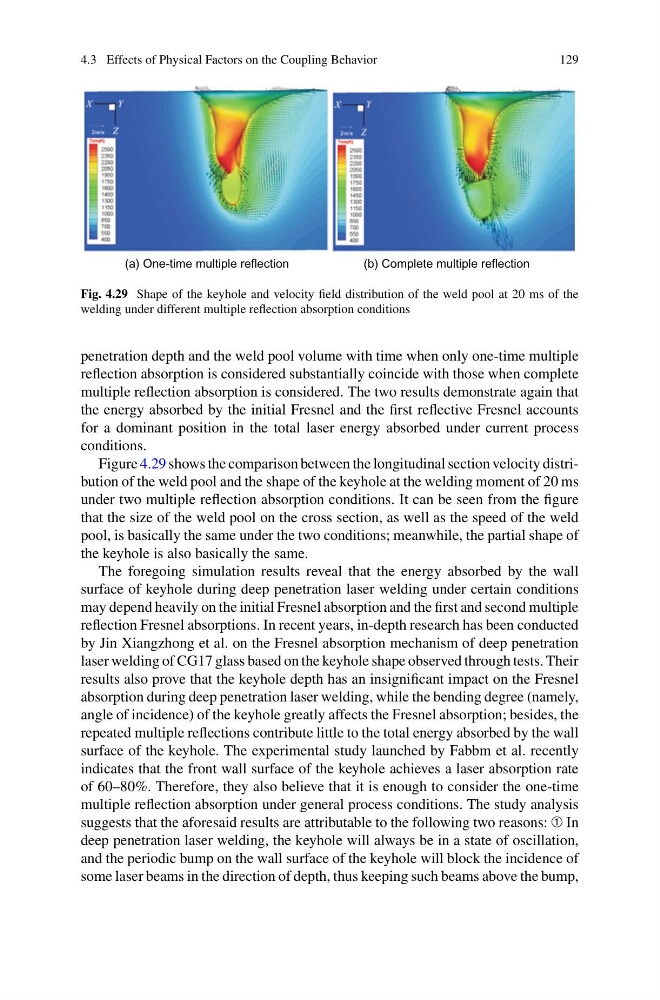
(a) One-time multiple reflection
(b) Complete multiple reflection
Fig. 4.29 Shape of the keyhole and velocity field distribution of the weld pool at 20 ms of the
welding under different multiple reflection absorption conditions
penetration depth and the weld pool volume with time when only one-time multiple
reflection absorption is considered substantially coincide with those when complete
multiple reflection absorption is considered. The two results demonstrate again that
the energy absorbed by the initial Fresnel and the first reflective Fresnel accounts
for a dominant position in the total laser energy absorbed under current process
conditions.
Figure 4.29 shows the comparison between the longitudinal section velocity distribution of the weld pool and the shape of the keyhole at the welding moment of 20 ms
under two multiple reflection absorption conditions. It can be seen from the figure
that the size of the weld pool on the cross section, as well as the speed of the weld
pool, is basically the same under the two conditions; meanwhile, the partial shape of
the keyhole is also basically the same.
The foregoing simulation results reveal that the energy absorbed by the wall
surface of keyhole during deep penetration laser welding under certain conditions
may depend heavily on the initial Fresnel absorption and the first and second multiple
reflection Fresnel absorptions. In recent years, in-depth research has been conducted
by Jin Xiangzhong et al. on the Fresnel absorption mechanism of deep penetration
laser welding of CG17 glass based on the keyhole shape observed through tests. Their
results also prove that the keyhole depth has an insignificant impact on the Fresnel
absorption during deep penetration laser welding, while the bending degree (namely,
angle of incidence) of the keyhole greatly affects the Fresnel absorption; besides, the
repeated multiple reflections contribute little to the total energy absorbed by the wall
surface of the keyhole. The experimental study launched by Fabbm et al. recently
indicates that the front wall surface of the keyhole achieves a laser absorption rate
of 60–80%. Therefore, they also believe that it is enough to consider the one-time
multiple reflection absorption under general process conditions. The study analysis
suggests that the aforesaid results are attributable to the following two reasons: ➀ In
deep penetration laser welding, the keyhole will always be in a state of oscillation,
and the periodic bump on the wall surface of the keyhole will block the incidence of
some laser beams in the direction of depth, thus keeping such beams above the bump,
129
(a) One-time multiple reflection
(b) Complete multiple reflection
Fig. 4.29 Shape of the keyhole and velocity field distribution of the weld pool at 20 ms of the
welding under different multiple reflection absorption conditions
penetration depth and the weld pool volume with time when only one-time multiple
reflection absorption is considered substantially coincide with those when complete
multiple reflection absorption is considered. The two results demonstrate again that
the energy absorbed by the initial Fresnel and the first reflective Fresnel accounts
for a dominant position in the total laser energy absorbed under current process
conditions.
Figure 4.29 shows the comparison between the longitudinal section velocity distribution of the weld pool and the shape of the keyhole at the welding moment of 20 ms
under two multiple reflection absorption conditions. It can be seen from the figure
that the size of the weld pool on the cross section, as well as the speed of the weld
pool, is basically the same under the two conditions; meanwhile, the partial shape of
the keyhole is also basically the same.
The foregoing simulation results reveal that the energy absorbed by the wall
surface of keyhole during deep penetration laser welding under certain conditions
may depend heavily on the initial Fresnel absorption and the first and second multiple
reflection Fresnel absorptions. In recent years, in-depth research has been conducted
by Jin Xiangzhong et al. on the Fresnel absorption mechanism of deep penetration
laser welding of CG17 glass based on the keyhole shape observed through tests. Their
results also prove that the keyhole depth has an insignificant impact on the Fresnel
absorption during deep penetration laser welding, while the bending degree (namely,
angle of incidence) of the keyhole greatly affects the Fresnel absorption; besides, the
repeated multiple reflections contribute little to the total energy absorbed by the wall
surface of the keyhole. The experimental study launched by Fabbm et al. recently
indicates that the front wall surface of the keyhole achieves a laser absorption rate
of 60–80%. Therefore, they also believe that it is enough to consider the one-time
multiple reflection absorption under general process conditions. The study analysis
suggests that the aforesaid results are attributable to the following two reasons: ➀ In
deep penetration laser welding, the keyhole will always be in a state of oscillation,
and the periodic bump on the wall surface of the keyhole will block the incidence of
some laser beams in the direction of depth, thus keeping such beams above the bump,