

4.3 Effects of Physical Factors on the Coupling Behavior
121
(a) With recoil pressure not considered
(b) With recoil pressure considered
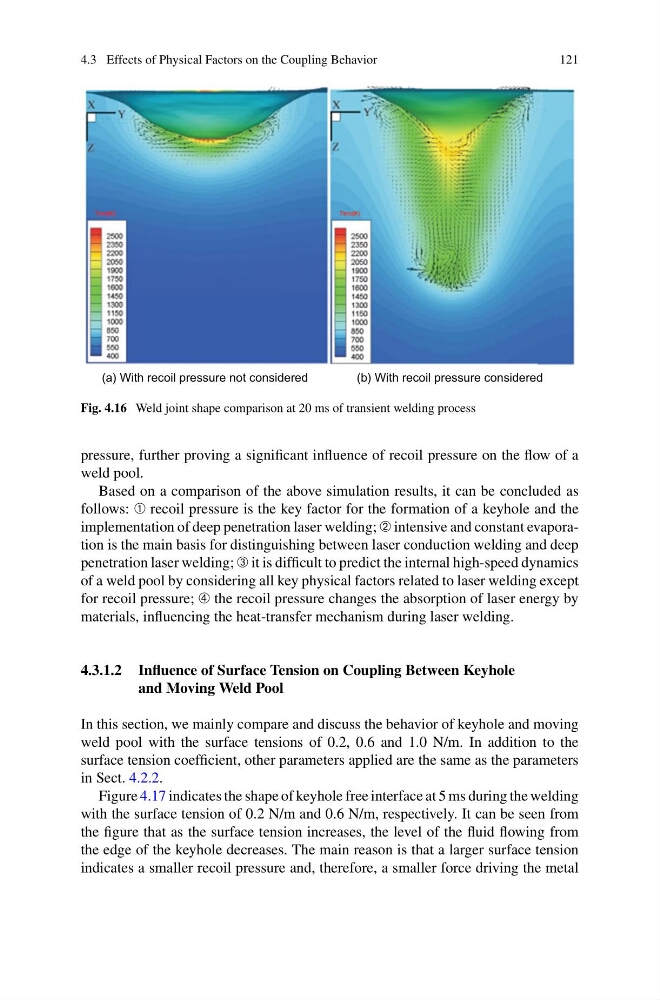
Fig. 4.16 Weld joint shape comparison at 20 ms of transient welding process
pressure, further proving a significant influence of recoil pressure on the flow of a
weld pool.
Based on a comparison of the above simulation results, it can be concluded as
follows: ➀ recoil pressure is the key factor for the formation of a keyhole and the
implementation of deep penetration laser welding; ➁ intensive and constant evaporation is the main basis for distinguishing between laser conduction welding and deep
penetration laser welding; ➂ it is difficult to predict the internal high-speed dynamics
of a weld pool by considering all key physical factors related to laser welding except
for recoil pressure; ➃ the recoil pressure changes the absorption of laser energy by
materials, influencing the heat-transfer mechanism during laser welding.
4.3.1.2 Influence of Surface Tension on Coupling Between Keyhole
and Moving Weld Pool
In this section, we mainly compare and discuss the behavior of keyhole and moving
weld pool with the surface tensions of 0.2, 0.6 and 1.0 N/m. In addition to the
surface tension coefficient, other parameters applied are the same as the parameters
in Sect. 4.2.2.
Figure 4.17 indicates the shape of keyhole free interface at 5 ms during the welding
with the surface tension of 0.2 N/m and 0.6 N/m, respectively. It can be seen from
the figure that as the surface tension increases, the level of the fluid flowing from
the edge of the keyhole decreases. The main reason is that a larger surface tension
indicates a smaller recoil pressure and, therefore, a smaller force driving the metal
121
(a) With recoil pressure not considered
(b) With recoil pressure considered
Fig. 4.16 Weld joint shape comparison at 20 ms of transient welding process
pressure, further proving a significant influence of recoil pressure on the flow of a
weld pool.
Based on a comparison of the above simulation results, it can be concluded as
follows: ➀ recoil pressure is the key factor for the formation of a keyhole and the
implementation of deep penetration laser welding; ➁ intensive and constant evaporation is the main basis for distinguishing between laser conduction welding and deep
penetration laser welding; ➂ it is difficult to predict the internal high-speed dynamics
of a weld pool by considering all key physical factors related to laser welding except
for recoil pressure; ➃ the recoil pressure changes the absorption of laser energy by
materials, influencing the heat-transfer mechanism during laser welding.
4.3.1.2 Influence of Surface Tension on Coupling Between Keyhole
and Moving Weld Pool
In this section, we mainly compare and discuss the behavior of keyhole and moving
weld pool with the surface tensions of 0.2, 0.6 and 1.0 N/m. In addition to the
surface tension coefficient, other parameters applied are the same as the parameters
in Sect. 4.2.2.
Figure 4.17 indicates the shape of keyhole free interface at 5 ms during the welding
with the surface tension of 0.2 N/m and 0.6 N/m, respectively. It can be seen from
the figure that as the surface tension increases, the level of the fluid flowing from
the edge of the keyhole decreases. The main reason is that a larger surface tension
indicates a smaller recoil pressure and, therefore, a smaller force driving the metal