

120
4 Simulation of Transient Keyhole and Weld Pool
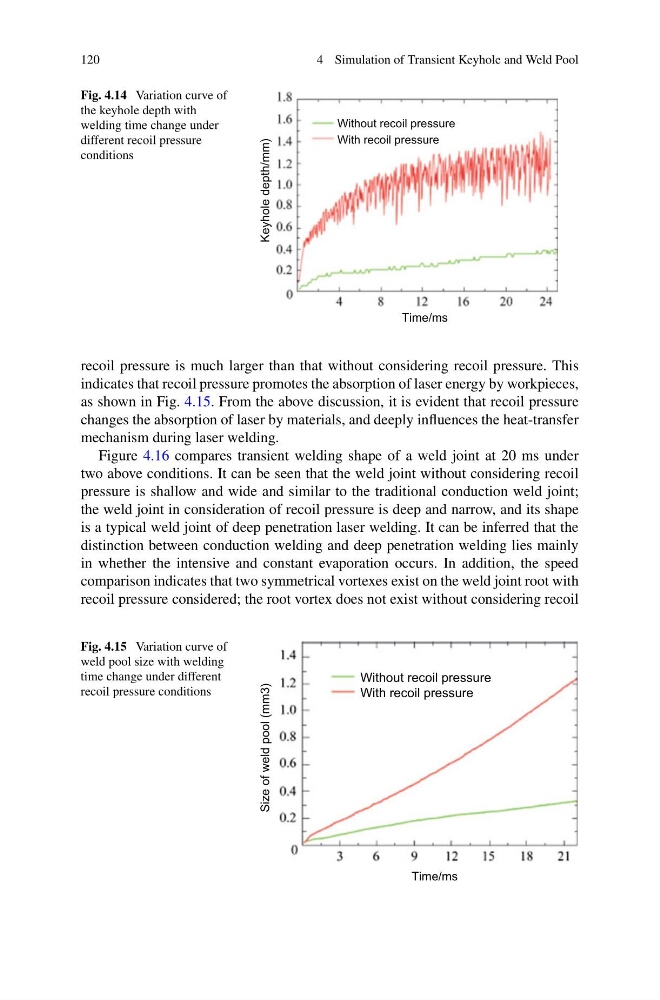
Fig. 4.14 Variation curve of
the keyhole depth with
welding time change under
different recoil pressure
conditions
Without recoil pressure
With recoil pressure
Time/ms
Keyhole depth/mm)
recoil pressure is much larger than that without considering recoil pressure. This
indicates that recoil pressure promotes the absorption of laser energy by workpieces,
as shown in Fig. 4.15. From the above discussion, it is evident that recoil pressure
changes the absorption of laser by materials, and deeply influences the heat-transfer
mechanism during laser welding.
Figure 4.16 compares transient welding shape of a weld joint at 20 ms under
two above conditions. It can be seen that the weld joint without considering recoil
pressure is shallow and wide and similar to the traditional conduction weld joint;
the weld joint in consideration of recoil pressure is deep and narrow, and its shape
is a typical weld joint of deep penetration laser welding. It can be inferred that the
distinction between conduction welding and deep penetration welding lies mainly
in whether the intensive and constant evaporation occurs. In addition, the speed
comparison indicates that two symmetrical vortexes exist on the weld joint root with
recoil pressure considered; the root vortex does not exist without considering recoil
Fig. 4.15 Variation curve of
weld pool size with welding
time change under different
recoil pressure conditions
Without recoil pressure
With recoil pressure
Time/ms
Size of weld pool (mm3)
4 Simulation of Transient Keyhole and Weld Pool
Fig. 4.14 Variation curve of
the keyhole depth with
welding time change under
different recoil pressure
conditions
Without recoil pressure
With recoil pressure
Time/ms
Keyhole depth/mm)
recoil pressure is much larger than that without considering recoil pressure. This
indicates that recoil pressure promotes the absorption of laser energy by workpieces,
as shown in Fig. 4.15. From the above discussion, it is evident that recoil pressure
changes the absorption of laser by materials, and deeply influences the heat-transfer
mechanism during laser welding.
Figure 4.16 compares transient welding shape of a weld joint at 20 ms under
two above conditions. It can be seen that the weld joint without considering recoil
pressure is shallow and wide and similar to the traditional conduction weld joint;
the weld joint in consideration of recoil pressure is deep and narrow, and its shape
is a typical weld joint of deep penetration laser welding. It can be inferred that the
distinction between conduction welding and deep penetration welding lies mainly
in whether the intensive and constant evaporation occurs. In addition, the speed
comparison indicates that two symmetrical vortexes exist on the weld joint root with
recoil pressure considered; the root vortex does not exist without considering recoil
Fig. 4.15 Variation curve of
weld pool size with welding
time change under different
recoil pressure conditions
Without recoil pressure
With recoil pressure
Time/ms
Size of weld pool (mm3)