

4.3 Effects of Physical Factors on the Coupling Behavior
119
(a) With recoil pressure not considered
(b) With recoil pressure considered
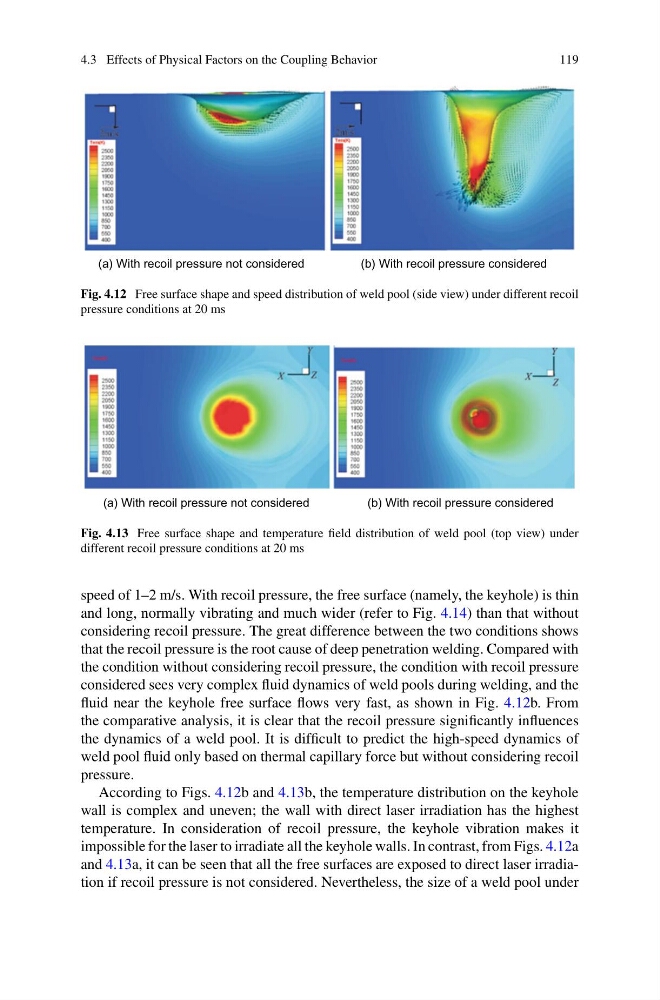
Fig. 4.12 Free surface shape and speed distribution of weld pool (side view) under different recoil
pressure conditions at 20 ms
(a) With recoil pressure not considered
(b) With recoil pressure considered
Fig. 4.13 Free surface shape and temperature field distribution of weld pool (top view) under
different recoil pressure conditions at 20 ms
speed of 1–2 m/s. With recoil pressure, the free surface (namely, the keyhole) is thin
and long, normally vibrating and much wider (refer to Fig. 4.14) than that without
considering recoil pressure. The great difference between the two conditions shows
that the recoil pressure is the root cause of deep penetration welding. Compared with
the condition without considering recoil pressure, the condition with recoil pressure
considered sees very complex fluid dynamics of weld pools during welding, and the
fluid near the keyhole free surface flows very fast, as shown in Fig. 4.12b. From
the comparative analysis, it is clear that the recoil pressure significantly influences
the dynamics of a weld pool. It is difficult to predict the high-speed dynamics of
weld pool fluid only based on thermal capillary force but without considering recoil
pressure.
According to Figs. 4.12b and 4.13b, the temperature distribution on the keyhole
wall is complex and uneven; the wall with direct laser irradiation has the highest
temperature. In consideration of recoil pressure, the keyhole vibration makes it
impossible for the laser to irradiate all the keyhole walls. In contrast, from Figs. 4.12a
and 4.13a, it can be seen that all the free surfaces are exposed to direct laser irradiation if recoil pressure is not considered. Nevertheless, the size of a weld pool under
119
(a) With recoil pressure not considered
(b) With recoil pressure considered
Fig. 4.12 Free surface shape and speed distribution of weld pool (side view) under different recoil
pressure conditions at 20 ms
(a) With recoil pressure not considered
(b) With recoil pressure considered
Fig. 4.13 Free surface shape and temperature field distribution of weld pool (top view) under
different recoil pressure conditions at 20 ms
speed of 1–2 m/s. With recoil pressure, the free surface (namely, the keyhole) is thin
and long, normally vibrating and much wider (refer to Fig. 4.14) than that without
considering recoil pressure. The great difference between the two conditions shows
that the recoil pressure is the root cause of deep penetration welding. Compared with
the condition without considering recoil pressure, the condition with recoil pressure
considered sees very complex fluid dynamics of weld pools during welding, and the
fluid near the keyhole free surface flows very fast, as shown in Fig. 4.12b. From
the comparative analysis, it is clear that the recoil pressure significantly influences
the dynamics of a weld pool. It is difficult to predict the high-speed dynamics of
weld pool fluid only based on thermal capillary force but without considering recoil
pressure.
According to Figs. 4.12b and 4.13b, the temperature distribution on the keyhole
wall is complex and uneven; the wall with direct laser irradiation has the highest
temperature. In consideration of recoil pressure, the keyhole vibration makes it
impossible for the laser to irradiate all the keyhole walls. In contrast, from Figs. 4.12a
and 4.13a, it can be seen that all the free surfaces are exposed to direct laser irradiation if recoil pressure is not considered. Nevertheless, the size of a weld pool under