

118
4 Simulation of Transient Keyhole and Weld Pool
Welding direction
Laser
beam
Metal vapor
plume
Metal liquid
Evaporating
fast
Bubble
Pore
flow
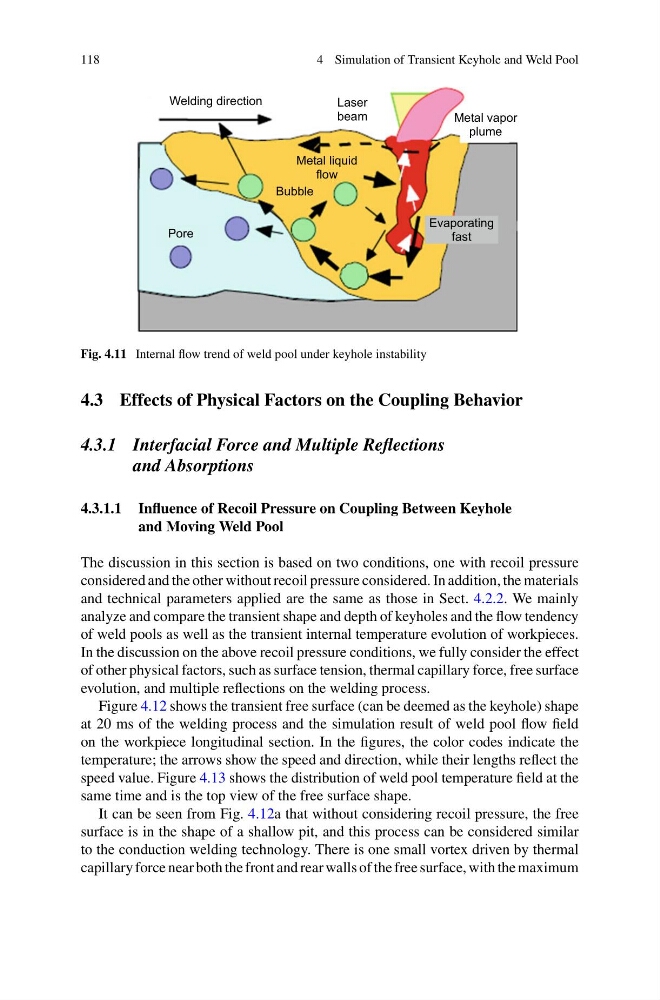
Fig. 4.11 Internal flow trend of weld pool under keyhole instability
4.3 Effects of Physical Factors on the Coupling Behavior
4.3.1 Interfacial Force and Multiple Reflections
and Absorptions
4.3.1.1 Influence of Recoil Pressure on Coupling Between Keyhole
and Moving Weld Pool
The discussion in this section is based on two conditions, one with recoil pressure
considered and the other without recoil pressure considered. In addition, the materials
and technical parameters applied are the same as those in Sect. 4.2.2. We mainly
analyze and compare the transient shape and depth of keyholes and the flow tendency
of weld pools as well as the transient internal temperature evolution of workpieces.
In the discussion on the above recoil pressure conditions, we fully consider the effect
of other physical factors, such as surface tension, thermal capillary force, free surface
evolution, and multiple reflections on the welding process.
Figure 4.12 shows the transient free surface (can be deemed as the keyhole) shape
at 20 ms of the welding process and the simulation result of weld pool flow field
on the workpiece longitudinal section. In the figures, the color codes indicate the
temperature; the arrows show the speed and direction, while their lengths reflect the
speed value. Figure 4.13 shows the distribution of weld pool temperature field at the
same time and is the top view of the free surface shape.
It can be seen from Fig. 4.12a that without considering recoil pressure, the free
surface is in the shape of a shallow pit, and this process can be considered similar
to the conduction welding technology. There is one small vortex driven by thermal
capillary force near both the front and rear walls of the free surface, with the maximum
4 Simulation of Transient Keyhole and Weld Pool
Welding direction
Laser
beam
Metal vapor
plume
Metal liquid
Evaporating
fast
Bubble
Pore
flow
Fig. 4.11 Internal flow trend of weld pool under keyhole instability
4.3 Effects of Physical Factors on the Coupling Behavior
4.3.1 Interfacial Force and Multiple Reflections
and Absorptions
4.3.1.1 Influence of Recoil Pressure on Coupling Between Keyhole
and Moving Weld Pool
The discussion in this section is based on two conditions, one with recoil pressure
considered and the other without recoil pressure considered. In addition, the materials
and technical parameters applied are the same as those in Sect. 4.2.2. We mainly
analyze and compare the transient shape and depth of keyholes and the flow tendency
of weld pools as well as the transient internal temperature evolution of workpieces.
In the discussion on the above recoil pressure conditions, we fully consider the effect
of other physical factors, such as surface tension, thermal capillary force, free surface
evolution, and multiple reflections on the welding process.
Figure 4.12 shows the transient free surface (can be deemed as the keyhole) shape
at 20 ms of the welding process and the simulation result of weld pool flow field
on the workpiece longitudinal section. In the figures, the color codes indicate the
temperature; the arrows show the speed and direction, while their lengths reflect the
speed value. Figure 4.13 shows the distribution of weld pool temperature field at the
same time and is the top view of the free surface shape.
It can be seen from Fig. 4.12a that without considering recoil pressure, the free
surface is in the shape of a shallow pit, and this process can be considered similar
to the conduction welding technology. There is one small vortex driven by thermal
capillary force near both the front and rear walls of the free surface, with the maximum