

4.2 Transient Coupling Dynamics of Keyholes and Weld Pool
117
(a) t+0 us
(b) t+275 us
(c) t+550 us
(d) t+825 us
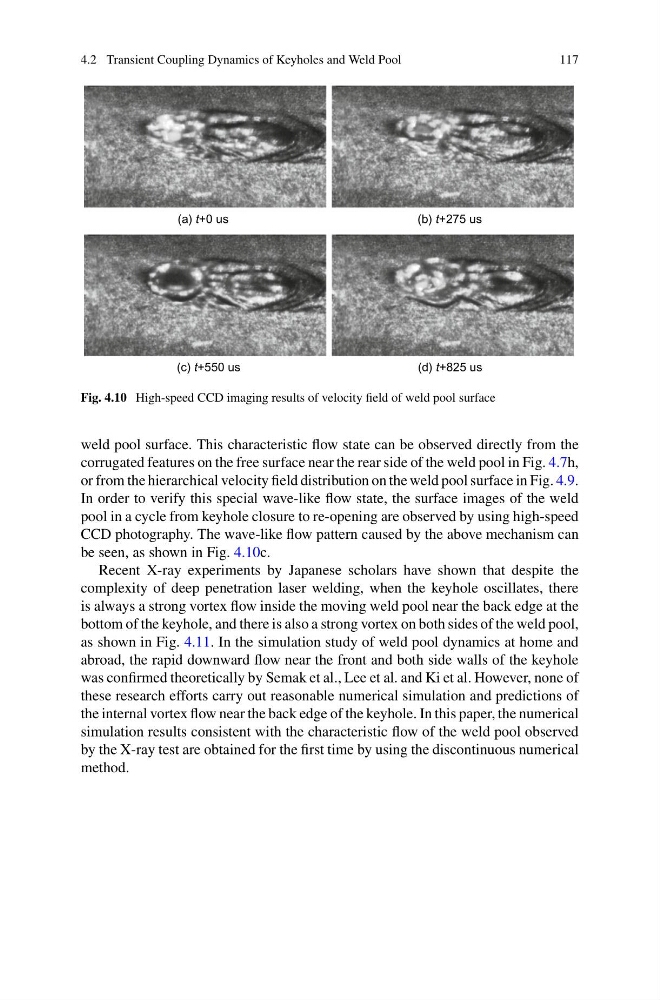
Fig. 4.10 High-speed CCD imaging results of velocity field of weld pool surface
weld pool surface. This characteristic flow state can be observed directly from the
corrugated features on the free surface near the rear side of the weld pool in Fig. 4.7h,
or from the hierarchical velocity field distribution on the weld pool surface in Fig. 4.9.
In order to verify this special wave-like flow state, the surface images of the weld
pool in a cycle from keyhole closure to re-opening are observed by using high-speed
CCD photography. The wave-like flow pattern caused by the above mechanism can
be seen, as shown in Fig. 4.10c.
Recent X-ray experiments by Japanese scholars have shown that despite the
complexity of deep penetration laser welding, when the keyhole oscillates, there
is always a strong vortex flow inside the moving weld pool near the back edge at the
bottom of the keyhole, and there is also a strong vortex on both sides of the weld pool,
as shown in Fig. 4.11. In the simulation study of weld pool dynamics at home and
abroad, the rapid downward flow near the front and both side walls of the keyhole
was confirmed theoretically by Semak et al., Lee et al. and Ki et al. However, none of
these research efforts carry out reasonable numerical simulation and predictions of
the internal vortex flow near the back edge of the keyhole. In this paper, the numerical
simulation results consistent with the characteristic flow of the weld pool observed
by the X-ray test are obtained for the first time by using the discontinuous numerical
method.
117
(a) t+0 us
(b) t+275 us
(c) t+550 us
(d) t+825 us
Fig. 4.10 High-speed CCD imaging results of velocity field of weld pool surface
weld pool surface. This characteristic flow state can be observed directly from the
corrugated features on the free surface near the rear side of the weld pool in Fig. 4.7h,
or from the hierarchical velocity field distribution on the weld pool surface in Fig. 4.9.
In order to verify this special wave-like flow state, the surface images of the weld
pool in a cycle from keyhole closure to re-opening are observed by using high-speed
CCD photography. The wave-like flow pattern caused by the above mechanism can
be seen, as shown in Fig. 4.10c.
Recent X-ray experiments by Japanese scholars have shown that despite the
complexity of deep penetration laser welding, when the keyhole oscillates, there
is always a strong vortex flow inside the moving weld pool near the back edge at the
bottom of the keyhole, and there is also a strong vortex on both sides of the weld pool,
as shown in Fig. 4.11. In the simulation study of weld pool dynamics at home and
abroad, the rapid downward flow near the front and both side walls of the keyhole
was confirmed theoretically by Semak et al., Lee et al. and Ki et al. However, none of
these research efforts carry out reasonable numerical simulation and predictions of
the internal vortex flow near the back edge of the keyhole. In this paper, the numerical
simulation results consistent with the characteristic flow of the weld pool observed
by the X-ray test are obtained for the first time by using the discontinuous numerical
method.