

110
4 Simulation of Transient Keyhole and Weld Pool
4.2.2 Flow Characteristics of Weld Pool with Stable Keyhole
According to the research on the mechanism of keyhole stability, the scale of the
change in keyhole depth decreases when the welding speed increases or the linear
energy decreases at constant power. Therefore, deep penetration laser welding with
a stable keyhole can be implemented at a lower line energy. The simulation results
show that the welding performed at the laser power of 1.3 kW and the welding speed
of 3 m/min is deep penetration laser welding that produces stable keyholes. The
keyhole morphology and weld pool flow under this process condition are analyzed
and discussed below (Table 4.2).
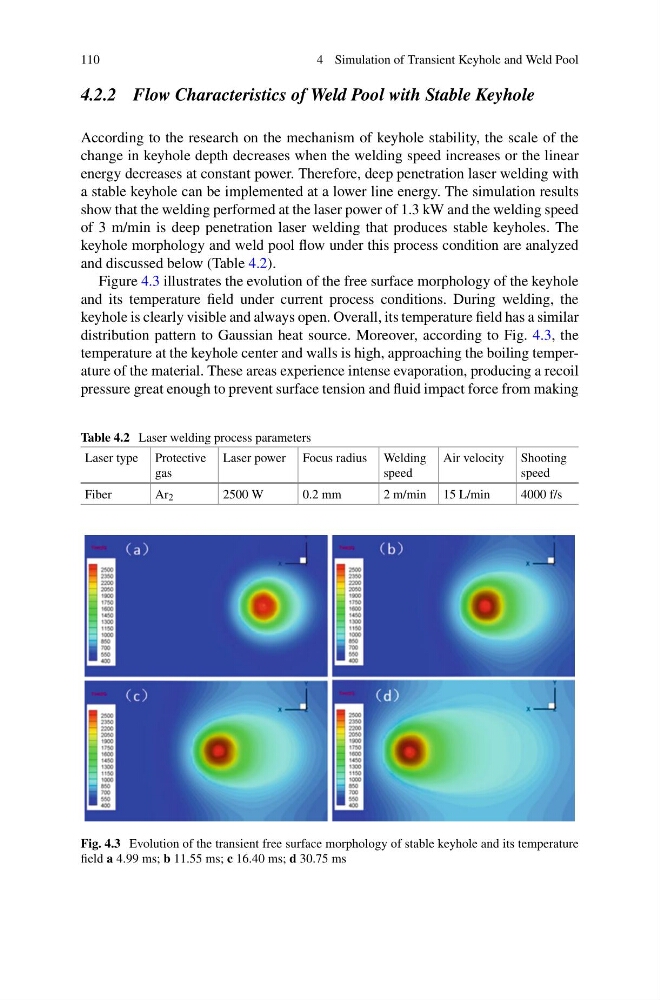
Figure 4.3 illustrates the evolution of the free surface morphology of the keyhole
and its temperature field under current process conditions. During welding, the
keyhole is clearly visible and always open. Overall, its temperature field has a similar
distribution pattern to Gaussian heat source. Moreover, according to Fig. 4.3, the
temperature at the keyhole center and walls is high, approaching the boiling temperature of the material. These areas experience intense evaporation, producing a recoil
pressure great enough to prevent surface tension and fluid impact force from making
Table 4.2 Laser welding process parameters
Laser type Protective
gas
Laser power Focus radius Welding
speed
Air velocity Shooting
speed
Fiber
Ar 2
2500 W
0.2 mm
2 m/min 15 L/min
4000 f/s
Fig. 4.3 Evolution of the transient free surface morphology of stable keyhole and its temperature
field a 4.99 ms; b 11.55 ms; c 16.40 ms; d 30.75 ms
4 Simulation of Transient Keyhole and Weld Pool
4.2.2 Flow Characteristics of Weld Pool with Stable Keyhole
According to the research on the mechanism of keyhole stability, the scale of the
change in keyhole depth decreases when the welding speed increases or the linear
energy decreases at constant power. Therefore, deep penetration laser welding with
a stable keyhole can be implemented at a lower line energy. The simulation results
show that the welding performed at the laser power of 1.3 kW and the welding speed
of 3 m/min is deep penetration laser welding that produces stable keyholes. The
keyhole morphology and weld pool flow under this process condition are analyzed
and discussed below (Table 4.2).
Figure 4.3 illustrates the evolution of the free surface morphology of the keyhole
and its temperature field under current process conditions. During welding, the
keyhole is clearly visible and always open. Overall, its temperature field has a similar
distribution pattern to Gaussian heat source. Moreover, according to Fig. 4.3, the
temperature at the keyhole center and walls is high, approaching the boiling temperature of the material. These areas experience intense evaporation, producing a recoil
pressure great enough to prevent surface tension and fluid impact force from making
Table 4.2 Laser welding process parameters
Laser type Protective
gas
Laser power Focus radius Welding
speed
Air velocity Shooting
speed
Fiber
Ar 2
2500 W
0.2 mm
2 m/min 15 L/min
4000 f/s
Fig. 4.3 Evolution of the transient free surface morphology of stable keyhole and its temperature
field a 4.99 ms; b 11.55 ms; c 16.40 ms; d 30.75 ms