

4.2 Transient Coupling Dynamics of Keyholes and Weld Pool
109
Table 4.1 Default parameters used in the numerical simulation
Parameter
Symbol
Value
Density (kg/m 3 )
ρ
2600
Specific heat (J/(kg K))
C p
1000
Heat conductivity (W/(m K))
k
90
Solidus temperature (K)
T s
831
Liquidus temperature (K)
T l
889
Evaporation temperature (K)
T b
2790
Melting latent (J/kg)
T m
5.03 × 10 5
Evaporation latent (J/kg)
T v
1.07 × 10 7
Surface tension (N/m)
σ
1.0
Dynamic viscosity (N m −2 s)
μ l
1.6 × 10 –3
Coefficient of thermal expansion (1/K)
β
2.36 × 10 –5
Surface tension temperature coefficient (N/(m K))
dσ
dT
−3 × 10 –4
Black-body radiation coefficient
ε r
0.3
Convective coefficient (W/(m K))
h
60
Fresnel absorption correlation constant
ε
0.20
Ambient temperature (K)
T ∞
300
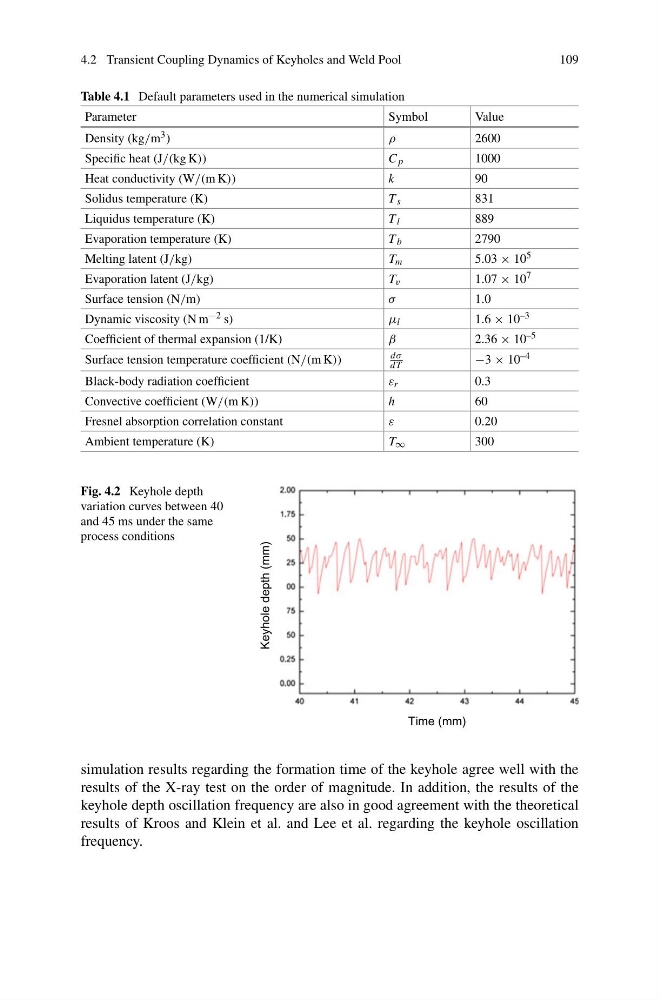
Fig. 4.2 Keyhole depth
variation curves between 40
and 45 ms under the same
process conditions
Keyhole depth (mm)
Time (mm)
simulation results regarding the formation time of the keyhole agree well with the
results of the X-ray test on the order of magnitude. In addition, the results of the
keyhole depth oscillation frequency are also in good agreement with the theoretical
results of Kroos and Klein et al. and Lee et al. regarding the keyhole oscillation
frequency.
109
Table 4.1 Default parameters used in the numerical simulation
Parameter
Symbol
Value
Density (kg/m 3 )
ρ
2600
Specific heat (J/(kg K))
C p
1000
Heat conductivity (W/(m K))
k
90
Solidus temperature (K)
T s
831
Liquidus temperature (K)
T l
889
Evaporation temperature (K)
T b
2790
Melting latent (J/kg)
T m
5.03 × 10 5
Evaporation latent (J/kg)
T v
1.07 × 10 7
Surface tension (N/m)
σ
1.0
Dynamic viscosity (N m −2 s)
μ l
1.6 × 10 –3
Coefficient of thermal expansion (1/K)
β
2.36 × 10 –5
Surface tension temperature coefficient (N/(m K))
dσ
dT
−3 × 10 –4
Black-body radiation coefficient
ε r
0.3
Convective coefficient (W/(m K))
h
60
Fresnel absorption correlation constant
ε
0.20
Ambient temperature (K)
T ∞
300
Fig. 4.2 Keyhole depth
variation curves between 40
and 45 ms under the same
process conditions
Keyhole depth (mm)
Time (mm)
simulation results regarding the formation time of the keyhole agree well with the
results of the X-ray test on the order of magnitude. In addition, the results of the
keyhole depth oscillation frequency are also in good agreement with the theoretical
results of Kroos and Klein et al. and Lee et al. regarding the keyhole oscillation
frequency.