

108
4 Simulation of Transient Keyhole and Weld Pool
and kinematic viscosity) and different welding technologies (spot radius, welding
speed and laser power) on the keyhole and moving weld pool coupling, and introduce the stability mechanism of laser welding keyhole and weld pool, providing the
theoretical guidance for the optimization of laser welding technology in the actual
industrial application.
4.2 Transient Coupling Dynamics of Keyholes and Weld
Pool
4.2.1 Dynamic Evolution Process and Characteristics
of Keyholes
In order to study the process, a numerical simulation study was carried out on the laser
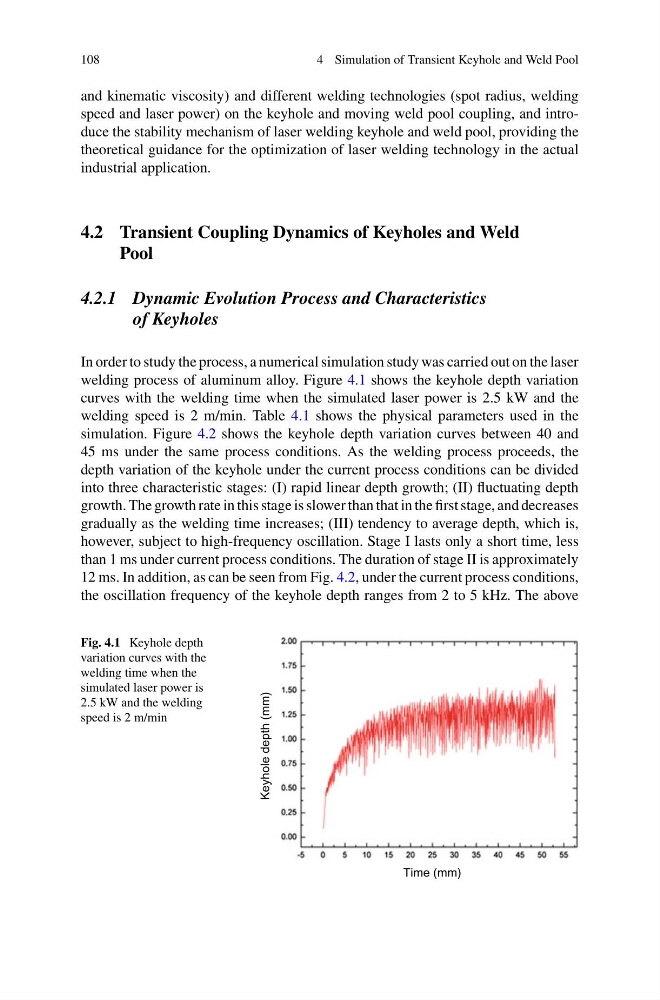
welding process of aluminum alloy. Figure 4.1 shows the keyhole depth variation
curves with the welding time when the simulated laser power is 2.5 kW and the
welding speed is 2 m/min. Table 4.1 shows the physical parameters used in the
simulation. Figure 4.2 shows the keyhole depth variation curves between 40 and
45 ms under the same process conditions. As the welding process proceeds, the
depth variation of the keyhole under the current process conditions can be divided
into three characteristic stages: (I) rapid linear depth growth; (II) fluctuating depth
growth. The growth rate in this stage is slower than that in the first stage, and decreases
gradually as the welding time increases; (III) tendency to average depth, which is,
however, subject to high-frequency oscillation. Stage I lasts only a short time, less
than 1 ms under current process conditions. The duration of stage II is approximately
12 ms. In addition, as can be seen from Fig. 4.2, under the current process conditions,
the oscillation frequency of the keyhole depth ranges from 2 to 5 kHz. The above
Fig. 4.1 Keyhole depth
variation curves with the
welding time when the
simulated laser power is
2.5 kW and the welding
speed is 2 m/min
Keyhole depth (mm)
Time (mm)
4 Simulation of Transient Keyhole and Weld Pool
and kinematic viscosity) and different welding technologies (spot radius, welding
speed and laser power) on the keyhole and moving weld pool coupling, and introduce the stability mechanism of laser welding keyhole and weld pool, providing the
theoretical guidance for the optimization of laser welding technology in the actual
industrial application.
4.2 Transient Coupling Dynamics of Keyholes and Weld
Pool
4.2.1 Dynamic Evolution Process and Characteristics
of Keyholes
In order to study the process, a numerical simulation study was carried out on the laser
welding process of aluminum alloy. Figure 4.1 shows the keyhole depth variation
curves with the welding time when the simulated laser power is 2.5 kW and the
welding speed is 2 m/min. Table 4.1 shows the physical parameters used in the
simulation. Figure 4.2 shows the keyhole depth variation curves between 40 and
45 ms under the same process conditions. As the welding process proceeds, the
depth variation of the keyhole under the current process conditions can be divided
into three characteristic stages: (I) rapid linear depth growth; (II) fluctuating depth
growth. The growth rate in this stage is slower than that in the first stage, and decreases
gradually as the welding time increases; (III) tendency to average depth, which is,
however, subject to high-frequency oscillation. Stage I lasts only a short time, less
than 1 ms under current process conditions. The duration of stage II is approximately
12 ms. In addition, as can be seen from Fig. 4.2, under the current process conditions,
the oscillation frequency of the keyhole depth ranges from 2 to 5 kHz. The above
Fig. 4.1 Keyhole depth
variation curves with the
welding time when the
simulated laser power is
2.5 kW and the welding
speed is 2 m/min
Keyhole depth (mm)
Time (mm)