

4.2 Transient Coupling Dynamics of Keyholes and Weld Pool
111
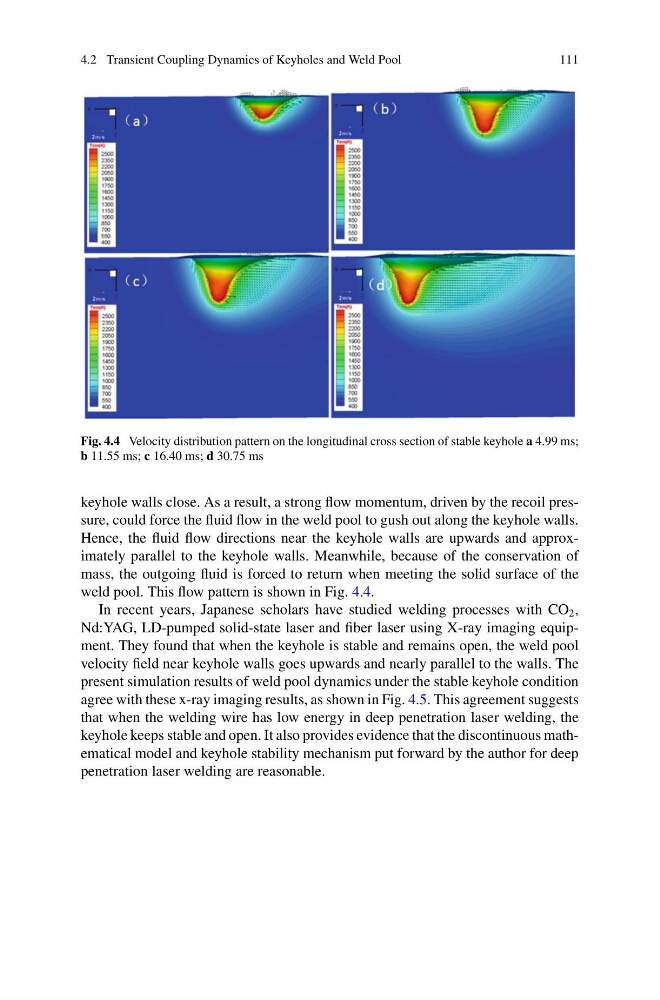
Fig. 4.4 Velocity distribution pattern on the longitudinal cross section of stable keyhole a 4.99 ms;
b 11.55 ms; c 16.40 ms; d 30.75 ms
keyhole walls close. As a result, a strong flow momentum, driven by the recoil pressure, could force the fluid flow in the weld pool to gush out along the keyhole walls.
Hence, the fluid flow directions near the keyhole walls are upwards and approximately parallel to the keyhole walls. Meanwhile, because of the conservation of
mass, the outgoing fluid is forced to return when meeting the solid surface of the
weld pool. This flow pattern is shown in Fig. 4.4.
In recent years, Japanese scholars have studied welding processes with CO 2 ,
Nd:YAG, LD-pumped solid-state laser and fiber laser using X-ray imaging equipment. They found that when the keyhole is stable and remains open, the weld pool
velocity field near keyhole walls goes upwards and nearly parallel to the walls. The
present simulation results of weld pool dynamics under the stable keyhole condition
agree with these x-ray imaging results, as shown in Fig. 4.5. This agreement suggests
that when the welding wire has low energy in deep penetration laser welding, the
keyhole keeps stable and open. It also provides evidence that the discontinuous mathematical model and keyhole stability mechanism put forward by the author for deep
penetration laser welding are reasonable.
111
Fig. 4.4 Velocity distribution pattern on the longitudinal cross section of stable keyhole a 4.99 ms;
b 11.55 ms; c 16.40 ms; d 30.75 ms
keyhole walls close. As a result, a strong flow momentum, driven by the recoil pressure, could force the fluid flow in the weld pool to gush out along the keyhole walls.
Hence, the fluid flow directions near the keyhole walls are upwards and approximately parallel to the keyhole walls. Meanwhile, because of the conservation of
mass, the outgoing fluid is forced to return when meeting the solid surface of the
weld pool. This flow pattern is shown in Fig. 4.4.
In recent years, Japanese scholars have studied welding processes with CO 2 ,
Nd:YAG, LD-pumped solid-state laser and fiber laser using X-ray imaging equipment. They found that when the keyhole is stable and remains open, the weld pool
velocity field near keyhole walls goes upwards and nearly parallel to the walls. The
present simulation results of weld pool dynamics under the stable keyhole condition
agree with these x-ray imaging results, as shown in Fig. 4.5. This agreement suggests
that when the welding wire has low energy in deep penetration laser welding, the
keyhole keeps stable and open. It also provides evidence that the discontinuous mathematical model and keyhole stability mechanism put forward by the author for deep
penetration laser welding are reasonable.