

3.5 Numerical Method
93
In the process of solving implicit equations, Gauss–Seidel iterative method is used in
this section for iterative solution. Meanwhile, in order to speed up the convergence
process, different grid sequences are adopted for iterative solution. It is proved in the
study that for the Eikonal equation, with the first-order scheme discrete Eq. (3.94),
the convergence solution can be generally obtained after 8 steps through Gauss–
Seidel iteration in different grid sequences. For third-order schemes, it is found in
this study that generally only a few steps are needed to obtain the convergent solution
satisfying the accuracy. The Gauss–Seidel iterative method needs a small calculation
amount for each iteration process, and it is very suitable for parallel calculation, so
the reinitialization efficiency is high when using the fast sweeping method.
3.5.2.2 Particle Level Set Interface Tracking and Solving Technology
Numerical dissipation is the biggest inherent defect of the Level Set method. In
recent years, the academia has proposed the CLSVOF method in which the Level
Set is combined with the VOF, and the Particle Level Set Method in which the front
tracking method is combined with the Level Set to correct the defect of the Level Set
Method. Both of the above methods have been proved to be effective in suppressing
the mass non-conservation problem of Level Set. However, the CLSVOF method
is less effective than the Particle Level Set method in the interface tracking effect.
In this study, the Particle Level Set method is adopted to overcome the quality loss
problem of the Level Set method.
The Particle Level Set method artificially arranges some massless particles with
different radii on both sides of the interface described by the Level Set, and makes
the particles move passively with the flow field, where the particle motion equation
is determined by Eq. (3.80). In the process of solving the particle motion equation,
the third-order TVD Runge–Kutta scheme is also adopted to integrate Eq. (3.80).
Since the particles can always reflect the characteristic information of the flow field,
the numerical dissipation error of the Level Set can be corrected by the position
information of the particles. In this study, particles are only arranged in two time
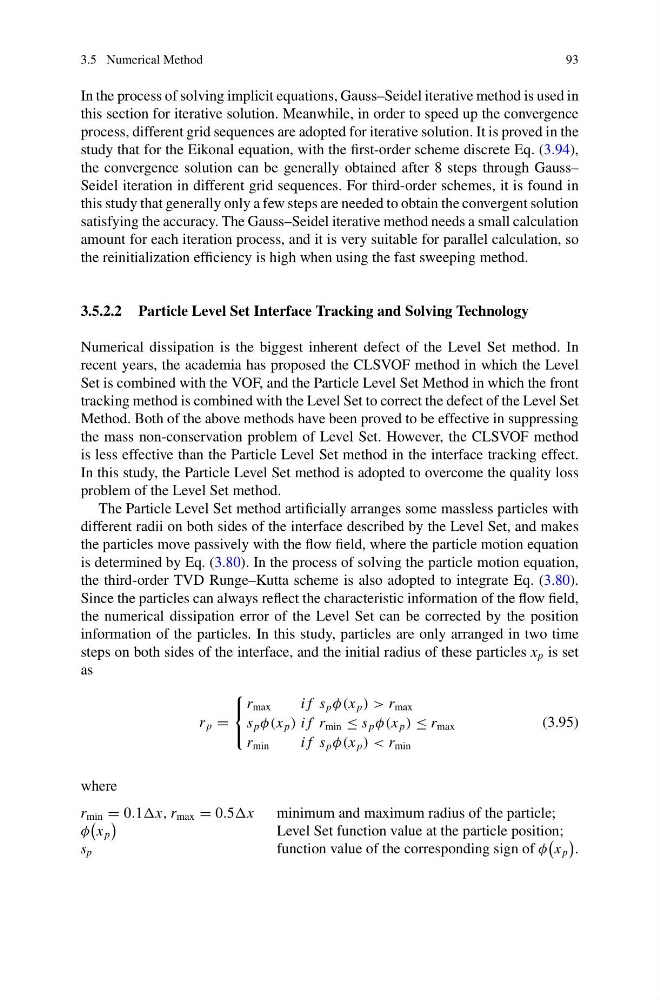
steps on both sides of the interface, and the initial radius of these particles x p is set
as
r p =
⎧
⎨
⎩
r max
i f s p φ(x p ) > r max
s p φ(x p ) i f r min ≤ s p φ(x p ) ≤ r max
r min
i f s p φ(x p ) < r min
(3.95)
where
r min = 0.1x, r max = 0.5x
minimum and maximum radius of the particle;
φ
x p
Level Set function value at the particle position;
s p
function value of the corresponding sign of φ
x p
.
93
In the process of solving implicit equations, Gauss–Seidel iterative method is used in
this section for iterative solution. Meanwhile, in order to speed up the convergence
process, different grid sequences are adopted for iterative solution. It is proved in the
study that for the Eikonal equation, with the first-order scheme discrete Eq. (3.94),
the convergence solution can be generally obtained after 8 steps through Gauss–
Seidel iteration in different grid sequences. For third-order schemes, it is found in
this study that generally only a few steps are needed to obtain the convergent solution
satisfying the accuracy. The Gauss–Seidel iterative method needs a small calculation
amount for each iteration process, and it is very suitable for parallel calculation, so
the reinitialization efficiency is high when using the fast sweeping method.
3.5.2.2 Particle Level Set Interface Tracking and Solving Technology
Numerical dissipation is the biggest inherent defect of the Level Set method. In
recent years, the academia has proposed the CLSVOF method in which the Level
Set is combined with the VOF, and the Particle Level Set Method in which the front
tracking method is combined with the Level Set to correct the defect of the Level Set
Method. Both of the above methods have been proved to be effective in suppressing
the mass non-conservation problem of Level Set. However, the CLSVOF method
is less effective than the Particle Level Set method in the interface tracking effect.
In this study, the Particle Level Set method is adopted to overcome the quality loss
problem of the Level Set method.
The Particle Level Set method artificially arranges some massless particles with
different radii on both sides of the interface described by the Level Set, and makes
the particles move passively with the flow field, where the particle motion equation
is determined by Eq. (3.80). In the process of solving the particle motion equation,
the third-order TVD Runge–Kutta scheme is also adopted to integrate Eq. (3.80).
Since the particles can always reflect the characteristic information of the flow field,
the numerical dissipation error of the Level Set can be corrected by the position
information of the particles. In this study, particles are only arranged in two time
steps on both sides of the interface, and the initial radius of these particles x p is set
as
r p =
⎧
⎨
⎩
r max
i f s p φ(x p ) > r max
s p φ(x p ) i f r min ≤ s p φ(x p ) ≤ r max
r min
i f s p φ(x p ) < r min
(3.95)
where
r min = 0.1x, r max = 0.5x
minimum and maximum radius of the particle;
φ
x p
Level Set function value at the particle position;
s p
function value of the corresponding sign of φ
x p
.