

92
3 Coupling Model and Numerical Computation Method of Keyhole and Weld Pool
After discretizing the space item, it is also required to discretize the time item
∂φ
∂t
of the Level Set equation. It can be conducted by calculating L(φ) = −
− →
U · ∇φ. If
the Level Set function at the moment of t is denoted as φ
(n)) , and as φ
(n+1) at the
moment of t + t, then the third-order TVD Runge–Kutta scheme can be used. The
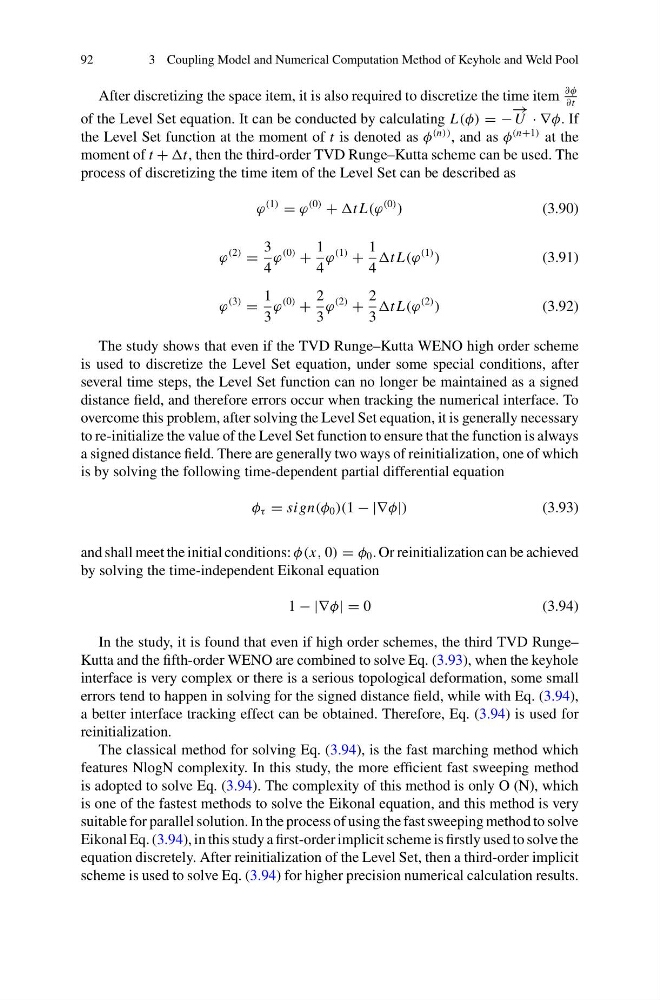
process of discretizing the time item of the Level Set can be described as
ϕ
(1)
= ϕ
(0)
+ t L(ϕ
(0)
)
(3.90)
ϕ
(2)
=
3
4
ϕ
(0)
+
1
4
ϕ
(1)
+
1
4
t L(ϕ
(1)
)
(3.91)
ϕ
(3)
=
1
3
ϕ
(0)
+
2
3
ϕ
(2)
+
2
3
t L(ϕ
(2)
)
(3.92)
The study shows that even if the TVD Runge–Kutta WENO high order scheme
is used to discretize the Level Set equation, under some special conditions, after
several time steps, the Level Set function can no longer be maintained as a signed
distance field, and therefore errors occur when tracking the numerical interface. To
overcome this problem, after solving the Level Set equation, it is generally necessary
to re-initialize the value of the Level Set function to ensure that the function is always
a signed distance field. There are generally two ways of reinitialization, one of which
is by solving the following time-dependent partial differential equation
φ τ = sign(φ 0 )(1 − |∇φ|)
(3.93)
and shall meet the initial conditions: φ(x, 0) = φ 0 . Or reinitialization can be achieved
by solving the time-independent Eikonal equation
1 − |∇φ| = 0
(3.94)
In the study, it is found that even if high order schemes, the third TVD Runge–
Kutta and the fifth-order WENO are combined to solve Eq. (3.93), when the keyhole
interface is very complex or there is a serious topological deformation, some small
errors tend to happen in solving for the signed distance field, while with Eq. (3.94),
a better interface tracking effect can be obtained. Therefore, Eq. (3.94) is used for
reinitialization.
The classical method for solving Eq. (3.94), is the fast marching method which
features NlogN complexity. In this study, the more efficient fast sweeping method
is adopted to solve Eq. (3.94). The complexity of this method is only O (N), which
is one of the fastest methods to solve the Eikonal equation, and this method is very
suitable for parallel solution. In the process of using the fast sweeping method to solve
Eikonal Eq. (3.94), in this study a first-order implicit scheme is firstly used to solve the
equation discretely. After reinitialization of the Level Set, then a third-order implicit
scheme is used to solve Eq. (3.94) for higher precision numerical calculation results.
3 Coupling Model and Numerical Computation Method of Keyhole and Weld Pool
After discretizing the space item, it is also required to discretize the time item
∂φ
∂t
of the Level Set equation. It can be conducted by calculating L(φ) = −
− →
U · ∇φ. If
the Level Set function at the moment of t is denoted as φ
(n)) , and as φ
(n+1) at the
moment of t + t, then the third-order TVD Runge–Kutta scheme can be used. The
process of discretizing the time item of the Level Set can be described as
ϕ
(1)
= ϕ
(0)
+ t L(ϕ
(0)
)
(3.90)
ϕ
(2)
=
3
4
ϕ
(0)
+
1
4
ϕ
(1)
+
1
4
t L(ϕ
(1)
)
(3.91)
ϕ
(3)
=
1
3
ϕ
(0)
+
2
3
ϕ
(2)
+
2
3
t L(ϕ
(2)
)
(3.92)
The study shows that even if the TVD Runge–Kutta WENO high order scheme
is used to discretize the Level Set equation, under some special conditions, after
several time steps, the Level Set function can no longer be maintained as a signed
distance field, and therefore errors occur when tracking the numerical interface. To
overcome this problem, after solving the Level Set equation, it is generally necessary
to re-initialize the value of the Level Set function to ensure that the function is always
a signed distance field. There are generally two ways of reinitialization, one of which
is by solving the following time-dependent partial differential equation
φ τ = sign(φ 0 )(1 − |∇φ|)
(3.93)
and shall meet the initial conditions: φ(x, 0) = φ 0 . Or reinitialization can be achieved
by solving the time-independent Eikonal equation
1 − |∇φ| = 0
(3.94)
In the study, it is found that even if high order schemes, the third TVD Runge–
Kutta and the fifth-order WENO are combined to solve Eq. (3.93), when the keyhole
interface is very complex or there is a serious topological deformation, some small
errors tend to happen in solving for the signed distance field, while with Eq. (3.94),
a better interface tracking effect can be obtained. Therefore, Eq. (3.94) is used for
reinitialization.
The classical method for solving Eq. (3.94), is the fast marching method which
features NlogN complexity. In this study, the more efficient fast sweeping method
is adopted to solve Eq. (3.94). The complexity of this method is only O (N), which
is one of the fastest methods to solve the Eikonal equation, and this method is very
suitable for parallel solution. In the process of using the fast sweeping method to solve
Eikonal Eq. (3.94), in this study a first-order implicit scheme is firstly used to solve the
equation discretely. After reinitialization of the Level Set, then a third-order implicit
scheme is used to solve Eq. (3.94) for higher precision numerical calculation results.