

86
3 Coupling Model and Numerical Computation Method of Keyhole and Weld Pool
accurately calculating the inverse bremsstrahlung absorption of the laser beam by
the plasma during CO 2 laser welding, or the energy absorption of the laser beam by
the metal vapor during Nd: YAG and fiber laser welding. Obviously, when the ray
tracing problem is solved by using the finite difference method, the calculation of the
length of intersecting line of the beam and any finite difference grid becomes the key
to calculating the beam transmission path value after all the finite difference grids
traversed by the beam between the current intersection point and the next intersection
point are judged.
In this study, a redundant point elimination algorithm with high computational
efficiency is proposed to calculate the length of intersecting line of the beam and the
difference grid. The flow of the algorithm is as follows: ➀ The intersection point set
of the beam and the straight line where the 6 sides of the finite difference grid are
located is calculated. Obviously, there are 6 intersection points at most in this set. ➁
The volume of the finite difference grid is slightly expanded outward, such as one
millionth, and then the points inside the intersection point set obtained in the first step
are judged sequentially to determine whether they are located in the enlarged grid. The
two points located in the grid are the intersection points of the beam and the difference
grid; ➂ The distance between the two intersection points is calculated, i.e. the length
of the intersecting line. Although the computation method above seems complicated,
the algorithm avoids too much conditional judgment when the intersection points are
directly calculated, which is conducive to computer calculation with high efficiency.
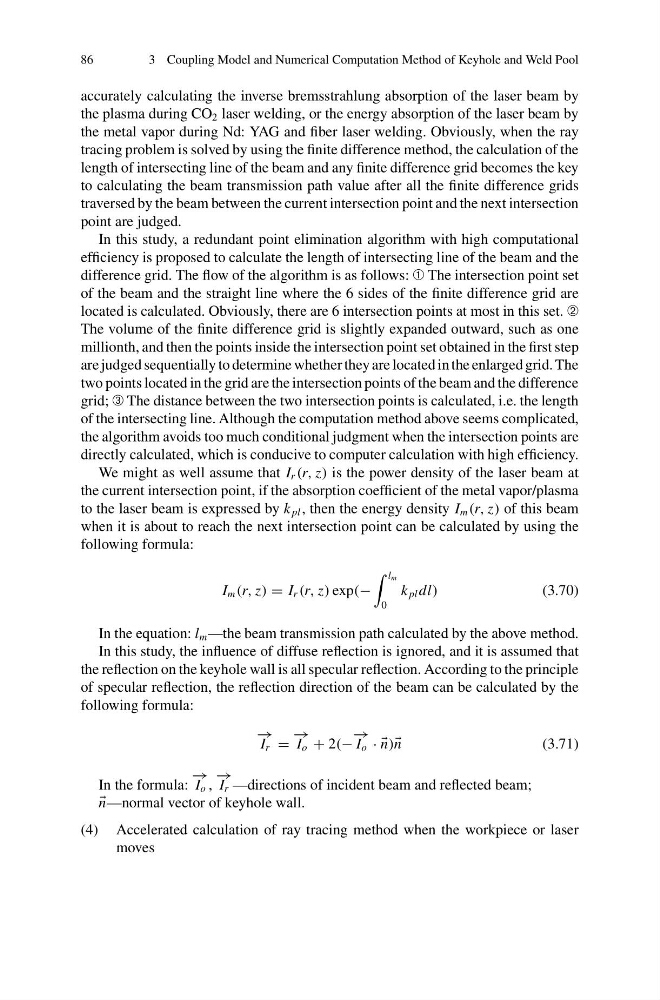
We might as well assume that I r (r, z) is the power density of the laser beam at
the current intersection point, if the absorption coefficient of the metal vapor/plasma
to the laser beam is expressed by k pl , then the energy density I m (r, z) of this beam
when it is about to reach the next intersection point can be calculated by using the
following formula:
I m (r, z) = I r (r, z) exp(−
l m
0
k pl dl)
(3.70)
In the equation: l m —the beam transmission path calculated by the above method.
In this study, the influence of diffuse reflection is ignored, and it is assumed that
the reflection on the keyhole wall is all specular reflection. According to the principle
of specular reflection, the reflection direction of the beam can be calculated by the
following formula:
− →
I r =
− →
I o + 2(−
− →
I o · ·
n) n
(3.71)
In the formula:
− →
I o ,
− →
I r —directions of incident beam and reflected beam;
n—normal vector of keyhole wall.
(4) Accelerated calculation of ray tracing method when the workpiece or laser
moves
3 Coupling Model and Numerical Computation Method of Keyhole and Weld Pool
accurately calculating the inverse bremsstrahlung absorption of the laser beam by
the plasma during CO 2 laser welding, or the energy absorption of the laser beam by
the metal vapor during Nd: YAG and fiber laser welding. Obviously, when the ray
tracing problem is solved by using the finite difference method, the calculation of the
length of intersecting line of the beam and any finite difference grid becomes the key
to calculating the beam transmission path value after all the finite difference grids
traversed by the beam between the current intersection point and the next intersection
point are judged.
In this study, a redundant point elimination algorithm with high computational
efficiency is proposed to calculate the length of intersecting line of the beam and the
difference grid. The flow of the algorithm is as follows: ➀ The intersection point set
of the beam and the straight line where the 6 sides of the finite difference grid are
located is calculated. Obviously, there are 6 intersection points at most in this set. ➁
The volume of the finite difference grid is slightly expanded outward, such as one
millionth, and then the points inside the intersection point set obtained in the first step
are judged sequentially to determine whether they are located in the enlarged grid. The
two points located in the grid are the intersection points of the beam and the difference
grid; ➂ The distance between the two intersection points is calculated, i.e. the length
of the intersecting line. Although the computation method above seems complicated,
the algorithm avoids too much conditional judgment when the intersection points are
directly calculated, which is conducive to computer calculation with high efficiency.
We might as well assume that I r (r, z) is the power density of the laser beam at
the current intersection point, if the absorption coefficient of the metal vapor/plasma
to the laser beam is expressed by k pl , then the energy density I m (r, z) of this beam
when it is about to reach the next intersection point can be calculated by using the
following formula:
I m (r, z) = I r (r, z) exp(−
l m
0
k pl dl)
(3.70)
In the equation: l m —the beam transmission path calculated by the above method.
In this study, the influence of diffuse reflection is ignored, and it is assumed that
the reflection on the keyhole wall is all specular reflection. According to the principle
of specular reflection, the reflection direction of the beam can be calculated by the
following formula:
− →
I r =
− →
I o + 2(−
− →
I o · ·
n) n
(3.71)
In the formula:
− →
I o ,
− →
I r —directions of incident beam and reflected beam;
n—normal vector of keyhole wall.
(4) Accelerated calculation of ray tracing method when the workpiece or laser
moves