

3.5 Numerical Method
85
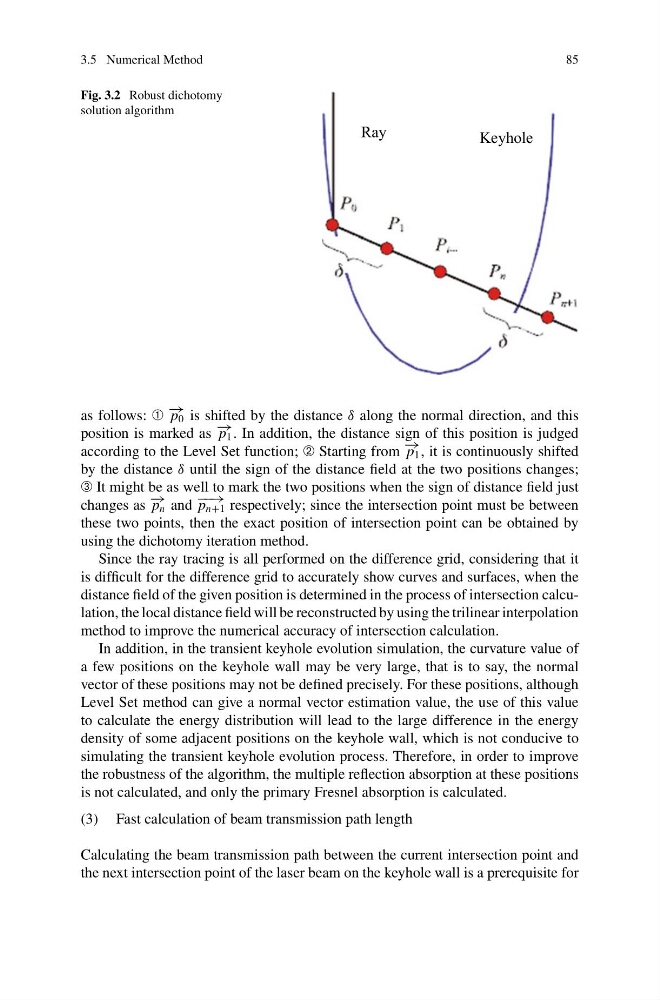
Fig. 3.2 Robust dichotomy
solution algorithm
Ray
Keyhole
as follows: ➀ − → p 0 is shifted by the distance δ along the normal direction, and this
position is marked as − → p 1 . In addition, the distance sign of this position is judged
according to the Level Set function; ➁ Starting from − → p 1 , it is continuously shifted
by the distance δ until the sign of the distance field at the two positions changes;
➂ It might be as well to mark the two positions when the sign of distance field just
changes as − → p n and − − →
p n+1 respectively; since the intersection point must be between
these two points, then the exact position of intersection point can be obtained by
using the dichotomy iteration method.
Since the ray tracing is all performed on the difference grid, considering that it
is difficult for the difference grid to accurately show curves and surfaces, when the
distance field of the given position is determined in the process of intersection calculation, the local distance field will be reconstructed by using the trilinear interpolation
method to improve the numerical accuracy of intersection calculation.
In addition, in the transient keyhole evolution simulation, the curvature value of
a few positions on the keyhole wall may be very large, that is to say, the normal
vector of these positions may not be defined precisely. For these positions, although
Level Set method can give a normal vector estimation value, the use of this value
to calculate the energy distribution will lead to the large difference in the energy
density of some adjacent positions on the keyhole wall, which is not conducive to
simulating the transient keyhole evolution process. Therefore, in order to improve
the robustness of the algorithm, the multiple reflection absorption at these positions
is not calculated, and only the primary Fresnel absorption is calculated.
(3) Fast calculation of beam transmission path length
Calculating the beam transmission path between the current intersection point and
the next intersection point of the laser beam on the keyhole wall is a prerequisite for
85
Fig. 3.2 Robust dichotomy
solution algorithm
Ray
Keyhole
as follows: ➀ − → p 0 is shifted by the distance δ along the normal direction, and this
position is marked as − → p 1 . In addition, the distance sign of this position is judged
according to the Level Set function; ➁ Starting from − → p 1 , it is continuously shifted
by the distance δ until the sign of the distance field at the two positions changes;
➂ It might be as well to mark the two positions when the sign of distance field just
changes as − → p n and − − →
p n+1 respectively; since the intersection point must be between
these two points, then the exact position of intersection point can be obtained by
using the dichotomy iteration method.
Since the ray tracing is all performed on the difference grid, considering that it
is difficult for the difference grid to accurately show curves and surfaces, when the
distance field of the given position is determined in the process of intersection calculation, the local distance field will be reconstructed by using the trilinear interpolation
method to improve the numerical accuracy of intersection calculation.
In addition, in the transient keyhole evolution simulation, the curvature value of
a few positions on the keyhole wall may be very large, that is to say, the normal
vector of these positions may not be defined precisely. For these positions, although
Level Set method can give a normal vector estimation value, the use of this value
to calculate the energy distribution will lead to the large difference in the energy
density of some adjacent positions on the keyhole wall, which is not conducive to
simulating the transient keyhole evolution process. Therefore, in order to improve
the robustness of the algorithm, the multiple reflection absorption at these positions
is not calculated, and only the primary Fresnel absorption is calculated.
(3) Fast calculation of beam transmission path length
Calculating the beam transmission path between the current intersection point and
the next intersection point of the laser beam on the keyhole wall is a prerequisite for