

84
3 Coupling Model and Numerical Computation Method of Keyhole and Weld Pool
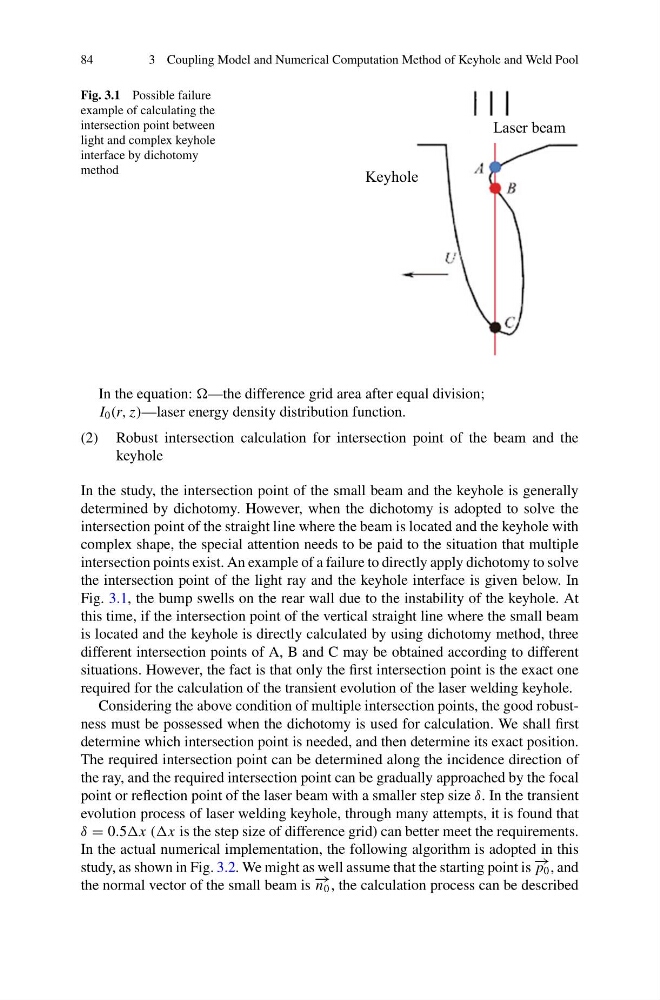
Fig. 3.1 Possible failure
example of calculating the
intersection point between
light and complex keyhole
interface by dichotomy
method
Keyhole
Laser beam
In the equation: —the difference grid area after equal division;
I 0 (r, z)—laser energy density distribution function.
(2) Robust intersection calculation for intersection point of the beam and the
keyhole
In the study, the intersection point of the small beam and the keyhole is generally
determined by dichotomy. However, when the dichotomy is adopted to solve the
intersection point of the straight line where the beam is located and the keyhole with
complex shape, the special attention needs to be paid to the situation that multiple
intersection points exist. An example of a failure to directly apply dichotomy to solve
the intersection point of the light ray and the keyhole interface is given below. In
Fig. 3.1, the bump swells on the rear wall due to the instability of the keyhole. At
this time, if the intersection point of the vertical straight line where the small beam
is located and the keyhole is directly calculated by using dichotomy method, three
different intersection points of A, B and C may be obtained according to different
situations. However, the fact is that only the first intersection point is the exact one
required for the calculation of the transient evolution of the laser welding keyhole.
Considering the above condition of multiple intersection points, the good robustness must be possessed when the dichotomy is used for calculation. We shall first
determine which intersection point is needed, and then determine its exact position.
The required intersection point can be determined along the incidence direction of
the ray, and the required intersection point can be gradually approached by the focal
point or reflection point of the laser beam with a smaller step size δ. In the transient
evolution process of laser welding keyhole, through many attempts, it is found that
δ = 0.5 ( is the step size of difference grid) can better meet the requirements.
In the actual numerical implementation, the following algorithm is adopted in this
study, as shown in Fig. 3.2. We might as well assume that the starting point is − → p 0 , and
the normal vector of the small beam is − → n 0 , the calculation process can be described
3 Coupling Model and Numerical Computation Method of Keyhole and Weld Pool
Fig. 3.1 Possible failure
example of calculating the
intersection point between
light and complex keyhole
interface by dichotomy
method
Keyhole
Laser beam
In the equation: —the difference grid area after equal division;
I 0 (r, z)—laser energy density distribution function.
(2) Robust intersection calculation for intersection point of the beam and the
keyhole
In the study, the intersection point of the small beam and the keyhole is generally
determined by dichotomy. However, when the dichotomy is adopted to solve the
intersection point of the straight line where the beam is located and the keyhole with
complex shape, the special attention needs to be paid to the situation that multiple
intersection points exist. An example of a failure to directly apply dichotomy to solve
the intersection point of the light ray and the keyhole interface is given below. In
Fig. 3.1, the bump swells on the rear wall due to the instability of the keyhole. At
this time, if the intersection point of the vertical straight line where the small beam
is located and the keyhole is directly calculated by using dichotomy method, three
different intersection points of A, B and C may be obtained according to different
situations. However, the fact is that only the first intersection point is the exact one
required for the calculation of the transient evolution of the laser welding keyhole.
Considering the above condition of multiple intersection points, the good robustness must be possessed when the dichotomy is used for calculation. We shall first
determine which intersection point is needed, and then determine its exact position.
The required intersection point can be determined along the incidence direction of
the ray, and the required intersection point can be gradually approached by the focal
point or reflection point of the laser beam with a smaller step size δ. In the transient
evolution process of laser welding keyhole, through many attempts, it is found that
δ = 0.5 ( is the step size of difference grid) can better meet the requirements.
In the actual numerical implementation, the following algorithm is adopted in this
study, as shown in Fig. 3.2. We might as well assume that the starting point is − → p 0 , and
the normal vector of the small beam is − → n 0 , the calculation process can be described