

3.12 A Bulk Model
85
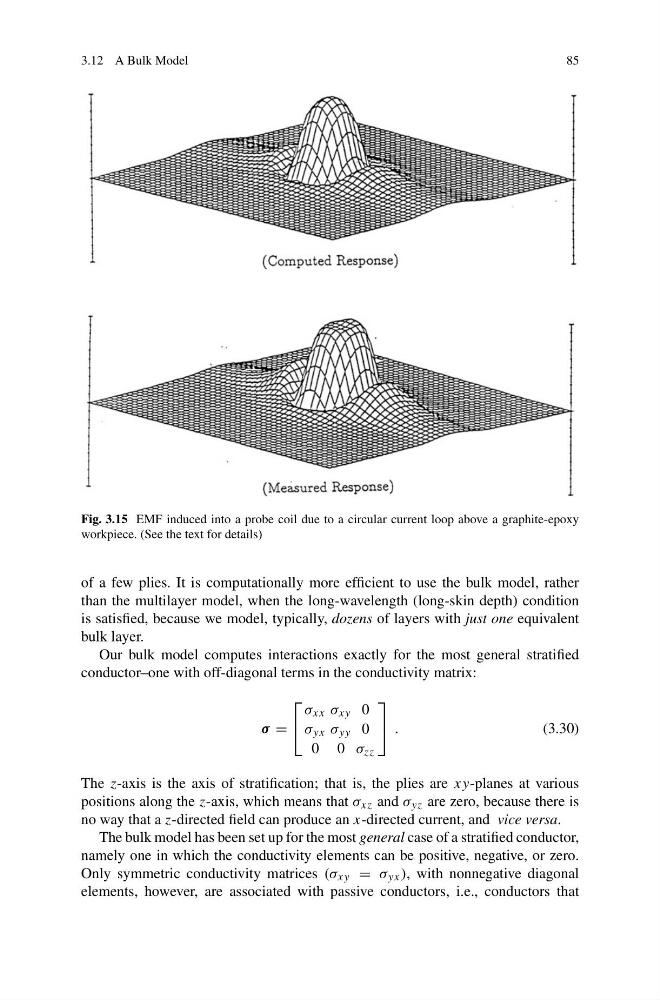
Fig. 3.15 EMF induced into a probe coil due to a circular current loop above a graphite-epoxy
workpiece. (See the text for details)
of a few plies. It is computationally more efficient to use the bulk model, rather
than the multilayer model, when the long-wavelength (long-skin depth) condition
is satisfied, because we model, typically, dozens of layers with just one equivalent
bulk layer.
Our bulk model computes interactions exactly for the most general stratified
conductor–one with off-diagonal terms in the conductivity matrix:
σ =
⎡
⎣
σ xx σ xy 0
σ yx σ yy 0
0 0 σ zz
⎤
⎦ .
(3.30)
The z-axis is the axis of stratification; that is, the plies are xy-planes at various
positions along the z-axis, which means that σ xz and σ yz are zero, because there is
no way that a z-directed field can produce an x-directed current, and vice versa.
The bulk model has been set up for the most general case of a stratified conductor,
namely one in which the conductivity elements can be positive, negative, or zero.
Only symmetric conductivity matrices (σ xy = σ yx ), with nonnegative diagonal
elements, however, are associated with passive conductors, i.e., conductors that
85
Fig. 3.15 EMF induced into a probe coil due to a circular current loop above a graphite-epoxy
workpiece. (See the text for details)
of a few plies. It is computationally more efficient to use the bulk model, rather
than the multilayer model, when the long-wavelength (long-skin depth) condition
is satisfied, because we model, typically, dozens of layers with just one equivalent
bulk layer.
Our bulk model computes interactions exactly for the most general stratified
conductor–one with off-diagonal terms in the conductivity matrix:
σ =
⎡
⎣
σ xx σ xy 0
σ yx σ yy 0
0 0 σ zz
⎤
⎦ .
(3.30)
The z-axis is the axis of stratification; that is, the plies are xy-planes at various
positions along the z-axis, which means that σ xz and σ yz are zero, because there is
no way that a z-directed field can produce an x-directed current, and vice versa.
The bulk model has been set up for the most general case of a stratified conductor,
namely one in which the conductivity elements can be positive, negative, or zero.
Only symmetric conductivity matrices (σ xy = σ yx ), with nonnegative diagonal
elements, however, are associated with passive conductors, i.e., conductors that