

3.9 Eigenmodes of Anisotropic Media
81
electric permittivity tensor, in its principal-axis coordinate system, then takes the
form
=
⎡
⎣
x 0 0
0 0
0 0
⎤
⎦ ,
(3.16)
which is typical of many graphite-epoxy composites.
The eigenmodes are solutions of (3.9) with the input currents set equal to
zero, and are simply the eigenvalues of S. It is straightforward to compute these
eigenvalues, ±λ 1 and ±λ 3 :
λ 1 =
(( x //)k
2
x + k
2
y − ω
2 μ 0 x
1/2
, λ 3 =
k
2
x + k
2
y − ω
2 μ 0
1/2
.
(3.17)
λ 1 corresponds to the extraordinary wave, and λ 3 to the ordinary wave. Clearly,
when x = , then λ 1 = λ 3 , and the extraordinary wave becomes ordinary, which
agrees with the results for an isotropic medium (such as free-space).
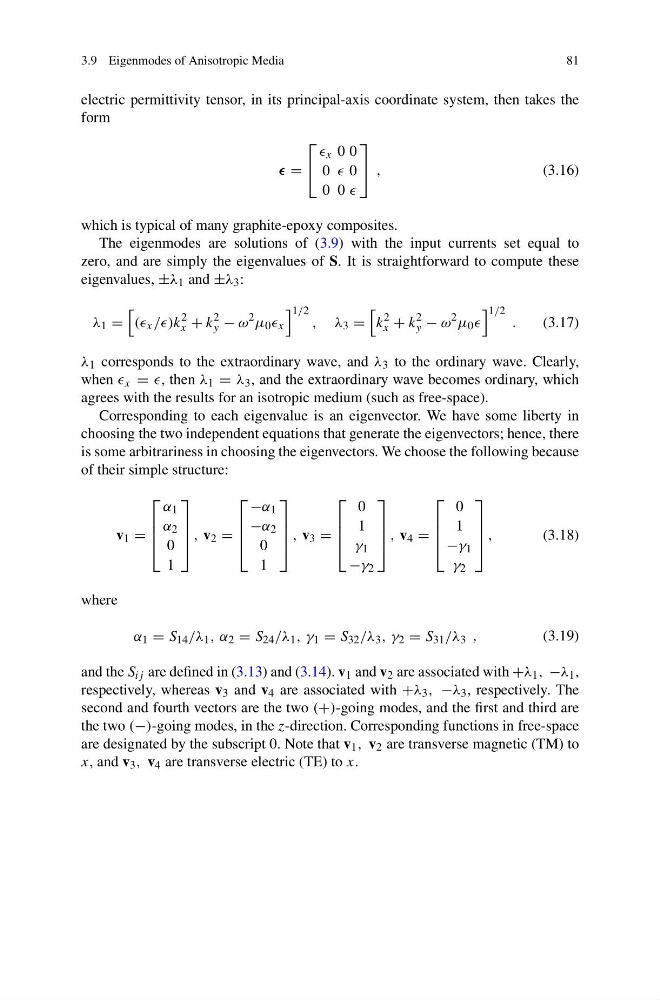
Corresponding to each eigenvalue is an eigenvector. We have some liberty in
choosing the two independent equations that generate the eigenvectors; hence, there
is some arbitrariness in choosing the eigenvectors. We choose the following because
of their simple structure:
v 1 =
⎡
⎢
⎢
⎣
α 1
α 2
0
1
⎤
⎥
⎥
⎦ , v 2 =
⎡
⎢
⎢
⎣
−α 1
−α 2
0
1
⎤
⎥
⎥
⎦ , v 3 =
⎡
⎢
⎢
⎣
0
1
γ 1
−γ 2
⎤
⎥
⎥
⎦ , v 4 =
⎡
⎢
⎢
⎣
0
1
−γ 1
γ 2
⎤
⎥
⎥
⎦ ,
(3.18)
where
α 1 = S 14 /λ 1 , α 2 = S 24 /λ 1 , γ 1 = S 32 /λ 3 , γ 2 = S 31 /λ 3 ,
(3.19)
and the S ij are defined in (3.13) and (3.14). v 1 and v 2 are associated with +λ 1 , −λ 1 ,
respectively, whereas v 3 and v 4 are associated with +λ 3 , −λ 3 , respectively. The
second and fourth vectors are the two (+)-going modes, and the first and third are
the two (−)-going modes, in the z-direction. Corresponding functions in free-space
are designated by the subscript 0. Note that v 1 , v 2 are transverse magnetic (TM) to
x, and v 3 , v 4 are transverse electric (TE) to x.
81
electric permittivity tensor, in its principal-axis coordinate system, then takes the
form
=
⎡
⎣
x 0 0
0 0
0 0
⎤
⎦ ,
(3.16)
which is typical of many graphite-epoxy composites.
The eigenmodes are solutions of (3.9) with the input currents set equal to
zero, and are simply the eigenvalues of S. It is straightforward to compute these
eigenvalues, ±λ 1 and ±λ 3 :
λ 1 =
(( x //)k
2
x + k
2
y − ω
2 μ 0 x
1/2
, λ 3 =
k
2
x + k
2
y − ω
2 μ 0
1/2
.
(3.17)
λ 1 corresponds to the extraordinary wave, and λ 3 to the ordinary wave. Clearly,
when x = , then λ 1 = λ 3 , and the extraordinary wave becomes ordinary, which
agrees with the results for an isotropic medium (such as free-space).
Corresponding to each eigenvalue is an eigenvector. We have some liberty in
choosing the two independent equations that generate the eigenvectors; hence, there
is some arbitrariness in choosing the eigenvectors. We choose the following because
of their simple structure:
v 1 =
⎡
⎢
⎢
⎣
α 1
α 2
0
1
⎤
⎥
⎥
⎦ , v 2 =
⎡
⎢
⎢
⎣
−α 1
−α 2
0
1
⎤
⎥
⎥
⎦ , v 3 =
⎡
⎢
⎢
⎣
0
1
γ 1
−γ 2
⎤
⎥
⎥
⎦ , v 4 =
⎡
⎢
⎢
⎣
0
1
−γ 1
γ 2
⎤
⎥
⎥
⎦ ,
(3.18)
where
α 1 = S 14 /λ 1 , α 2 = S 24 /λ 1 , γ 1 = S 32 /λ 3 , γ 2 = S 31 /λ 3 ,
(3.19)
and the S ij are defined in (3.13) and (3.14). v 1 and v 2 are associated with +λ 1 , −λ 1 ,
respectively, whereas v 3 and v 4 are associated with +λ 3 , −λ 3 , respectively. The
second and fourth vectors are the two (+)-going modes, and the first and third are
the two (−)-going modes, in the z-direction. Corresponding functions in free-space
are designated by the subscript 0. Note that v 1 , v 2 are transverse magnetic (TM) to
x, and v 3 , v 4 are transverse electric (TE) to x.