

308
11 Spintronics
-8150
-8100
-8050
-8000
-7950
-7900
-7850
-7800
-7750
-7700
-7650
0
2
4
6
8
10
Frequency (GHz)
H (kgauss)
Spectrum for Exchange Interaction
1
2
3
4
5
6
7
8
9
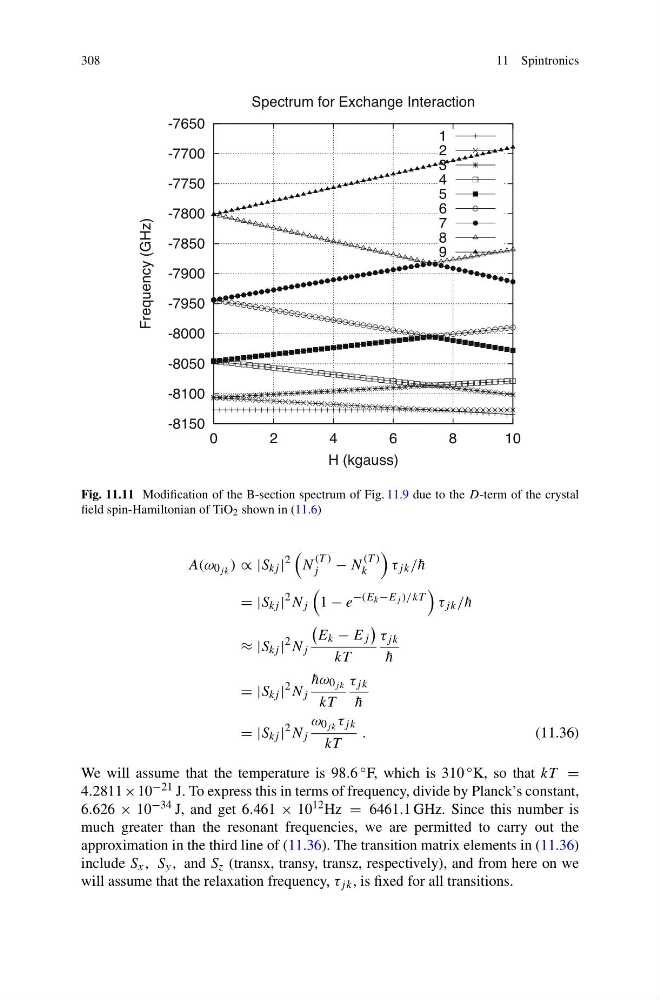
Fig. 11.11 Modification of the B-section spectrum of Fig. 11.9 due to the D-term of the crystal
field spin-Hamiltonian of TiO 2 shown in (11.6)
A(ω 0 jk ) ∝ |S kj |
2
N
(T )
j
− N
(T )
k
τ jk / ¯
h
= |S kj |
2 N j
1 − e
−(E k −E j )/kT
τ jk / ¯
h
≈ |S kj |
2 N j
E k − E j
kT
τ jk
¯
h
= |S kj |
2 N j
¯
hω 0 jk
kT
τ jk
¯
h
= |S kj |
2 N j
ω 0 jk τ jk
kT
.
(11.36)
We will assume that the temperature is 98.6 ◦ F, which is 310 ◦ K, so that kT =
4.2811 × 10 −21 J. To express this in terms of frequency, divide by Planck’s constant,
6.626 × 10 −34 J, and get 6.461 × 10 12 Hz = 6461.1 GHz. Since this number is
much greater than the resonant frequencies, we are permitted to carry out the
approximation in the third line of (11.36). The transition matrix elements in (11.36)
include S x , S y , and S z (transx, transy, transz, respectively), and from here on we
will assume that the relaxation frequency, τ jk , is fixed for all transitions.
11 Spintronics
-8150
-8100
-8050
-8000
-7950
-7900
-7850
-7800
-7750
-7700
-7650
0
2
4
6
8
10
Frequency (GHz)
H (kgauss)
Spectrum for Exchange Interaction
1
2
3
4
5
6
7
8
9
Fig. 11.11 Modification of the B-section spectrum of Fig. 11.9 due to the D-term of the crystal
field spin-Hamiltonian of TiO 2 shown in (11.6)
A(ω 0 jk ) ∝ |S kj |
2
N
(T )
j
− N
(T )
k
τ jk / ¯
h
= |S kj |
2 N j
1 − e
−(E k −E j )/kT
τ jk / ¯
h
≈ |S kj |
2 N j
E k − E j
kT
τ jk
¯
h
= |S kj |
2 N j
¯
hω 0 jk
kT
τ jk
¯
h
= |S kj |
2 N j
ω 0 jk τ jk
kT
.
(11.36)
We will assume that the temperature is 98.6 ◦ F, which is 310 ◦ K, so that kT =
4.2811 × 10 −21 J. To express this in terms of frequency, divide by Planck’s constant,
6.626 × 10 −34 J, and get 6.461 × 10 12 Hz = 6461.1 GHz. Since this number is
much greater than the resonant frequencies, we are permitted to carry out the
approximation in the third line of (11.36). The transition matrix elements in (11.36)
include S x , S y , and S z (transx, transy, transz, respectively), and from here on we
will assume that the relaxation frequency, τ jk , is fixed for all transitions.