

298
11 Spintronics
(1)
( 2)
( 3)
( 4)
( 5)
( 6)
( 7)
( 8)
⎡
⎢
⎢
⎢
⎢
⎢
⎢
⎢
⎢
⎢
⎢
⎢
⎢
⎣
1.0
0.0
0.0
0.0
0.0
0.0
0.0
0.0
⎤
⎥
⎥
⎥
⎥
⎥
⎥
⎥
⎥
⎥
⎥
⎥
⎥
⎦
⎡
⎢
⎢
⎢
⎢
⎢
⎢
⎢
⎢
⎢
⎢
⎢
⎢
⎣
0.0
0.5774
0.5774
0.0
0.5774
0.0
0.0
0.0
⎤
⎥
⎥
⎥
⎥
⎥
⎥
⎥
⎥
⎥
⎥
⎥
⎥
⎦
⎡
⎢
⎢
⎢
⎢
⎢
⎢
⎢
⎢
⎢
⎢
⎢
⎢
⎣
0.0
0.0
0.0
0.5774
0.0
0.5774
0.5774
0.0
⎤
⎥
⎥
⎥
⎥
⎥
⎥
⎥
⎥
⎥
⎥
⎥
⎥
⎦
⎡
⎢
⎢
⎢
⎢
⎢
⎢
⎢
⎢
⎢
⎢
⎢
⎢
⎣
0.0
0.0
0.0
0.0
0.0
0.0
0.0
1.0
⎤
⎥
⎥
⎥
⎥
⎥
⎥
⎥
⎥
⎥
⎥
⎥
⎥
⎦
⎡
⎢
⎢
⎢
⎢
⎢
⎢
⎢
⎢
⎢
⎢
⎢
⎢
⎣
0.0
0.8165
−0.4082
0.0
−0.4082
0.0
0.0
0.0
⎤
⎥
⎥
⎥
⎥
⎥
⎥
⎥
⎥
⎥
⎥
⎥
⎥
⎦
⎡
⎢
⎢
⎢
⎢
⎢
⎢
⎢
⎢
⎢
⎢
⎢
⎢
⎣
0.0
0.0
0.7071
0.0
−0.7071
0.0
0.0
0.0
⎤
⎥
⎥
⎥
⎥
⎥
⎥
⎥
⎥
⎥
⎥
⎥
⎥
⎦
⎡
⎢
⎢
⎢
⎢
⎢
⎢
⎢
⎢
⎢
⎢
⎢
⎢
⎣
0.0
0.0
0.0
0.8165
0.0
−0.4082
−0.4082
0.0
⎤
⎥
⎥
⎥
⎥
⎥
⎥
⎥
⎥
⎥
⎥
⎥
⎥
⎦
⎡
⎢
⎢
⎢
⎢
⎢
⎢
⎢
⎢
⎢
⎢
⎢
⎢
⎣
0.0
0.0
0.0
0.0
0.0
0.7071
−0.7071
0.0
⎤
⎥
⎥
⎥
⎥
⎥
⎥
⎥
⎥
⎥
⎥
⎥
⎥
⎦
,
(11.29)
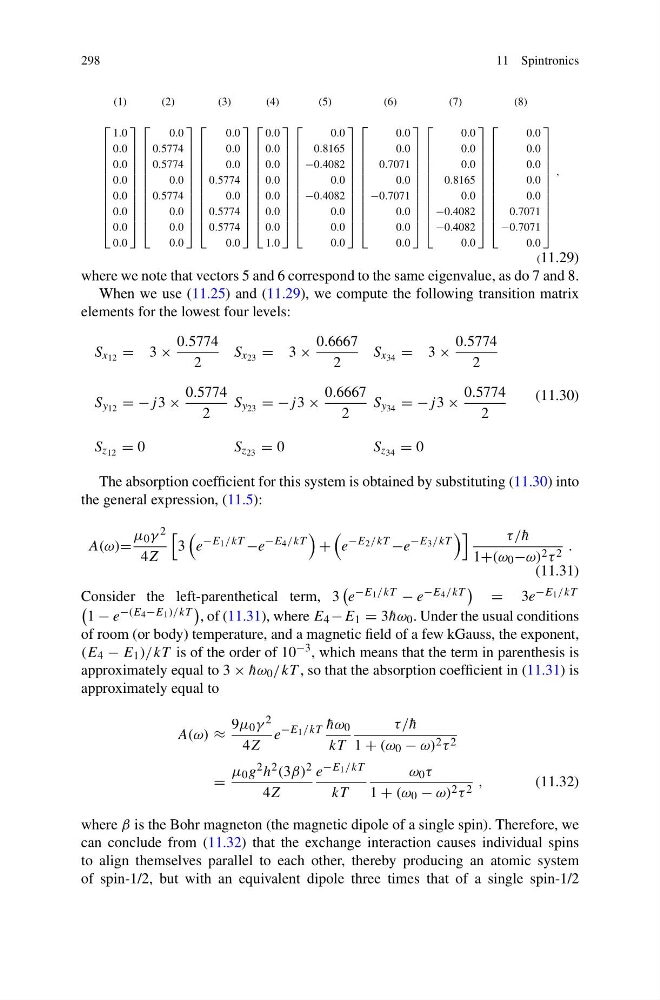
where we note that vectors 5 and 6 correspond to the same eigenvalue, as do 7 and 8.
When we use (11.25) and (11.29), we compute the following transition matrix
elements for the lowest four levels:
S x 12 = 3 ×
0.5774
2
S x 23 = 3 ×
0.6667
2
S x 34 = 3 ×
0.5774
2
S y 12 = −j 3 ×
0.5774
2
S y 23 = −j 3 ×
0.6667
2
S y 34 = −j 3 ×
0.5774
2
S z 12 = 0
S z 23 = 0
S z 34 = 0
(11.30)
The absorption coefficient for this system is obtained by substituting (11.30) into
the general expression, (11.5):
A(ω)=
μ 0 γ 2
4Z
3
e
−E 1 /kT
−e
−E 4 /kT
+
e
−E 2 /kT
−e
−E 3 /kT
τ/ ¯
h
1+(ω 0 −ω) 2 τ 2 .
(11.31)
Consider the left-parenthetical term, 3
e −E 1 /kT − e −E 4 /kT = 3e −E 1 /kT
1 − e −(E 4 −E 1 )/kT
, of (11.31), where E 4 −E 1 = 3 ¯
hω 0 . Under the usual conditions
of room (or body) temperature, and a magnetic field of a few kGauss, the exponent,
(E 4 − E 1 )/kT is of the order of 10 −3 , which means that the term in parenthesis is
approximately equal to 3 × ¯
hω 0 /kT , so that the absorption coefficient in (11.31) is
approximately equal to
A(ω) ≈
9μ 0 γ 2
4Z
e
−E 1 /kT ¯
hω 0
kT
τ/ ¯
h
1 + (ω 0 − ω) 2 τ 2
=
μ 0 g 2 h 2 (3β) 2
4Z
e −E 1 /kT
kT
ω 0 τ
1 + (ω 0 − ω) 2 τ 2 ,
(11.32)
where β is the Bohr magneton (the magnetic dipole of a single spin). Therefore, we
can conclude from (11.32) that the exchange interaction causes individual spins
to align themselves parallel to each other, thereby producing an atomic system
of spin-1/2, but with an equivalent dipole three times that of a single spin-1/2
11 Spintronics
(1)
( 2)
( 3)
( 4)
( 5)
( 6)
( 7)
( 8)
⎡
⎢
⎢
⎢
⎢
⎢
⎢
⎢
⎢
⎢
⎢
⎢
⎢
⎣
1.0
0.0
0.0
0.0
0.0
0.0
0.0
0.0
⎤
⎥
⎥
⎥
⎥
⎥
⎥
⎥
⎥
⎥
⎥
⎥
⎥
⎦
⎡
⎢
⎢
⎢
⎢
⎢
⎢
⎢
⎢
⎢
⎢
⎢
⎢
⎣
0.0
0.5774
0.5774
0.0
0.5774
0.0
0.0
0.0
⎤
⎥
⎥
⎥
⎥
⎥
⎥
⎥
⎥
⎥
⎥
⎥
⎥
⎦
⎡
⎢
⎢
⎢
⎢
⎢
⎢
⎢
⎢
⎢
⎢
⎢
⎢
⎣
0.0
0.0
0.0
0.5774
0.0
0.5774
0.5774
0.0
⎤
⎥
⎥
⎥
⎥
⎥
⎥
⎥
⎥
⎥
⎥
⎥
⎥
⎦
⎡
⎢
⎢
⎢
⎢
⎢
⎢
⎢
⎢
⎢
⎢
⎢
⎢
⎣
0.0
0.0
0.0
0.0
0.0
0.0
0.0
1.0
⎤
⎥
⎥
⎥
⎥
⎥
⎥
⎥
⎥
⎥
⎥
⎥
⎥
⎦
⎡
⎢
⎢
⎢
⎢
⎢
⎢
⎢
⎢
⎢
⎢
⎢
⎢
⎣
0.0
0.8165
−0.4082
0.0
−0.4082
0.0
0.0
0.0
⎤
⎥
⎥
⎥
⎥
⎥
⎥
⎥
⎥
⎥
⎥
⎥
⎥
⎦
⎡
⎢
⎢
⎢
⎢
⎢
⎢
⎢
⎢
⎢
⎢
⎢
⎢
⎣
0.0
0.0
0.7071
0.0
−0.7071
0.0
0.0
0.0
⎤
⎥
⎥
⎥
⎥
⎥
⎥
⎥
⎥
⎥
⎥
⎥
⎥
⎦
⎡
⎢
⎢
⎢
⎢
⎢
⎢
⎢
⎢
⎢
⎢
⎢
⎢
⎣
0.0
0.0
0.0
0.8165
0.0
−0.4082
−0.4082
0.0
⎤
⎥
⎥
⎥
⎥
⎥
⎥
⎥
⎥
⎥
⎥
⎥
⎥
⎦
⎡
⎢
⎢
⎢
⎢
⎢
⎢
⎢
⎢
⎢
⎢
⎢
⎢
⎣
0.0
0.0
0.0
0.0
0.0
0.7071
−0.7071
0.0
⎤
⎥
⎥
⎥
⎥
⎥
⎥
⎥
⎥
⎥
⎥
⎥
⎥
⎦
,
(11.29)
where we note that vectors 5 and 6 correspond to the same eigenvalue, as do 7 and 8.
When we use (11.25) and (11.29), we compute the following transition matrix
elements for the lowest four levels:
S x 12 = 3 ×
0.5774
2
S x 23 = 3 ×
0.6667
2
S x 34 = 3 ×
0.5774
2
S y 12 = −j 3 ×
0.5774
2
S y 23 = −j 3 ×
0.6667
2
S y 34 = −j 3 ×
0.5774
2
S z 12 = 0
S z 23 = 0
S z 34 = 0
(11.30)
The absorption coefficient for this system is obtained by substituting (11.30) into
the general expression, (11.5):
A(ω)=
μ 0 γ 2
4Z
3
e
−E 1 /kT
−e
−E 4 /kT
+
e
−E 2 /kT
−e
−E 3 /kT
τ/ ¯
h
1+(ω 0 −ω) 2 τ 2 .
(11.31)
Consider the left-parenthetical term, 3
e −E 1 /kT − e −E 4 /kT = 3e −E 1 /kT
1 − e −(E 4 −E 1 )/kT
, of (11.31), where E 4 −E 1 = 3 ¯
hω 0 . Under the usual conditions
of room (or body) temperature, and a magnetic field of a few kGauss, the exponent,
(E 4 − E 1 )/kT is of the order of 10 −3 , which means that the term in parenthesis is
approximately equal to 3 × ¯
hω 0 /kT , so that the absorption coefficient in (11.31) is
approximately equal to
A(ω) ≈
9μ 0 γ 2
4Z
e
−E 1 /kT ¯
hω 0
kT
τ/ ¯
h
1 + (ω 0 − ω) 2 τ 2
=
μ 0 g 2 h 2 (3β) 2
4Z
e −E 1 /kT
kT
ω 0 τ
1 + (ω 0 − ω) 2 τ 2 ,
(11.32)
where β is the Bohr magneton (the magnetic dipole of a single spin). Therefore, we
can conclude from (11.32) that the exchange interaction causes individual spins
to align themselves parallel to each other, thereby producing an atomic system
of spin-1/2, but with an equivalent dipole three times that of a single spin-1/2