

11.3 Superparamagnetic Iron Oxide
299
particle. As indicated in (11.31), the effect of the AC field is to cause this single
macrospin system to transit from spin-up to spin-down, with all individual spins
remaining parallel to each other. In contrast, three noninteracting spins would have
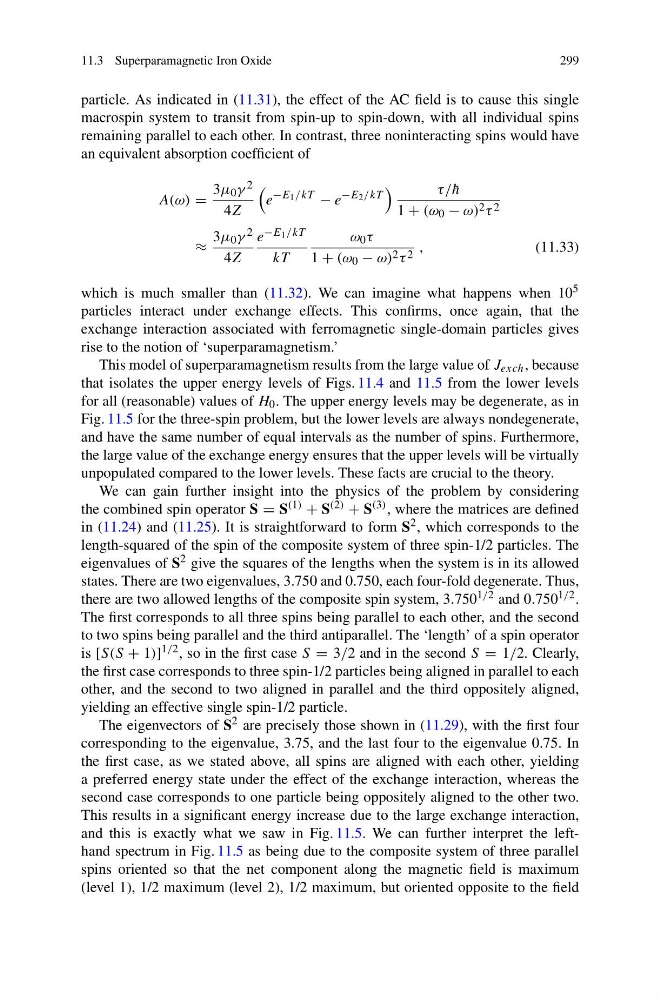
an equivalent absorption coefficient of
A(ω) =
3μ 0 γ 2
4Z
e
−E 1 /kT
− e
−E 2 /kT
τ/ ¯
h
1 + (ω 0 − ω) 2 τ 2
≈
3μ 0 γ 2
4Z
e −E 1 /kT
kT
ω 0 τ
1 + (ω 0 − ω) 2 τ 2 ,
(11.33)
which is much smaller than (11.32). We can imagine what happens when 10 5
particles interact under exchange effects. This confirms, once again, that the
exchange interaction associated with ferromagnetic single-domain particles gives
rise to the notion of ‘superparamagnetism.’
This model of superparamagnetism results from the large value of J exch , because
that isolates the upper energy levels of Figs. 11.4 and 11.5 from the lower levels
for all (reasonable) values of H 0 . The upper energy levels may be degenerate, as in
Fig. 11.5 for the three-spin problem, but the lower levels are always nondegenerate,
and have the same number of equal intervals as the number of spins. Furthermore,
the large value of the exchange energy ensures that the upper levels will be virtually
unpopulated compared to the lower levels. These facts are crucial to the theory.
We can gain further insight into the physics of the problem by considering
the combined spin operator S = S (1) + S (2) + S (3) , where the matrices are defined
in (11.24) and (11.25). It is straightforward to form S 2 , which corresponds to the
length-squared of the spin of the composite system of three spin-1/2 particles. The
eigenvalues of S 2 give the squares of the lengths when the system is in its allowed
states. There are two eigenvalues, 3.750 and 0.750, each four-fold degenerate. Thus,
there are two allowed lengths of the composite spin system, 3.750 1/2 and 0.750 1/2 .
The first corresponds to all three spins being parallel to each other, and the second
to two spins being parallel and the third antiparallel. The ‘length’ of a spin operator
is [S(S + 1)] 1/2 , so in the first case S = 3/2 and in the second S = 1/2. Clearly,
the first case corresponds to three spin-1/2 particles being aligned in parallel to each
other, and the second to two aligned in parallel and the third oppositely aligned,
yielding an effective single spin-1/2 particle.
The eigenvectors of S 2 are precisely those shown in (11.29), with the first four
corresponding to the eigenvalue, 3.75, and the last four to the eigenvalue 0.75. In
the first case, as we stated above, all spins are aligned with each other, yielding
a preferred energy state under the effect of the exchange interaction, whereas the
second case corresponds to one particle being oppositely aligned to the other two.
This results in a significant energy increase due to the large exchange interaction,
and this is exactly what we saw in Fig. 11.5. We can further interpret the lefthand spectrum in Fig. 11.5 as being due to the composite system of three parallel
spins oriented so that the net component along the magnetic field is maximum
(level 1), 1/2 maximum (level 2), 1/2 maximum, but oriented opposite to the field
299
particle. As indicated in (11.31), the effect of the AC field is to cause this single
macrospin system to transit from spin-up to spin-down, with all individual spins
remaining parallel to each other. In contrast, three noninteracting spins would have
an equivalent absorption coefficient of
A(ω) =
3μ 0 γ 2
4Z
e
−E 1 /kT
− e
−E 2 /kT
τ/ ¯
h
1 + (ω 0 − ω) 2 τ 2
≈
3μ 0 γ 2
4Z
e −E 1 /kT
kT
ω 0 τ
1 + (ω 0 − ω) 2 τ 2 ,
(11.33)
which is much smaller than (11.32). We can imagine what happens when 10 5
particles interact under exchange effects. This confirms, once again, that the
exchange interaction associated with ferromagnetic single-domain particles gives
rise to the notion of ‘superparamagnetism.’
This model of superparamagnetism results from the large value of J exch , because
that isolates the upper energy levels of Figs. 11.4 and 11.5 from the lower levels
for all (reasonable) values of H 0 . The upper energy levels may be degenerate, as in
Fig. 11.5 for the three-spin problem, but the lower levels are always nondegenerate,
and have the same number of equal intervals as the number of spins. Furthermore,
the large value of the exchange energy ensures that the upper levels will be virtually
unpopulated compared to the lower levels. These facts are crucial to the theory.
We can gain further insight into the physics of the problem by considering
the combined spin operator S = S (1) + S (2) + S (3) , where the matrices are defined
in (11.24) and (11.25). It is straightforward to form S 2 , which corresponds to the
length-squared of the spin of the composite system of three spin-1/2 particles. The
eigenvalues of S 2 give the squares of the lengths when the system is in its allowed
states. There are two eigenvalues, 3.750 and 0.750, each four-fold degenerate. Thus,
there are two allowed lengths of the composite spin system, 3.750 1/2 and 0.750 1/2 .
The first corresponds to all three spins being parallel to each other, and the second
to two spins being parallel and the third antiparallel. The ‘length’ of a spin operator
is [S(S + 1)] 1/2 , so in the first case S = 3/2 and in the second S = 1/2. Clearly,
the first case corresponds to three spin-1/2 particles being aligned in parallel to each
other, and the second to two aligned in parallel and the third oppositely aligned,
yielding an effective single spin-1/2 particle.
The eigenvectors of S 2 are precisely those shown in (11.29), with the first four
corresponding to the eigenvalue, 3.75, and the last four to the eigenvalue 0.75. In
the first case, as we stated above, all spins are aligned with each other, yielding
a preferred energy state under the effect of the exchange interaction, whereas the
second case corresponds to one particle being oppositely aligned to the other two.
This results in a significant energy increase due to the large exchange interaction,
and this is exactly what we saw in Fig. 11.5. We can further interpret the lefthand spectrum in Fig. 11.5 as being due to the composite system of three parallel
spins oriented so that the net component along the magnetic field is maximum
(level 1), 1/2 maximum (level 2), 1/2 maximum, but oriented opposite to the field