

11.3 Superparamagnetic Iron Oxide
293
(1)
(2)
(3)
(4)
⎡
⎢
⎢
⎣
0.0
−0.707
+0.707
0.0
⎤
⎥
⎥
⎦
⎡
⎢
⎢
⎣
1.0
0.0
0.0
0.0
⎤
⎥
⎥
⎦
⎡
⎢
⎢
⎣
0.0
0.707
0.707
0
⎤
⎥
⎥
⎦
⎡
⎢
⎢
⎣
0.0
0.0
0.0
1.0
⎤
⎥
⎥
⎦
,
(11.19)
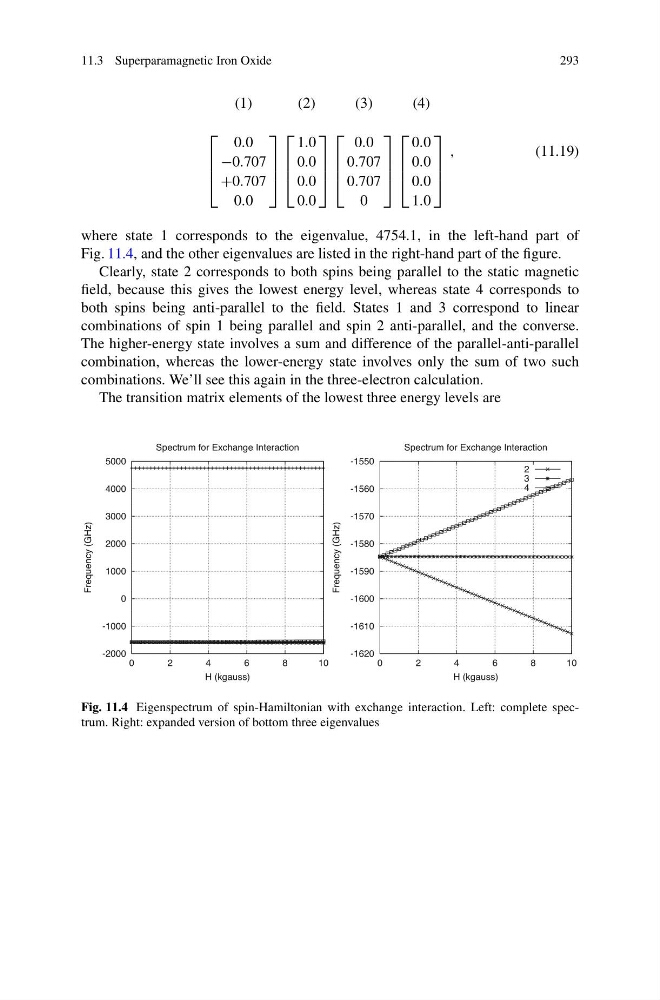
where state 1 corresponds to the eigenvalue, 4754.1, in the left-hand part of
Fig. 11.4, and the other eigenvalues are listed in the right-hand part of the figure.
Clearly, state 2 corresponds to both spins being parallel to the static magnetic
field, because this gives the lowest energy level, whereas state 4 corresponds to
both spins being anti-parallel to the field. States 1 and 3 correspond to linear
combinations of spin 1 being parallel and spin 2 anti-parallel, and the converse.
The higher-energy state involves a sum and difference of the parallel-anti-parallel
combination, whereas the lower-energy state involves only the sum of two such
combinations. We’ll see this again in the three-electron calculation.
The transition matrix elements of the lowest three energy levels are
-2000
-1000
0
1000
2000
3000
4000
5000
0
2
4
6
8
10
Frequency (GHz)
H (kgauss)
Spectrum for Exchange Interaction
-1620
-1610
-1600
-1590
-1580
-1570
-1560
-1550
0
2
4
6
8
10
Frequency (GHz)
H (kgauss)
Spectrum for Exchange Interaction
2
3
4
Fig. 11.4 Eigenspectrum of spin-Hamiltonian with exchange interaction. Left: complete spectrum. Right: expanded version of bottom three eigenvalues
293
(1)
(2)
(3)
(4)
⎡
⎢
⎢
⎣
0.0
−0.707
+0.707
0.0
⎤
⎥
⎥
⎦
⎡
⎢
⎢
⎣
1.0
0.0
0.0
0.0
⎤
⎥
⎥
⎦
⎡
⎢
⎢
⎣
0.0
0.707
0.707
0
⎤
⎥
⎥
⎦
⎡
⎢
⎢
⎣
0.0
0.0
0.0
1.0
⎤
⎥
⎥
⎦
,
(11.19)
where state 1 corresponds to the eigenvalue, 4754.1, in the left-hand part of
Fig. 11.4, and the other eigenvalues are listed in the right-hand part of the figure.
Clearly, state 2 corresponds to both spins being parallel to the static magnetic
field, because this gives the lowest energy level, whereas state 4 corresponds to
both spins being anti-parallel to the field. States 1 and 3 correspond to linear
combinations of spin 1 being parallel and spin 2 anti-parallel, and the converse.
The higher-energy state involves a sum and difference of the parallel-anti-parallel
combination, whereas the lower-energy state involves only the sum of two such
combinations. We’ll see this again in the three-electron calculation.
The transition matrix elements of the lowest three energy levels are
-2000
-1000
0
1000
2000
3000
4000
5000
0
2
4
6
8
10
Frequency (GHz)
H (kgauss)
Spectrum for Exchange Interaction
-1620
-1610
-1600
-1590
-1580
-1570
-1560
-1550
0
2
4
6
8
10
Frequency (GHz)
H (kgauss)
Spectrum for Exchange Interaction
2
3
4
Fig. 11.4 Eigenspectrum of spin-Hamiltonian with exchange interaction. Left: complete spectrum. Right: expanded version of bottom three eigenvalues