

294
11 Spintronics
S x23 = u 2 ·
S
(1)
x + S
(2)
x
· u 3 =
0.707
S x34 = u 3 ·
S
(1)
x + S
(2)
x
· u 4 =
0.707
S y23 = u 2 ·
S
(1)
y + S
(2)
y
· u 3 = −j 0.707
S y34 = u 3 ·
S
(1)
y + S
(2)
y
· u 4 = −j 0.707
S z23 = u 2 ·
S
(1)
z + S
(2)
z
· u 3 =
0.0
S z34 = u 3 ·
S
(1)
z + S
(2)
z
· u 4 =
0.0
,
(11.20)
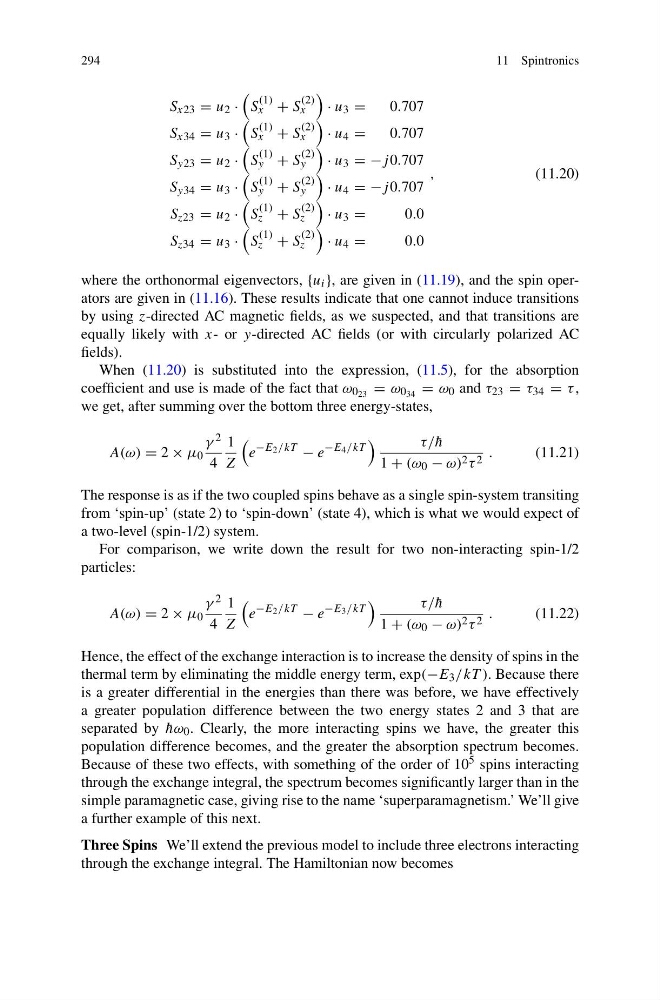
where the orthonormal eigenvectors, {u i }, are given in (11.19), and the spin operators are given in (11.16). These results indicate that one cannot induce transitions
by using z-directed AC magnetic fields, as we suspected, and that transitions are
equally likely with x- or y-directed AC fields (or with circularly polarized AC
fields).
When (11.20) is substituted into the expression, (11.5), for the absorption
coefficient and use is made of the fact that ω 0 23 = ω 0 34 = ω 0 and τ 23 = τ 34 = τ ,
we get, after summing over the bottom three energy-states,
A(ω) = 2 × μ 0
γ 2
4
1
Z
e
−E 2 /kT
− e
−E 4 /kT
τ/ ¯
h
1 + (ω 0 − ω) 2 τ 2 .
(11.21)
The response is as if the two coupled spins behave as a single spin-system transiting
from ‘spin-up’ (state 2) to ‘spin-down’ (state 4), which is what we would expect of
a two-level (spin-1/2) system.
For comparison, we write down the result for two non-interacting spin-1/2
particles:
A(ω) = 2 × μ 0
γ 2
4
1
Z
e
−E 2 /kT
− e
−E 3 /kT
τ/ ¯
h
1 + (ω 0 − ω) 2 τ 2 .
(11.22)
Hence, the effect of the exchange interaction is to increase the density of spins in the
thermal term by eliminating the middle energy term, exp(−E 3 /kT ). Because there
is a greater differential in the energies than there was before, we have effectively
a greater population difference between the two energy states 2 and 3 that are
separated by ¯
hω 0 . Clearly, the more interacting spins we have, the greater this
population difference becomes, and the greater the absorption spectrum becomes.
Because of these two effects, with something of the order of 10 5 spins interacting
through the exchange integral, the spectrum becomes significantly larger than in the
simple paramagnetic case, giving rise to the name ‘superparamagnetism.’ We’ll give
a further example of this next.
Three Spins We’ll extend the previous model to include three electrons interacting
through the exchange integral. The Hamiltonian now becomes
11 Spintronics
S x23 = u 2 ·
S
(1)
x + S
(2)
x
· u 3 =
0.707
S x34 = u 3 ·
S
(1)
x + S
(2)
x
· u 4 =
0.707
S y23 = u 2 ·
S
(1)
y + S
(2)
y
· u 3 = −j 0.707
S y34 = u 3 ·
S
(1)
y + S
(2)
y
· u 4 = −j 0.707
S z23 = u 2 ·
S
(1)
z + S
(2)
z
· u 3 =
0.0
S z34 = u 3 ·
S
(1)
z + S
(2)
z
· u 4 =
0.0
,
(11.20)
where the orthonormal eigenvectors, {u i }, are given in (11.19), and the spin operators are given in (11.16). These results indicate that one cannot induce transitions
by using z-directed AC magnetic fields, as we suspected, and that transitions are
equally likely with x- or y-directed AC fields (or with circularly polarized AC
fields).
When (11.20) is substituted into the expression, (11.5), for the absorption
coefficient and use is made of the fact that ω 0 23 = ω 0 34 = ω 0 and τ 23 = τ 34 = τ ,
we get, after summing over the bottom three energy-states,
A(ω) = 2 × μ 0
γ 2
4
1
Z
e
−E 2 /kT
− e
−E 4 /kT
τ/ ¯
h
1 + (ω 0 − ω) 2 τ 2 .
(11.21)
The response is as if the two coupled spins behave as a single spin-system transiting
from ‘spin-up’ (state 2) to ‘spin-down’ (state 4), which is what we would expect of
a two-level (spin-1/2) system.
For comparison, we write down the result for two non-interacting spin-1/2
particles:
A(ω) = 2 × μ 0
γ 2
4
1
Z
e
−E 2 /kT
− e
−E 3 /kT
τ/ ¯
h
1 + (ω 0 − ω) 2 τ 2 .
(11.22)
Hence, the effect of the exchange interaction is to increase the density of spins in the
thermal term by eliminating the middle energy term, exp(−E 3 /kT ). Because there
is a greater differential in the energies than there was before, we have effectively
a greater population difference between the two energy states 2 and 3 that are
separated by ¯
hω 0 . Clearly, the more interacting spins we have, the greater this
population difference becomes, and the greater the absorption spectrum becomes.
Because of these two effects, with something of the order of 10 5 spins interacting
through the exchange integral, the spectrum becomes significantly larger than in the
simple paramagnetic case, giving rise to the name ‘superparamagnetism.’ We’ll give
a further example of this next.
Three Spins We’ll extend the previous model to include three electrons interacting
through the exchange integral. The Hamiltonian now becomes